Residential Complex Security: Cameras, Remote Reception and AI for HOAs and Condos
How to improve residential complex security with cameras, remote reception and AI, without replacing your hardware or blowing up the monthly dues.
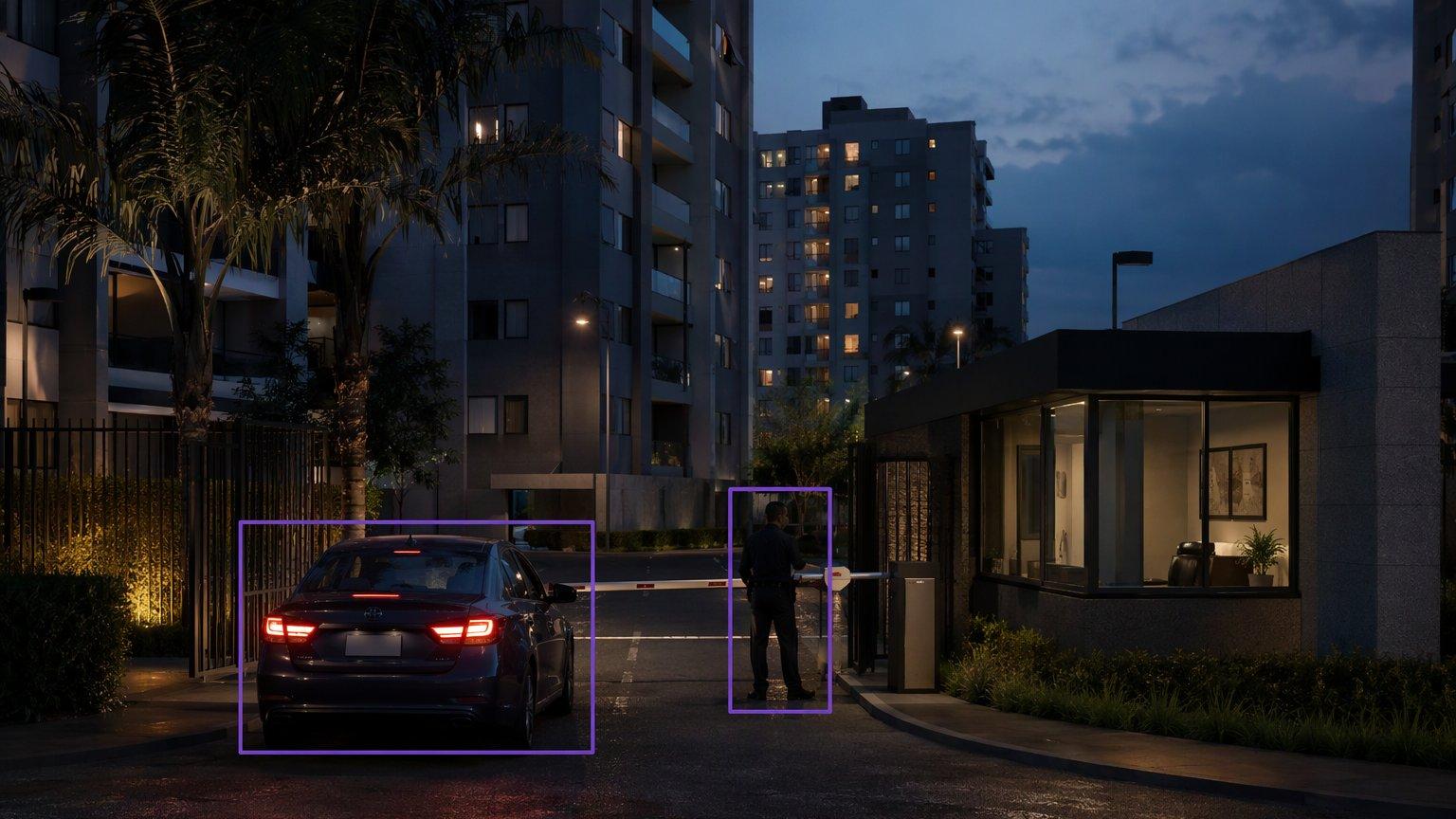
If you manage a residential complex, an HOA or a condo building, or you simply live in one, you know the scene: a few cameras at the gate, one guard per shift and a yearly meeting where the same debate comes back. Do we raise the monthly fees to pay for more security, or cut shifts? This article offers a third path: improving residential complex security by getting more out of the cameras you already own, using remote reception and artificial intelligence to support the guard instead of replacing anyone blindly. If you want to see how it would look on your own cameras, you can try Closely with a free 2-week demo.
Why residential complex security is a different problem
A residential complex is not an office or a store. People come and go all day: residents, delivery drivers, guests, technicians, movers, relatives. Almost all of them are legitimate, and that is exactly what makes the job hard. The guard has to decide in seconds who gets in, often with a paper logbook, an intercom and ten other things on their mind.
On top of that, there is the shared-ownership model. In Colombia it is called propiedad horizontal and is governed by Law 675 of 2001; in the US you would recognize it in condo associations and HOAs. Security decisions are made by a board or an assembly and carried out by a manager, with a budget that comes from everyone's fees. Every dollar has to be justified to neighbors who are not technical people, and rightly so.
The same problems show up again and again in complexes across Colombia, Mexico and the US:
- Cameras that record, but nobody watches them. They get reviewed after something has already happened.
- Weak access control. Paper logs, guests who walk in without verification and deliveries nobody records.
- One guard for everything. The same person handles the gate, the intercom, packages and patrols.
- Costs that rise every year. Guarding is usually one of the heaviest items in the budget.
What you can actually ask of your security cameras
Many complexes have a decent number of cameras installed, but they are only used to review footage. A security camera by itself prevents nothing: it records. What changes the game is having someone, or something, paying attention to what it sees.
That is where AI comes in. With video analytics, the security cameras already installed can flag events that matter, for example:
- A person loitering in front of the pedestrian entrance at night.
- Someone climbing or trying to get past a fence or wall.
- A vehicle that tailgates another one through the gate.
- A person in the parking garage or common areas at a time when nobody is normally there.
- A package or object left unattended at the lobby.
The key is that the system must not flood you with useless alerts. If every moving leaf triggers a notification, the guard stops looking. To understand that problem in depth, read our piece on false alarm fatigue.
On your current cameras, no new hardware
A common question from managers is: "do I have to replace the whole system?". Usually not. Closely works on top of existing cameras and connects through RTSP/ONVIF or your NVR, with brands such as Hikvision, Dahua, Axis, Bosch or Reolink. The budget does not go into new cameras; it goes into using what is already installed. You can request a free demo at closely.dev and see it working on your complex's cameras for two weeks.
Remote reception: what it is and when it makes sense
Remote reception (called portería remota in Latin America) replaces or complements the on-site guard with operators in a monitoring center who serve several properties at once. They watch the cameras, answer the intercom or video call, verify the visitor with the resident and open access when appropriate.
It is not magic and it does not fit every case. It makes the most sense when:
- The complex already has cameras of acceptable quality and good connectivity.
- The board wants to cut costs without losing coverage.
- There is interest in reinforcing security with technology, not just with more people.
It also has limits: some complexes prefer to keep someone on site to receive deliveries, handle large packages or respond to physical emergencies. In many cases the most sensible setup is a mixed one: fewer on-site shifts, plus a remote AI backup that never gets tired. For a deeper look at how it works and what a building needs, see our guide to remote reception in Bogotá.
What AI does inside a remote reception setup
At Closely, the work is split between specialized agents. For a residential complex, the most useful ones are:
- Watcher: watches the cameras in real time and detects relevant events while filtering out the noise.
- Gatekeeper: manages visitors and access; notifies the resident by WhatsApp and phone call.
- Investigator: lets you search recordings in natural language, for example "person in a red jacket in the parking lot last night".
- Supervisor: reviews staff patrol rounds.
- Reporter: documents what happened automatically, handy for the manager's monthly report.
A human operator validates before anything is dispatched: the AI proposes, the person decides. Rules are set in plain language, no code.
Access control: where most problems slip through
If we had to pick one place to invest first, it would be access control. Most incidents in residential complexes start with a door that opened when it should not have: a visitor who claimed to be a relative, a "delivery person" nobody confirmed, a car that followed the previous one in.
Some practices that work, with or without AI:
- Always verify with the resident before authorizing a visitor, and keep a record.
- Log who comes in, with a photo or a plate read, instead of relying on a paper logbook.
- Separate delivery flow from visitors and residents, so the guard is not improvising.
- Review exceptions, not all the video. Look at the unusual events, not eight hours of footage.
On this topic, you can also read how AI changes visitor management compared with the old paper log.
Cameras, personal data and the board: what you cannot skip
Installing cameras in common areas usually requires a decision by the assembly or board, plus visible video surveillance notices. Images of people are also personal data. In Colombia, Law 1581 of 2012 applies, so you need to define who can access recordings, how long they are kept and for what purpose. In the US, local and state rules vary, so check yours.
We are not lawyers and this is not legal advice; always review your community's bylaws and talk to a professional. As a starting point, we have a guide on Law 1581 and AI video analytics in Colombia.
How to present this to the board
For a security upgrade to get approved, it helps to bring numbers from your own property, not catalog promises. A simple way to build the proposal:
- Diagnosis: how many cameras exist, how many work and what they cover.
- Last year's incidents: what happened, when and where the problem got in.
- Current cost: how much each guard shift costs.
- Short pilot: test the AI on existing cameras before committing to a long contract.
- Metrics: alerts handled, response times and false positives.
That last point matters. Closely cuts false alarms by up to 88% with multi-layer filtering, and one operator can monitor up to 100 sites. But what counts is that you measure it in your own complex during the pilot. If you want to set it up, reach out at closely.dev and we will look at it with your cameras.
A practical summary for condo and HOA managers
In a shared-ownership community, the manager answers to the board for every dollar. So it is worth being clear about what you are buying: it is not more security cameras, it is making the security cameras you already have useful 24 hours a day. A good checklist: working cameras, access control with a record, remote or on-site reception with a backup, and clear rules about who sees recordings. With that, residential complex security stops depending on one guard's memory and starts depending on a process.
Frequently asked questions
How can I improve the security of a residential complex without raising fees much?
Start by getting more from what you already have: working cameras, orderly access control and smart alerts instead of reviewing video by hand. An AI pilot on your existing cameras usually costs far less than replacing the system or adding guard shifts.
What is remote reception in a residential complex?
It is a service where operators in a monitoring center handle the front desk or gate remotely: they watch the cameras, talk to visitors, confirm with the resident and open access. It can replace or complement the on-site guard.
Is remote reception safe?
It can be, if the center has solid processes, stable connectivity and cameras with good image quality. The recommended setup has a person validating important decisions and a backup plan for internet or power failures.
Do I need to replace my cameras to use artificial intelligence?
In most cases, no. Closely connects to existing cameras via RTSP/ONVIF or through the NVR, with no proprietary hardware. What does matter is image quality and good camera placement.
Do security cameras prevent break-ins in a residential complex?
By themselves, no: they record. They prevent when someone reacts in time. That is why real-time alerts on suspicious behavior help, rather than recordings you only review afterward.
What does AI do with a residential complex's cameras?
It detects people, vehicles and out-of-the-ordinary behavior, such as loitering, attempts to enter through unauthorized areas or presence at unusual hours, and alerts the operator so they can decide.
Do I need board approval to install cameras in common areas?
Generally yes: decisions about common areas go through the board or assembly and your community's bylaws. Review your documents and consult a lawyer you trust.
How are personal data handled with a complex's cameras?
Images of people are personal data. In Colombia, Law 1581 of 2012 applies, so it is wise to have a data-treatment policy, surveillance notices and clear rules about who sees recordings and for how long.
How long does it take to test an AI solution in my complex?
Closely offers a free 2-week demo on your current cameras. In that time you can see which alerts arrive, how many are useful and how it compares with your current operation.
Does AI replace the guard at the complex?
It should not replace them blindly. The ideal setup lets the AI handle the repetitive part, watching many screens without getting tired, while people focus on validating, responding and helping residents.
The bottom line
Residential complex security does not improve just by adding people or cameras: it improves when someone is actually watching what matters, at the right moment. With remote reception, orderly access control and AI on the cameras you already have, the board can raise protection without the fees skyrocketing. If you want to verify it with data from your own property, request your free demo at closely.dev.