Visitor Management Systems: Why the Old Sign-In Sheet Is Costing You More Than You Think in 2026
A paper log isn't visitor management — it's a false sense of security. Here's how AI-powered visitor management systems actually work, and why buildings are upgrading.
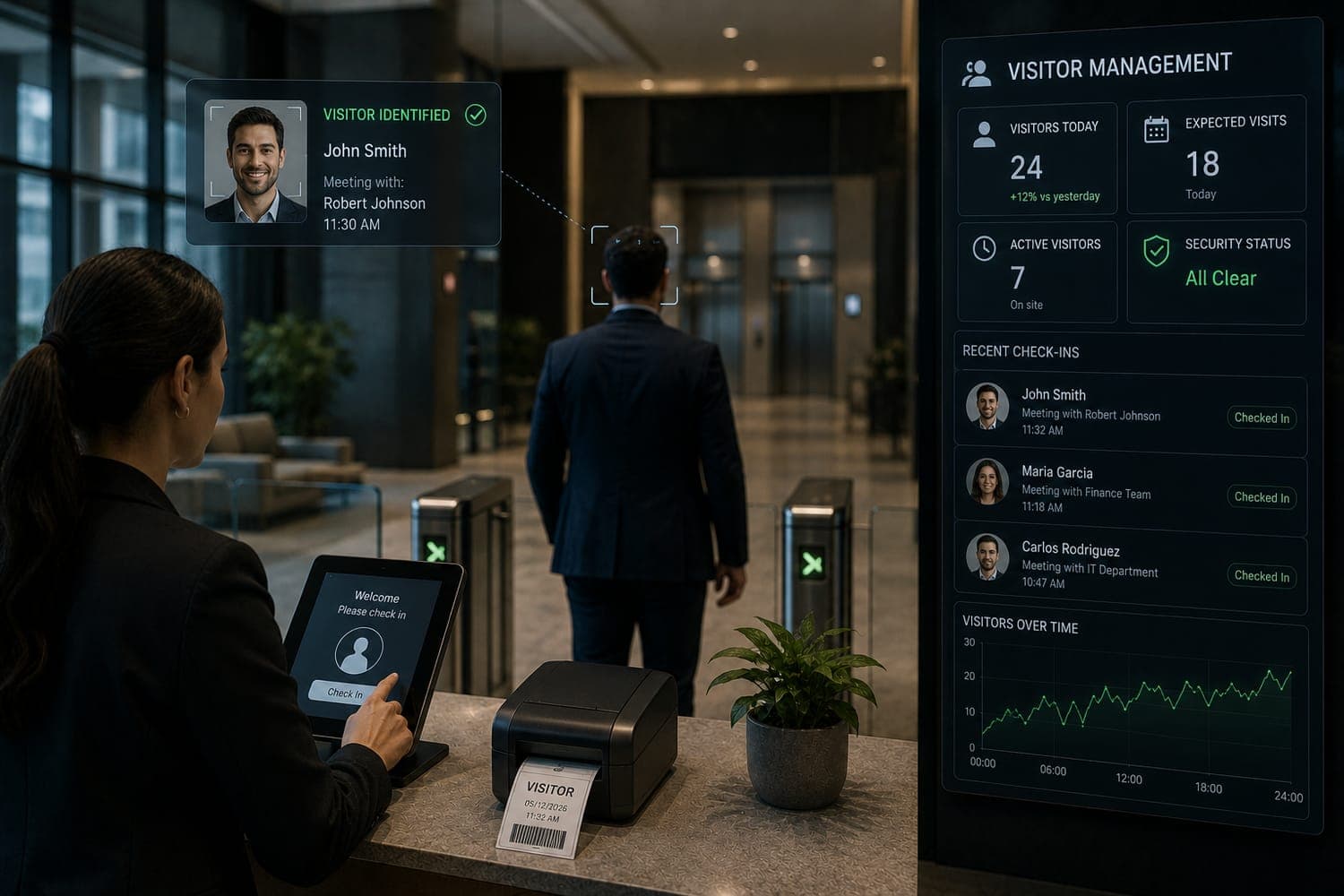
Most visitor management systems are just a digital sign-in sheet: they record a name, maybe print a badge, and create a log. They don't verify identity, don't alert anyone when someone who shouldn't be there walks in, and don't know if a visitor who signed out at 3pm is still in the building at 8pm. AI closes that gap with real-time verification, dual-channel host notification, and structured auditable records tied to what the cameras actually see.
Every building has a visitor problem. Most of them don't know it until something goes wrong. Here's how modern visitor management — with AI built in — actually works.
The visitor gap that nobody talks about
Think about the last time you walked into an office building, a residential complex, or a school as a visitor. What happened at the front desk?
Maybe someone wrote your name in a physical log. Maybe you signed into an iPad with your name and time. Maybe a receptionist called up to the person you were visiting. In some cases — probably more than you'd like to admit — you just walked in.
That's the visitor gap. The space between who a building thinks is inside it and who is actually inside it. And it's bigger than most security managers want to acknowledge.
A visitor management system — or more broadly, visitor management software — is supposed to close that gap. But most of what gets called a visitor management system today is really just a digital version of the sign-in sheet — it captures names, maybe prints a badge, and creates a log. It doesn't verify identity. It doesn't alert anyone when someone who shouldn't be there walks in anyway. It doesn't tell you if a visitor who signed out at 3pm is still in the building at 8pm.
The gap between a log and actual visitor security management is where modern AI closes the distance. And the organizations figuring this out first — across the United States and Latin America — are the ones that stop having incidents they didn't see coming.
What a visitor management system actually needs to do
The four functions that matter
A visitor management system that actually improves security — rather than just creating the appearance of it — needs to do four things that most legacy systems handle poorly or not at all.
1. Verify, not just record
Recording a visitor's name and time of arrival is not verification. Most basic visitor management software stops there — and that's exactly where the security gap begins. Verification means confirming that the person presenting themselves is who they claim to be, that they have a legitimate reason for being there, and that the person they're visiting is expecting them and has authorized the visit. The difference between recording and verifying is the difference between a log and a security control.
2. Notify in real time
The person being visited should know a visitor has arrived before that visitor is let through. Not after. Not when the front desk sends an email that gets read an hour later. Immediately — with enough information (who it is, what they want) to make an informed decision about whether to authorize access. Digital visitor management that notifies via a channel the host actually monitors in real time is fundamental.
3. Create auditable, structured records
Every visitor event — arrival, authorization, access granted or denied, departure — should generate a structured data record that's searchable, auditable, and reliable. Not a handwritten log that can be incomplete, illegible, or modified. Structured records that a property manager can pull up six months later and see exactly what happened, when, and what was decided.
4. Integrate with access control and camera systems
A visitor management system that exists in isolation — separate from the cameras that cover the entrance, separate from the access control hardware that governs who can open which doors — is fundamentally limited. The most useful visitor management happens when the system can correlate what it knows about a visitor with what the cameras see and what the access control hardware does.
How AI changes visitor management from reactive to proactive
The traditional model and its failure points
The traditional visitor management system workflow goes like this: visitor arrives, receptionist or guard acknowledges them, visitor states their name and who they're visiting, receptionist calls or messages the host, host confirms, visitor gets a badge or is escorted. If the host doesn't answer, the visitor waits or is turned away.
That model has several failure points that are well-understood but rarely fixed:
Tailgating — a visitor authorized for one entry point follows someone through a different access point without going through any verification. Common in busy office buildings during peak hours.
Host unavailability — the host doesn't answer the call. The receptionist makes a judgment call about whether to let the visitor wait inside the lobby or turn them away. That judgment varies by person, by shift, by how busy it is.
No-show departures — visitors sign in but the system doesn't track when they leave. A visitor who was expected to meet for 30 minutes and is still in the building three hours later isn't flagged by anything.
Impersonation — a visitor states a name and a host. The system records it. Nobody verifies that the person is who they claim to be, or that they have a genuine relationship with the stated host.
After-hours access — the front desk is staffed during business hours but the building is still accessed in the evenings. The visitor log for after-hours events is often nonexistent or relies entirely on an honor system.
AI-powered digital visitor management addresses each of these failure points — not by adding friction to the visitor experience, but by automating the verification and monitoring functions that humans handle inconsistently.
What AI adds at each stage of the visitor flow
Pre-registration and pre-authorization — hosts can register expected visitors in advance, creating an authorized visitor record before the visitor arrives. When the visitor presents at the entrance, the system already knows who to expect, which host authorized the visit, what time window the visit is authorized for, and which access points are permitted. No receptionist needs to make a real-time judgment call.
Real-time identity verification — camera-based recognition at the entry point can confirm that the person arriving matches the pre-registered visitor, or flag when an unregistered person presents themselves. This isn't necessarily full biometric facial recognition (which has regulatory considerations in some jurisdictions) — it can be as simple as the camera capturing a clear image of the visitor that's logged with the entry record, creating a visual audit trail that wasn't available with a written log.
Automated host notification — when a visitor arrives, the host is notified immediately through whatever channel is most likely to reach them: a push notification, a WhatsApp message, a phone call. Not an email. Not a message on a platform they might not check for an hour. The notification includes who has arrived, what they've stated their purpose is, and a request to authorize or deny access — which the host can do with a single tap from wherever they are.
Dual-channel notification — the most reliable visitor management notification systems use parallel channels rather than sequential ones. If the host doesn't respond to the WhatsApp message within 30 seconds, the system simultaneously initiates a phone call. This guarantees the notification reaches the host regardless of whether they're at their desk, in a meeting, or in a different location in the building.
Access correlation and camera monitoring — once a visitor is authorized and inside the building, AI visitor management can continue monitoring through camera coverage. A visitor who moves into an area outside their authorized zone triggers an alert. A visitor who stays significantly past the end of their authorized time window is flagged. A visitor-shaped figure detected in a restricted zone during a visit window for a different area is correlated and reviewed.
Automated departure logging — in integrated systems, when a visitor badged through an entry also badges through an exit, their departure is logged automatically. In camera-based systems, the exit event can be detected visually. The result is a complete visitor lifecycle record — not just an arrival log.
Visitor management across different building types
Corporate offices and business parks
Visitor management systems in corporate environments have to balance security with the professional experience of arriving at a workplace. Slow, cumbersome visitor check-in processes create a bad first impression. No visitor check-in process creates a security gap.
The model that works: pre-registration by the host creates an expected visitor record. When the visitor arrives, a brief automated check-in (identity confirmation, host notification, badge printing or digital pass) takes under two minutes. The host gets notified in real time and can meet the visitor or grant access remotely. Security logs the visit automatically without requiring manual data entry.
In multi-tenant office buildings across the US — a particularly common setup in cities like New York, Miami, Houston, and Los Angeles — visitor management software that handles multiple tenants from a single lobby check-in point is essential. The system needs to route notifications to the correct host across multiple companies without exposing one tenant's visitor data to another.
Residential buildings and condominiums
Residential visitor security management is one of the most frequent and operationally complex use cases, particularly in Latin American cities like Bogotá, Medellín, Mexico City, and Lima where residential towers and gated communities have high visitor volumes from deliveries, domestic workers, contractors, and personal visits.
The key distinction from commercial visitor management is the volume and diversity of visitor types: a delivery driver who needs 30-second authorization is very different from a recurring domestic worker who should have a pre-authorized access schedule, who is different again from a one-time guest who needs the resident to actively approve entry.
AI-powered residential visitor management handles all three flows differently — automating routine authorized visits, streamlining delivery identification and notification, and maintaining the full authorization workflow for one-time visitors — without requiring the resident to manage complex configurations.
Schools and educational campuses
Schools have some of the most specific visitor management system requirements of any building type. Who is allowed on campus is a direct safety question, not just an access control preference. Authorized adults (parents, guardians, approved visitors) need to be distinguishable from unauthorized adults. Visitors who arrived at the authorized main entrance shouldn't be able to access restricted areas (classrooms, administrative offices) without escort. And the entire process needs to happen without creating bottlenecks at the school entrance during drop-off and pick-up peaks.
AI-enhanced digital visitor management for schools adds identity verification, sex offender registry cross-referencing (a standard requirement in the US), and real-time monitoring of visitor movement within campus perimeters to the core check-in workflow.
Industrial facilities and logistics centers
Visitor management at industrial sites — factories, warehouses, distribution centers — involves additional complexity: safety inductions, PPE requirements, contractor credentials, and vehicle access in addition to personnel access. A visitor management workflow that doesn't track whether a contractor completed their safety briefing, or whether their credentials are current, is creating regulatory and liability exposure in addition to security gaps.
AI-powered visitor security management at industrial sites can integrate credential verification, safety briefing completion tracking, and access zone restriction into a unified flow — ensuring that every person and vehicle accessing the site has been through the appropriate clearance steps before entry.
How Closely handles visitor management
Closely approaches visitor management as one component of a broader AI-powered security operations layer — not a standalone check-in app.
The core of Closely's visitor management functionality is the Portero AI module: an AI voice agent that handles the intercom interaction at building entry points. When a visitor arrives and presses the intercom button, Portero AI initiates the conversation — greeting the visitor, asking for their name and who they're visiting, and collecting the information needed to route the notification.
The host is then notified simultaneously via WhatsApp and phone call — both channels at once, ensuring the message gets through regardless of the host's situation. The host can authorize or deny access with a single response. If the host doesn't respond within the defined window, the system follows the escalation protocol configured for that building or site.
Every visitor interaction is logged automatically: who arrived, what they stated, which host they requested, which notification channels were used, how the host responded, whether access was granted, and at what time. That log is structured, searchable, and auditable — not a handwritten entry that someone filled in manually at end of shift.
Because Closely connects to existing camera infrastructure and access control hardware, visitor management events don't exist in isolation. A visitor authorization at the intercom correlates with what the entrance camera sees at that moment. A visitor who moves into an unexpected area of the building after authorization is flagged by the same Watchers that handle perimeter breach and loitering detection across the rest of the facility.
For security operators managing visitor management systems across multiple client buildings from a centralized SOC, Closely provides a unified interface where all visitor events across all sites are visible, auditable, and actionable from one place.
Whether you're managing a residential building in Bogotá, a corporate campus in Miami, a school in Mexico City, or an industrial facility in Texas, get in touch. We'll show you how visitor management fits into your broader security operation — on the cameras and intercoms you already have.
Frequently Asked Questions
What is a visitor management system and why do buildings need one?
A visitor management system is the process and technology a building uses to control, record, and monitor who enters as a visitor — not as a resident, employee, or regular authorized user. Buildings need them because uncontrolled visitor access is one of the most common physical security vulnerabilities: unauthorized individuals gain access by posing as visitors, visitors access areas they're not authorized for, and after-the-fact investigations lack usable records because visitor logs are incomplete or inconsistent. A well-designed visitor management system closes these gaps with a combination of verification, notification, access control, and auditable record-keeping.
What's the difference between a digital visitor management system and a traditional paper sign-in sheet?
A paper sign-in sheet records a name and time — nothing is verified, nothing triggers a notification, and the record is difficult to search and easy to falsify. Visitor management software adds identity capture, real-time host notification, access control integration, and structured searchable records. More importantly, AI-powered digital systems add verification and monitoring capabilities that neither paper nor basic digital systems have: camera-based identity logging, automated host notification via multiple channels simultaneously, and post-authorization monitoring of visitor movement within the facility.
How does AI improve visitor management compared to a standard receptionist-based check-in?
A receptionist handles one visitor at a time, is only present during working hours, applies inconsistent judgment on edge cases, and creates records manually. AI visitor management handles concurrent visitors without quality degradation, operates 24/7, applies consistent protocols regardless of who's on shift, and generates structured records automatically. The biggest practical gain is in host notification: an AI system notifies the host through multiple simultaneous channels in real time and handles the authorization response automatically — which is faster and more reliable than a receptionist calling an extension and waiting.
How does Closely's Portero AI handle visitor management at building intercoms?
Closely's Portero AI is an AI voice agent that answers the building intercom when a visitor arrives. It greets the visitor, collects their name and the person they're visiting, and simultaneously notifies the host via WhatsApp and phone call. The host can authorize or deny access directly from their phone. Every interaction is logged automatically — timestamp, visitor identity, host response, and access outcome — creating a complete, searchable visitor record without any manual data entry.
What happens in a visitor management system when the host doesn't respond to the notification?
A well-designed visitor management system has a defined escalation protocol for non-response. In Closely's implementation, the dual-channel notification (WhatsApp + phone call simultaneously) maximizes the chance of reaching the host in the first attempt. If there's no response within the defined window, the system follows the building's escalation protocol: this might mean routing to a backup contact, alerting the building manager, or following a pre-defined policy for unresponded visitor requests. The specific protocol is configured per building based on the operator's requirements.
Can a visitor management system track when visitors leave, not just when they arrive?
Yes — integrated systems that combine visitor management with access control hardware log exit events when a visitor badges out through the exit point. Camera-based systems can detect departure visually. The result is a complete visitor lifecycle record: arrival time, authorization, access granted, and departure time. For facilities where knowing exactly who is currently inside the building is a safety or compliance requirement — industrial sites, schools, healthcare facilities — this departure tracking is essential, not optional.
How does AI visitor management handle high visitor volumes, like during a busy delivery period or a school pickup?
AI-powered digital visitor management handles concurrent visitor flows without degradation — the system processes multiple intercom interactions simultaneously, routes notifications to different hosts in parallel, and manages multiple authorization requests at the same time. The voice agent doesn't get slower or less consistent when there are five visitors waiting rather than one. For buildings with predictable high-volume periods (morning deliveries, school dismissal, event start times), pre-authorization workflows reduce the real-time processing load further: expected visitors with pre-registered authorizations move through faster than unregistered visitors requiring full verification.
What visitor management system features are most important for residential buildings in Latin America?
In LATAM residential buildings, the most critical visitor management system features are: dual-channel notification to residents (WhatsApp is non-negotiable as the primary channel — phone as backup), delivery identification and streamlined authorization for the high volume of daily delivery interactions, pre-authorization capability for recurring visitors like domestic workers and regular service providers, and a complete auditable visitor log that the building administrator can access and that serves as documentation for any incident investigation. Integration with the existing intercom and camera infrastructure without requiring hardware replacement is a practical requirement for most existing residential buildings.
Is visitor management through AI intercoms and cameras legally compliant with data protection laws in the US and Latin America?
AI-powered visitor management systems that collect identity information, capture camera images, and store visitor records operate within data protection frameworks that apply to the underlying camera and data collection infrastructure. In the US, requirements vary by state (California's CCPA, BIPA in Illinois for biometric data, etc.). In Latin America, Colombia's Ley 1581, Mexico's LFPDPPP, and Brazil's LGPD all apply to personal data collected in visitor management contexts. The key compliance requirements are: clear notice to visitors that their data is being collected (posted signage at entry points), defined retention periods for visitor records, restricted access to visitor data, and a legitimate business purpose for collection. A properly configured digital visitor management system operating within these parameters is legally compliant in both markets.
How does visitor management integrate with the rest of a building's security system?
The most effective visitor management systems don't operate in isolation — they're one layer of a broader security infrastructure. In Closely's implementation, visitor management events (intercom interactions, host notifications, access authorizations) are correlated with camera feeds (what the entrance camera sees when the visitor arrives), access control events (which door opened when the authorization was granted), and ongoing monitoring (whether the visitor moves to areas outside their authorized zone). This integration means a visitor who is authorized at the front entrance but detected in a restricted area 10 minutes later triggers an alert through the same Watcher system that handles perimeter breaches and loitering — not a separate process. That unified approach is what separates visitor management as a genuine security control from visitor management as a digital sign-in sheet.