Healthcare Security Systems: How AI Is Changing the Protection of Hospitals and Clinics
Hospital security with AI: pharmacy access control, preventing violence against staff, visitor management, and regulation in LATAM and the U.S.
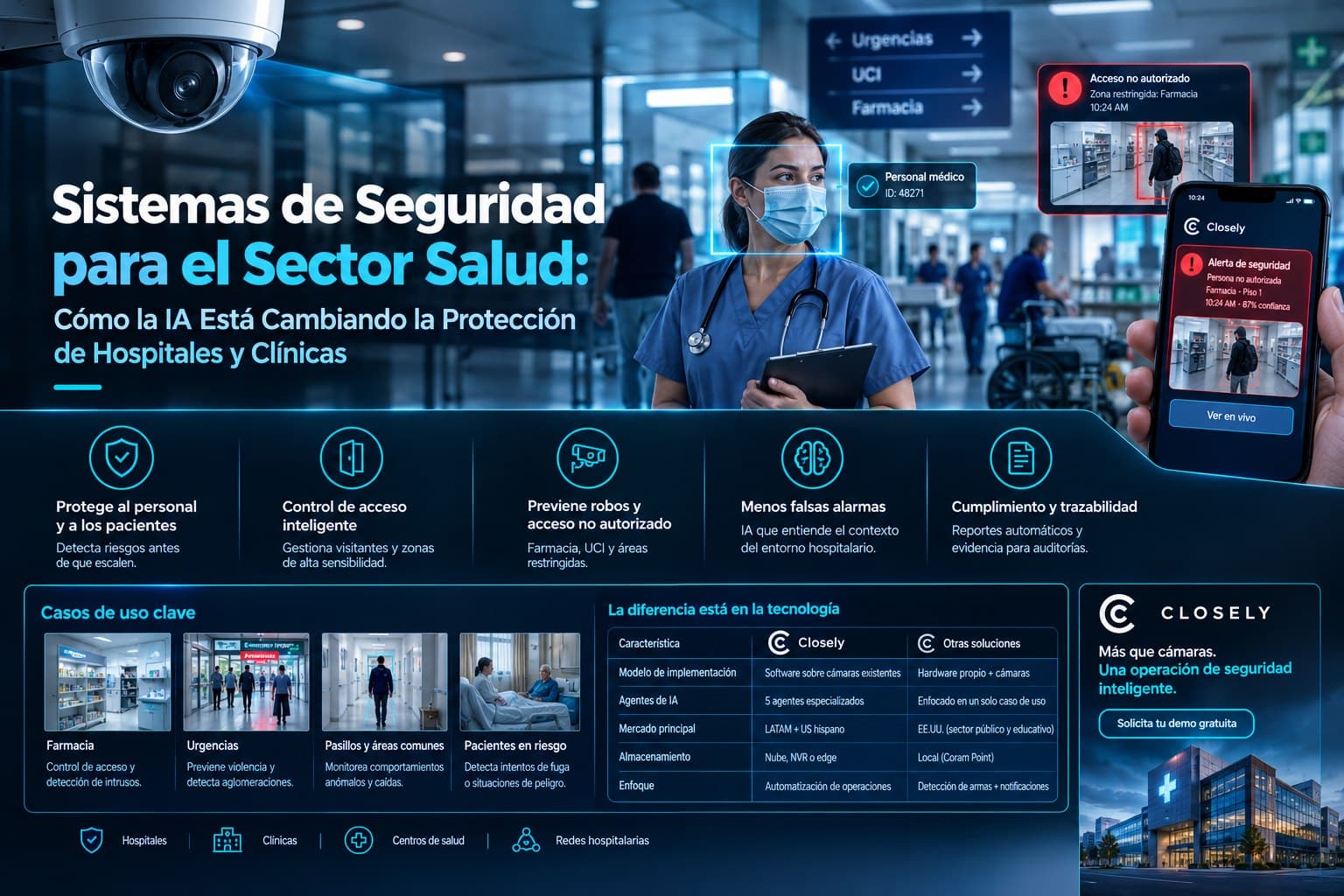
Hospitals and clinics are unique security environments. They have 24-hour public access, high-risk areas such as pharmacies and ICUs, staff working under extreme pressure, and vulnerable patients who can't always protect themselves. This guide explains how modern healthcare security systems work and why artificial intelligence is changing the way they operate.
Why Security in Healthcare Is a Different Problem
Designing security systems for healthcare isn't the same as designing security for an office, a shopping center, or an industrial plant. The challenges are different, and generic solutions tend to fall short.
A typical hospital has dozens or hundreds of entrances, many of them open to the public at all times. It has highly sensitive areas such as the pharmacy, the ICU, the neonatal unit, and the emergency rooms. It has staff working under intense emotional pressure and patients who, in some cases, pose a risk to themselves or others.
According to industry data, healthcare workers experience a significantly higher rate of workplace violence than workers in other sectors. Physical assaults against doctors and nurses are one of the most underreported and poorly managed problems in hospital operations, in both the United States and Latin America.
At the same time, hospital security systems have to protect without getting in the way. You can't turn a waiting room into a militarized checkpoint. The flow of patients, visitors, and staff has to keep moving, and security has to operate in the background, detecting real problems without creating unnecessary friction.
The Most Common Security Problems in Hospitals and Clinics
Before talking about solutions, it's worth clearly understanding the problems hospital security systems have to solve in practice.
Violence Against Staff
It's the most urgent problem and the least solved. Incidents range from insults and threats in the emergency department to serious physical assaults. In many hospitals, nurses and emergency physicians are the most exposed.
Prevention requires detecting situations that are escalating before they reach the point of violence: confrontations, aggressive body language, unusual crowding in specific areas. That's exactly what AI video analysis systems can do when they're properly configured.
Unauthorized Access to the Pharmacy and Restricted Areas
Hospital pharmacies hold high-value controlled medications. Unauthorized access, internal theft, and drug diversion are real problems, in private clinics in Latin America as well as in public hospitals.
Modern healthcare security systems combine access control with video validation to detect after-hours access, the presence of unauthorized people, or suspicious behavior patterns near critical areas.
Visitor Management and Access Control
A large hospital can receive thousands of visitors a day. Knowing who comes in, which area they go to, who they meet, and how long they stay is an enormous operational challenge that manual paper or logbook registration systems simply can't solve.
Intelligent visitor management is one of the areas where the most modern hospital security systems are showing concrete operational improvements.
Patients at Risk of Elopement or Falls
Some patients, especially in mental health units, emergency departments, or geriatrics, may try to leave the facility without authorization or are at risk of falling. Detecting these situations in time requires continuous monitoring, not periodic checks.
False Alarms and Operator Fatigue
This is a systemic problem in any security operation, but in hospitals it's especially critical. Security operators monitor dozens of cameras at once in high-activity environments. Conventional motion detection generates such a high volume of alerts that staff end up ignoring many of them, including the real ones.
How a Modern Hospital Security System Works
A next-generation hospital security system isn't simply an NVR with more cameras. It's an intelligence infrastructure that combines several components.
AI Video Analysis
Security cameras become intelligent sensors when they have an AI layer analyzing video in real time. Instead of detecting generic motion, the system can detect specific behaviors: a person who has been standing at the pharmacy door for more than 10 minutes, unusual crowding in the emergency department, someone running where they shouldn't, or a door held open longer than normal.
Access Control Integrated with Video
Card or biometric access control becomes much more effective when it's correlated with video. If the card says one person entered but the camera shows two people coming in, the system can alert automatically. This solves the tailgating problem, which is especially common in hospital environments where doors open constantly.
Intelligent Visitor Management
Modern security systems for clinics and hospitals automate visitor reception: they identify who arrives, check their registration in the system, notify the responsible staff, and manage access without needing an operator in front of a monitor at every point.
Forensic Search in Recordings
When an incident happens, the time it takes to review hours of footage to reconstruct what happened is one of the most frustrating bottlenecks in any security operation. Systems with natural language search let you run queries like "woman in a blue gown in the north wing between 2 and 4 pm" and get the relevant clips in minutes.
Closely: Artificial Intelligence for Healthcare Security
Closely is an AI agent platform that integrates with the existing security cameras in hospitals, clinics, health centers, and any medical facility to automate the security operation.
It doesn't require replacing existing cameras or installing additional hardware. It connects via RTSP to any IP camera on the market, including Hikvision, Dahua, Axis, Bosch, and dozens of other brands.
Closely's five agents solve concrete problems in healthcare facilities:
Watcher detects anomalous behavior in real time: crowding in the emergency department that could escalate into violence, people loitering in restricted areas such as the pharmacy or ICU, abandoned objects, after-hours access, and risk situations before they become incidents. It reduces false alarms by up to 88% compared with conventional motion detection, which means security staff respond to real alerts, not noise.
Gatekeeper (AI Doorman) manages visitor flow autonomously. It identifies who arrives at reception or specific entrances, notifies the responsible staff via WhatsApp and a simultaneous phone call, and coordinates access without needing a dedicated operator at every point. This is especially valuable in hospitals with multiple entrances and controlled visiting hours.
Investigator turns searching through recordings from a task that takes hours into a query that takes minutes. When an incident happens, the security team can describe what they're looking for in natural language and the system finds the relevant clips. It's essential for incident documentation, internal investigations, and cooperation with the authorities.
Supervisor tracks security staff patrols in real time, verifying that rounds are completed within the defined times and that critical points are checked as often as required.
Reporter automatically documents every security event with a timestamp, description, cameras involved, and actions taken. In healthcare facilities where traceability is a regulatory and legal requirement, this removes the dependence on inconsistent manual logs.
Closely offers a free two-week demo on the cameras your healthcare facility already has installed. No infrastructure changes, no commitments.
Regulation and Compliance in Hospital Security
Healthcare security systems operate within specific regulatory frameworks that vary by country but share common principles.
In the United States, The Joint Commission publishes hospital safety standards that include requirements on workplace violence prevention, access control, and protection of sensitive areas. Several states have specific legislation protecting healthcare workers, including California and New York.
In Colombia, the Mandatory Health Quality Assurance System sets licensing conditions that include physical infrastructure and facility security. Departmental and district Health Departments verify those conditions during the licensing process, under Resolution 3100 of 2019, and the National Health Superintendence oversees the sector.
In Mexico, healthcare facilities seeking certification from the General Health Council must meet standards that include facility management and safety and the protection of controlled medication areas.
In every case, the regulatory trend is toward greater demands: more traceability, better response times, and better incident documentation. Modern hospital security systems not only improve operations, but also simplify regulatory compliance by automatically generating the records auditors and regulators require.
What Works and What Doesn't in Hospital Security
When implementing security in healthcare facilities, some patterns repeat about what works well and what doesn't.
What works: integrating the security system with the hospital's operational workflows instead of treating it as something separate. Security that understands the hospital's context, that knows there's more activity in the emergency department at 2 am than in a corporate office, generates far fewer false alarms and much more precise responses.
What doesn't work: installing more cameras without improving analysis capacity. In the most outdated hospital security systems there are dozens or hundreds of cameras that nobody can monitor effectively, because the volume of video far exceeds human attention. More cameras without artificial intelligence on top only generate more noise.
What also doesn't work: relying exclusively on technology without clear human protocols. The best technology fails if staff don't know how to respond when the system raises a real alert.
10 Frequently Asked Questions About Healthcare Security Systems
1. What security system does a mid-sized hospital or clinic need?
A complete hospital security system for a mid-sized facility should include at least IP cameras at entrances, the emergency department, the pharmacy, main hallways, and high-risk areas; credential-based access control for restricted areas; a visitor management system for reception; and an artificial intelligence platform that analyzes video in real time to detect anomalous behavior. For smaller clinics, the starting point can be simpler: cameras with good coverage and a system like Closely that adds AI on top of that existing infrastructure.
2. How can technology help prevent violence against medical staff?
The most effective healthcare security systems for preventing violence focus on early detection of risk situations. AI cameras analyze behavior in real time and can detect confrontations, unusual crowding in the emergency department, people who have stayed in an area for too long, or aggressive body language before it escalates into physical violence. The key is response time: the system alerts security staff while the situation is still manageable, not after the incident has already happened.
3. Can security AI be integrated with the hospital's existing surveillance cameras?
Yes. Modern hospital security platforms like Closely connect via RTSP to any IP camera on the market, regardless of brand or model. That means the hospital doesn't need to change its existing camera infrastructure to add an artificial intelligence layer. The investment is in software on top of hardware that already exists, which significantly reduces implementation costs.
4. How does AI-assisted pharmacy access control work in a hospital?
Pharmacy access control in a modern hospital security system works in several layers: credential-based access control that limits who can physically enter, an AI camera analyzing the area in real time to detect unauthorized people, automatic alerts when someone is in the area outside their usual hours, and automatic logging of every access with associated video for traceability. When these layers work together, the level of protection is much higher than with any of them alone.
5. How much does a complete security system cost for a clinic or hospital in Colombia or Mexico?
The cost varies widely depending on the size of the facility, the number of cameras, the complexity of access control, and the AI features required. In Colombia and Mexico, a mid-sized installation with 20 to 40 cameras can have infrastructure costs starting at around 15 million Colombian pesos and going much higher for large facilities. What has changed with platforms like Closely is that the artificial intelligence layer no longer requires replacing existing infrastructure: it's added on top of what's already there, with per-installation pricing that makes AI more accessible to mid-sized clinics.
6. What physical security legal requirements must hospitals meet in Colombia?
Hospitals and clinics in Colombia must meet the standards of the Mandatory Health Quality Assurance System, which includes physical infrastructure and safety requirements. Licensing before the relevant Health Department requires minimum safety conditions at the facility. Hospital security systems that generate automatic records, incident documentation, and access traceability make it easier to meet these requirements by keeping the evidence organized and available when an audit comes.
7. Can security AI detect a patient trying to leave the facility?
Yes. AI hospital security systems can be configured to detect behavior associated with elopement attempts: people running toward exits at unusual times, presence in areas that don't match the type of patient, or movement toward secondary exits during low-activity hours. This is especially relevant for mental health units, psychiatric emergency departments, and geriatrics. The system alerts floor staff so they can intervene before the patient reaches the exit.
8. How does artificial intelligence improve visitor management in hospitals?
Intelligent visitor management automates what used to require dedicated staff at every entrance: it identifies who arrives, checks whether they have an authorized visit on record, notifies the responsible staff (physicians, nursing, administration) via WhatsApp or a simultaneous phone call, and manages access in a coordinated way. The result is shorter lines at reception, less workload for administrative staff, and better control over who is in each area at any given time.
9. What happens to patient privacy when AI cameras are installed in a hospital?
Patient privacy is a critical consideration in healthcare security systems. Best practices include: not installing cameras where there's a reasonable expectation of privacy, such as restrooms, locker rooms, or closed treatment rooms; informing patients and visitors about video surveillance with visible signage; implementing clear retention and access policies for recordings; and, for facial recognition, storing only vectors (not images) and restricting access to that biometric data. In Colombia, Law 1581 on personal data protection also applies to biometric data captured by security systems.
10. Can Closely work across a hospital network with multiple sites?
Yes. Closely is designed to operate across multiple facilities from a centralized platform, which makes it especially useful for hospital networks, clinic groups, or health systems with several sites. A security operator can monitor events at every facility from a single point, with the Watcher agent analyzing video at all sites simultaneously and Reporter automatically documenting every incident at every site. For growing health networks, this means there's no need to scale the security team in proportion to the number of facilities.