HID Access Control and Proximity Cards: Complete Guide to Choosing the Right System in 2026
Guide to HID access control and proximity cards, comparing Hikvision, Intelbras, Suprema, ZKTeco, Lenel and Honeywell.
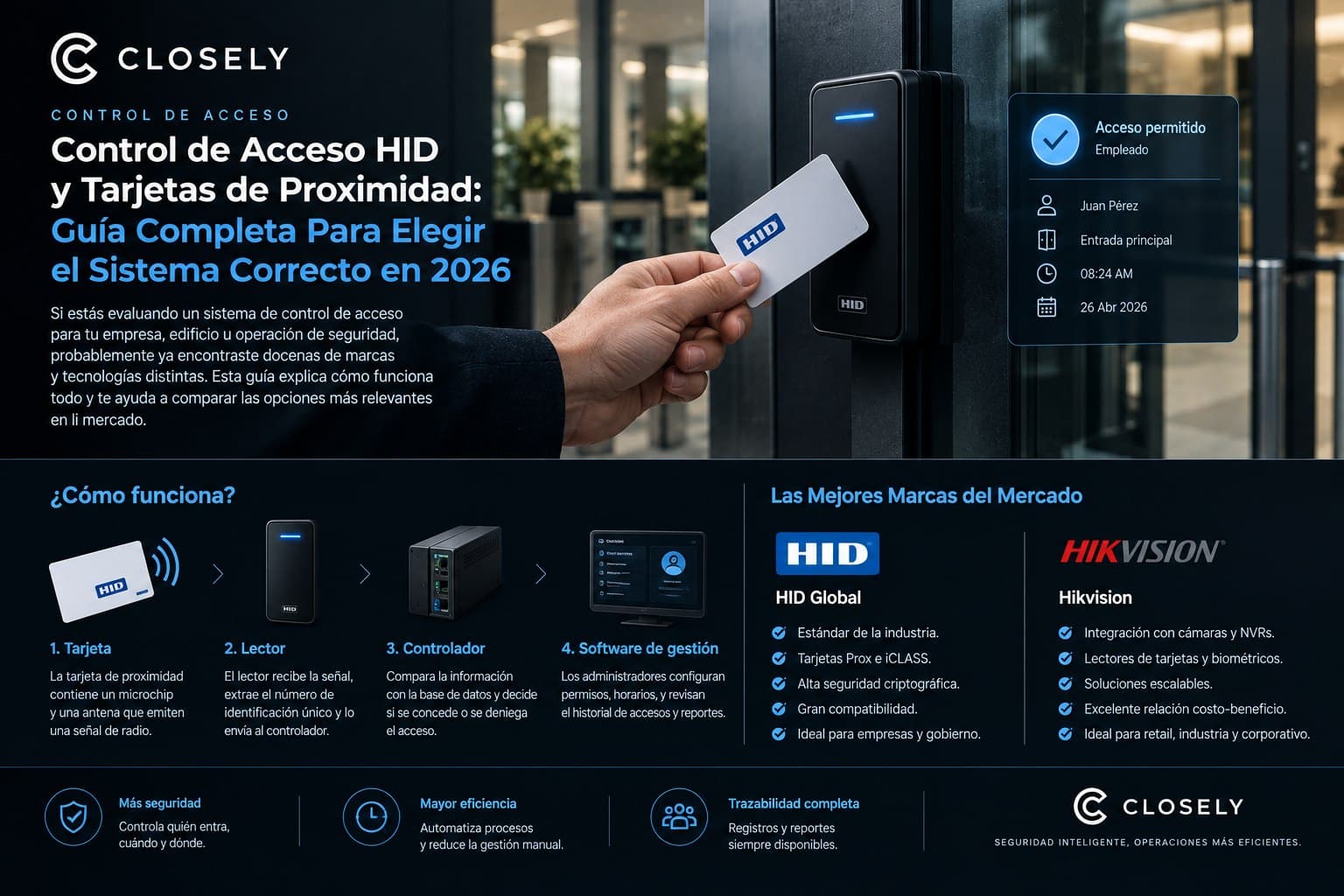
If you're evaluating an access control system for your enterprise, building, or security operation, you've probably already encountered dozens of distinct brands and technologies. This guide explains how it all works and helps you compare the most relevant options in the market.
What Is Access Control and Why It Goes Far Beyond a Door with a Lock
Access control is the set of technologies and processes that determine who can enter a physical space, when, and under what conditions. A locked door is the most basic form of access control. HID proximity cards, biometric readers, smart intercoms, and integrated management systems are the modern evolution of that same principle.
The difference between a key and a modern access control system with cards is not just technological. It's operational. A key leaves no record of who entered or when. It cannot be disabled remotely if lost. It cannot restrict access to certain hours. It does not generate alerts when someone attempts entry outside authorized hours.
A modern access control system does all of that and more. And in the context of security operations in Latin America and the United States, where the need for traceability, regulatory compliance, and audit records is growing, the difference between having a well-implemented system and not having one is significant.
How Proximity Cards and HID Systems Work
The Technology Behind Proximity Cards
HID proximity cards and other access control cards work through radiofrequency communication, known as RFID. The card contains a microchip and antenna that emit a radio signal when brought close to a reader. The reader receives that signal, extracts the card's unique identification number, and sends it to a controller that decides whether access should be granted or denied.
Reading distance varies based on frequency used. Low-frequency cards operating at 125 kHz are the most common in older installations and read at distances up to 10 centimeters. High-frequency cards operating at 13.56 MHz under the ISO 14443 standard (the same standard used by contactless banking cards) offer greater cryptographic security and read at similar distances but with greater resistance to cloning.
HID Global, the company that gave its name to the most recognized technology in the sector, has its own encoding standards that have become virtually universal in the enterprise market. Its access control card formats, especially the 26-bit Wiegand format, are supported by most readers and controllers on the market, making them the de facto standard for access control systems in corporate and government installations in both the United States and Latin America.
The Components of a Complete System
A card-based access control system has four main components:
The credential is what the user presents to identify themselves: it can be a physical card, an RFID keychain, a PIN code, or a mobile credential on a cell phone.
The reader is the device installed at the access point that reads the credential. Readers can be card-only, card plus PIN, or biometric with fingerprint or facial recognition.
The controller is the system's brain. It receives information from the reader, compares it against the database of authorized access, and decides whether to open the door or not. It also records each access event with a timestamp.
The management software is the interface where administrators configure who has access to what, at which hours, and where they can review access history, generate reports, and manage credentials.
Leading Access Control Providers in the Market
HID Global
HID Global is the most recognized company in proximity card access control worldwide. Its Prox (125 kHz) and iCLASS (13.56 MHz) card technology is installed in millions of organizations worldwide. Its multiformat readers, such as the OSDP line and Prox Point readers, are compatible with major controllers on the market.
HID's strength lies in its credential ecosystem and the trust the enterprise market has in its technology. Its products are generally more expensive than market alternatives, but offer greater cryptographic security, better technical support, and guaranteed compatibility with enterprise management systems.
For large corporate installations in the United States, government, healthcare, education, and banking, HID is frequently the baseline design specification. In Latin America, its presence is strong in the banking sector, government, and industrial installations of multinational companies.
Hikvision
Hikvision is primarily known as a security camera manufacturer, but its access control system line is extensive and among the most installed in Latin America. Its access controllers, card readers, and biometric readers integrate directly with its ecosystem of cameras and NVRs, making them attractive for installations already using Hikvision cameras and wanting a unified solution.
Hikvision's access control line includes Mifare card readers, fingerprint readers, facial recognition terminals, and two and four-door controllers. Its management software, Hikvision IVMS, allows managing cameras and access control from a single platform.
Hikvision's main advantage in the Latin American market is its competitive pricing and the availability of its products through local distributors in virtually every country in the region. The restriction on use in U.S. federal government installations under the NDAA law is a factor to consider in that specific market.
Intelbras
Intelbras is a Brazilian company with dominant presence in Brazil's security market and growing presence throughout the rest of Latin America. Its access control line includes controllers, RFID card readers, biometric readers, and integrated access centers with its ecosystem of alarms and intercoms.
What distinguishes Intelbras in the Latin American market is its local technical support, its documentation in Spanish and Portuguese, and its understanding of specific regional market needs. Its prices are competitive and its products are designed for the typical installation conditions of Brazil, Colombia, Argentina, and other regional markets.
For residential, commercial, and small industrial installations in Latin America, Intelbras is often the most accessible alternative to more expensive HID or Lenel systems.
Suprema
Suprema is a South Korean company recognized especially for its biometric access control products. Its fingerprint readers and facial recognition devices, especially the BioStation and FaceStation lines, are recognized in the industry for their accuracy and identification speed.
Suprema has presence in high-security installations in Latin America and the United States where biometric identification is a specific requirement: manufacturing, pharmaceuticals, data centers, government facilities, and banking. Its integration with major access control manufacturers, including HID and others, makes it a viable option in multi-vendor projects.
ZKTeco
ZKTeco is a Chinese manufacturer with a value proposition centered on accessible biometrics for the mass market. Its devices combine RFID card, fingerprint, and, in more advanced models, facial recognition, at significantly lower prices than Suprema or HID.
In Latin America, ZKTeco has significant presence in the small and medium business sector, where price is a critical variable and security requirements are not as demanding as in enterprise installations. Its management software, ZKBio Security, is functional but has a steeper learning curve than software from more established manufacturers.
Lenel and Honeywell
Lenel (part of Carrier) and Honeywell are two U.S.-based manufacturers that dominate the enterprise access control market in the United States and have significant presence in large Latin American projects. Their platforms, Lenel OnGuard and Honeywell Pro-Watch, are enterprise-level physical security management systems (PSIM) that integrate access control, video surveillance, and intrusion detection into a single platform.
For large-scale installations with complex integration requirements, airports, hospitals, large university campuses, multi-tower corporate buildings, Lenel and Honeywell are often the reference systems. Their implementation cost is significantly higher than options like Hikvision or Intelbras, but their scalability and customization capability justify that investment in the right context.
How to Choose the Right System: Variables That Matter
The choice of an access control system should not start with the brand. It should start with the use case.
Number of doors and size. A system for 3 doors has very different requirements than one for 300. Access controllers typically have capacity for 2, 4, 8, or 16 doors per unit, and cost scales with the number of access points.
Required security level. Not all doors need the same protection. The main entrance of a corporate building has different requirements than a warehouse door. The credential type (card only, card plus PIN, biometric) should correspond to the risk level of each access point.
Integration with other systems. Does access control need to integrate with security cameras? With alarm systems? With HR software for schedule management? Each platform's integration capability determines how much additional value the system can deliver.
Traceability and reporting requirements. For installations needing regulatory compliance, audits, or detailed access reports, management software is as important as hardware. HID and Lenel have an advantage here. For installations with more basic requirements, Hikvision and Intelbras are more than sufficient.
Budget and local availability. In Latin America, the availability of spare parts, local technical support, and reliable distributors is a critical factor that doesn't always receive the attention it deserves in the initial evaluation.
How Closely's Gatekeeper Integrates with Any Access Control System
Regardless of which access control manufacturer you choose, there is a layer that more and more security operations are adding on top: an artificial intelligence agent that makes the system not just record access, but manage it intelligently and autonomously.
Closely's Gatekeeper is that agent. It integrates with the leading access control systems on the market, including HID, Hikvision, Intelbras, Suprema, and others, and adds three capabilities that no conventional access control system includes natively.
First, autonomous visitor management: when someone arrives at an access point without a registered credential, the Gatekeeper handles the interaction automatically, notifying the responsible party via WhatsApp and simultaneous phone call, and recording the decision with evidence.
Second, structured recording of all events: every access, every failed attempt, every authorized or denied visit is documented in structured form with timestamp, identity of the accessee, and outcome. That record is auditable, exportable, and queryable from a centralized interface that aggregates all access points of all installations managed by the operator.
Third, anomaly detection in access patterns: the Gatekeeper learns normal access patterns in each installation and alerts when it detects deviations, such as a credential used at an unusual hour, access to an area outside the user's typical profile, or repeated failed access attempts.
For organizations in the United States and Latin America that already have invested in an HID, Hikvision, Intelbras, or any other manufacturer's access control system, Closely's Gatekeeper does not require replacing anything. It integrates on top of what already exists and adds the intelligence that hardware alone cannot provide.
Closely offers two weeks of free demo to see how the Gatekeeper integrates with your existing access control system.
10 Frequently Asked Questions About HID Access Control and Proximity Cards
1. What is an HID proximity card and how does it work?
An HID proximity card is one of the most widespread access control credentials in the world. HID proximity cards use RFID technology to communicate with a reader without requiring physical contact. The card contains a microchip with a unique identification number that emits a radio signal when brought close to the reader. The reader sends that number to a controller, which decides whether access should be granted based on configured rules. HID Global is the manufacturer that popularized this standard, and its encoding formats are compatible with most access control systems on the market.
2. What is the difference between low-frequency (125 kHz) and high-frequency (13.56 MHz) cards in access control?
Low-frequency cards at 125 kHz, such as HID Prox cards, are the oldest and most widespread. They are simple, durable, and compatible with many installed systems, but are vulnerable to cloning with readily available equipment. High-frequency cards at 13.56 MHz, such as HID iCLASS, Mifare, and DESFire, include cryptographic encryption that makes cloning significantly more difficult. For new installations that value security, high-frequency cards are the standard recommendation in today's market.
3. Does Hikvision have an access control system or just cameras?
Hikvision has a complete line of access control systems, including 2 and 4-door controllers, Mifare card readers, fingerprint terminals, and facial recognition devices. Its main advantage is native integration with its cameras and NVRs, allowing managing video surveillance and access control from the same software. In Latin America, Hikvision's access control products have wide availability and competitive prices, making them attractive for mid-sized installations.
4. What is the best access control option for residential buildings in Latin America?
For residential buildings in Colombia, Mexico, Peru, Chile, and other Latin American markets, the most common options are Intelbras (especially in Brazil and neighboring countries), Hikvision (for price and availability), and ZKTeco (for installations with basic biometric requirements). For higher-end buildings with remote concierge or autonomous visitor management, combining any of these manufacturers with Closely's Gatekeeper adds the access management intelligence that hardware alone cannot provide.
5. Are HID cards compatible with readers from other manufacturers?
Generally yes, but with nuances. HID's 26-bit Wiegand format is a widely adopted standard that most readers and controllers on the market read without issue. Proprietary HID formats, such as iCLASS, require specific readers. The OSDP protocol, which is progressively replacing Wiegand in new installations, offers greater security and bidirectionality, but requires both reader and controller to be compatible with that protocol.
6. When does it make sense to use biometrics instead of proximity cards in access control?
Biometrics, fingerprint or facial recognition, make sense at access points where identity verification is critical and the risk of shared or lost credentials is significant. In installations such as pharmaceutical labs, server rooms, high-security bank zones, or industrial facilities with valuable materials, biometrics eliminate the risk of credential-based tailgating. For general office or residential access, conventional access control cards are more convenient for users and sufficiently secure for typical risk levels. High-frequency encrypted access control cards are the natural evolution when greater protection is needed.
7. What is the OSDP protocol and why is it replacing Wiegand in new installations?
OSDP (Open Supervised Device Protocol) is a bidirectional communication protocol between readers and access controllers that offers several advantages over traditional Wiegand protocol: encrypted communication that prevents credential interception, real-time reader status supervision, greater cable distance, and capability to transmit additional data. In new installations, especially in markets like the United States where physical security requirements are stricter, OSDP is increasingly the standard design specification for enterprise-level access control systems with cards.
8. How does Closely's Gatekeeper integrate with an existing access control system?
Closely's Gatekeeper integrates with leading access control systems on the market, including HID, Hikvision, Intelbras, Suprema, and others, without replacing existing hardware. The integration allows the Gatekeeper to manage the access intelligence layer, including autonomous visitor notification, structured recording of all access events, and anomaly detection in credential usage patterns, while existing access control hardware continues functioning normally.
9. What are the main cost factors in an access control system?
The main cost factors are: the number of doors or access points (determines how many controllers and readers are needed), the type of credential (basic card is cheaper than biometrics), management software (can be free or have significant annual licenses), installation and cabling (especially in existing buildings where running cable is expensive), and technical support and maintenance. In mid-sized installations in Latin America, the cost per installed door with a basic HID or Hikvision access control system can range from USD 300 to USD 800, depending on credential type and installation complexity.
10. Is it necessary to replace the existing access control system to add artificial intelligence to access management?
No. Closely's Gatekeeper integrates on top of the existing access control system without replacing it. Regardless of whether the system is from HID, Hikvision, Intelbras, Suprema, or another manufacturer, the Gatekeeper adds the access management intelligence layer on top: autonomous visitor management, structured and auditable recording, and anomaly detection in access patterns. Closely offers two weeks of free demo to see how the Gatekeeper works with your specific access control system.
The Conclusion
Access control is a mature technology where the market offers options for every need, budget, and installation. The right choice is not the most expensive brand or the most globally recognized, but the one that best adapts to your operation's specific use case.
For operations in Latin America and the United States that already have an installed access control system from any manufacturer, the relevant question is not whether to replace, but how to add intelligence on top. Closely's Gatekeeper is designed exactly for that: turning an access logging system into an intelligent access management system.
Request the free two-week demo at closely.dev to see how it works with your specific infrastructure.