Corporate Security: How Modern Companies Protect Their Operations in 2026
Modern corporate security: what it covers, how AI has changed it, and the technologies leading companies use to protect their operations.
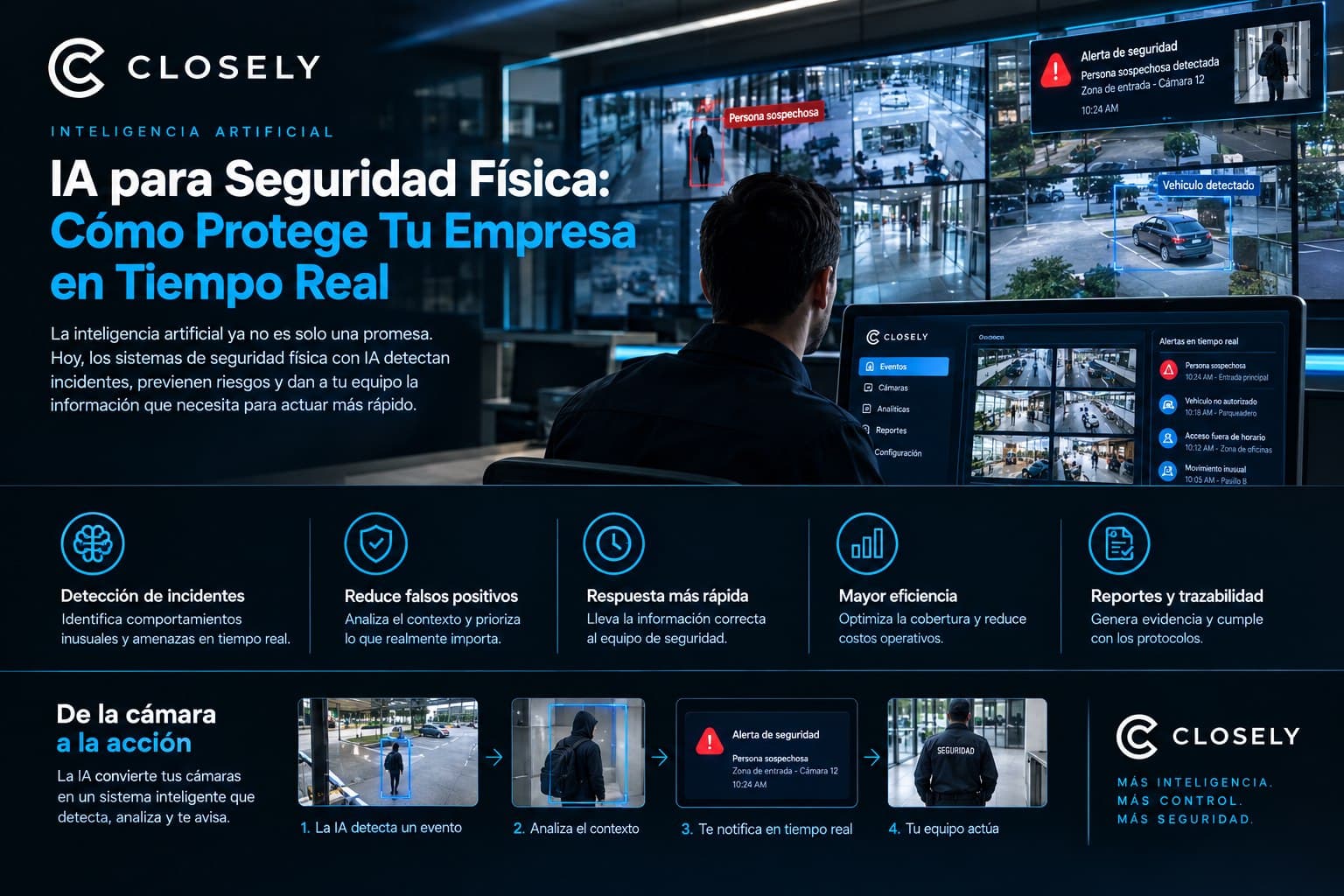
Corporate security is no longer just guards at the door and cameras in the hallways. It's a strategic function that brings together technology, processes, and people to protect an organization's most valuable assets. This guide explains how it works and what has changed.
What Corporate Security Is and What It Actually Covers
Corporate security is the set of strategies, policies, technologies, and processes an organization implements to protect its people, physical assets, information, and operational continuity against internal and external threats.
That definition is broader than most people imagine when they hear the term. Corporate security isn't limited to a guard at reception or security cameras in the hallways. It covers controlling who enters and leaves facilities, protecting sensitive data, managing incidents, coordinating with authorities when needed, keeping the business running through emergencies, protecting executives, and managing reputation during security crises.
In mid-sized and large organizations, enterprise security is a function with its own budget, specialized staff, and dedicated technology. In smaller organizations, it's often outsourced to private security companies that run the function on their behalf. In both cases, the trend of recent years is clear: corporate security is moving from a reactive model based on human presence to a proactive model that is data-driven and supported by artificial intelligence.
The Three Pillars of Modern Corporate Security
Physical Security
Physical security is the most visible layer of corporate security. It includes facility access control, video surveillance, visitor management, perimeter protection, alarm systems, guard coordination, and incident response at the organization's physical sites.
In companies with multiple sites, physical security gets significantly more complicated. It's not just about protecting one location, but about maintaining consistent standards across dozens or hundreds of facilities spread across several cities or countries. That scale is where centralized corporate security systems make the biggest difference: a security team can't physically be everywhere at once, but a management platform can monitor every site at the same time.
Information Security and Cybersecurity
Modern enterprise security can't ignore the digital dimension. Unauthorized access to information systems, theft of customer data or intellectual property, ransomware attacks, and corporate espionage are threats with consequences as serious as, or more serious than, physical incidents.
The intersection between physical security and cybersecurity keeps getting tighter. An employee who physically enters a server room after hours is both a physical security event and a possible sign of a cyber threat. Modern corporate security systems account for that intersection and generate alerts that correlate physical events with digital behavior patterns.
Business Continuity and Crisis Management
The third dimension of corporate security is the organization's ability to keep operating through adverse situations: a major security incident, a natural emergency, a reputational crisis, or a supply chain disruption.
Corporate security includes emergency response planning, evacuation protocols, business continuity plans, and crisis communication procedures. These functions require coordination between security, human resources, communications, technology, and executive leadership.
How Corporate Security Has Changed in the Last Ten Years
From a Reactive Model to a Proactive Model
The traditional corporate security model was fundamentally reactive: systems recorded what happened, guards responded when something occurred, and investigations began after the incident had already taken place. The central question was "what happened?" rather than "what is happening?"
Artificial intelligence has changed that equation. Modern corporate security systems don't just record; they analyze what cameras capture in real time, identify anomalous patterns before they become incidents, and alert security teams while there is still time to intervene.
From Human Monitoring to AI-Assisted Monitoring
For decades, the industry standard was for human operators to manually monitor security cameras in 8- or 12-hour shifts. That model has a well-known physiological limit: after 20 minutes of continuous observation, an operator loses up to 95% of their effective attention.
Modern corporate security platforms solve this problem with artificial intelligence that monitors every camera feed simultaneously, filters out the noise of irrelevant alerts, and hands the human operator only the events that genuinely require their attention and judgment.
From Fragmentation to Integration
Historically, the different functions of enterprise security operated in silos: the access control system came from one vendor, the cameras from another, the alarm system from a third. Each system's information lived separately, making a unified real-time view almost impossible.
Modern corporate security management platforms are designed to integrate those layers into a single interface that correlates events from different sources. An unauthorized access at a door can be automatically correlated with what the nearest camera captured at that moment, generating an integrated alert with full context.
The Technologies That Define Modern Corporate Security
PSIM Platforms
PSIM (Physical Security Information Management) systems are software platforms designed to integrate multiple security systems into a centralized operational interface. PSIM-based corporate security systems from the leading enterprise vendors, such as Lenel OnGuard, Honeywell Pro-Watch, and Genetec Security Center, are powerful but typically expensive and complex to implement, aimed at large corporations with robust IT infrastructure.
Intelligent Access Control
Modern access control goes far beyond the magnetic card or PIN. Today's enterprise security platforms integrate mobile credentials, biometrics, behavioral analysis that detects anomalous access patterns, and correlation with work schedules to flag access outside expected hours.
In companies with multiple sites across Latin American countries or across U.S. states, centralized access control management makes it possible to deactivate a credential instantly at every facility without local intervention.
Video Surveillance with Video Analytics
Security cameras without video analytics are basically recorders. Cameras with analytics, or connected to external AI platforms, are active detection systems. The difference in a corporate security context is significant: a conventional camera records the theft of a laptop. A camera with analytics detects when someone lingers near the equipment longer than expected outside normal hours, before the theft happens.
AI Agents for Security Operations
The most recent evolution in corporate security systems is the addition of autonomous artificial intelligence agents that don't just analyze video but run complete operational workflows: visitor management at reception, guard patrol tracking, automatic report generation, and forensic investigation in historical recordings, a task that goes from taking hours to taking minutes.
Corporate Security in Latin America and the United States
The Latin American Market
In Latin America, corporate security faces a significantly higher threat environment than most European markets. Colombia, Mexico, Brazil, Peru, and Venezuela have crime rates that force companies to invest in security as a critical operational necessity.
The region's private security industry is one of the largest in the world by employment. Colombia alone has more than 200,000 private security guards. That labor force carries a growing cost, especially with the minimum wage increases of recent years, which is accelerating the adoption of technology to multiply each operator's effectiveness.
Multinational companies operating in Latin America often have global corporate security standards that must adapt to local realities: less uniform infrastructure, greater variability in the availability of technology vendors, and different regulatory frameworks for private security from country to country.
The North American Market
In the United States, corporate security operates in a context where regulatory compliance is a critical dimension. Companies that handle health data, financial data, or federal government contracts have physical and logical security requirements dictated by specific regulations such as HIPAA, SOX, NDAA, and FedRAMP.
AI adoption in corporate security is more advanced in the North American market, with greater penetration of PSIM platforms and video analytics in mid-sized companies. However, vendor fragmentation and integration complexity remain a frequent challenge.
How Closely Transforms Corporate Security Management
Closely is an AI-powered corporate security platform designed to cover the complete operational cycle of a security team.
The platform works through five autonomous agents:
Watcher, Closely's computer vision agent, analyzes every camera feed in real time. It detects anomalous behavior against a baseline learned per camera and per time of day: loitering, perimeter violation, aggressive behavior, weapon detection, abandoned objects, and more than thirty additional patterns.
Gatekeeper, the access control agent, manages visitor flows autonomously. It notifies the host via WhatsApp and a simultaneous phone call, and records every interaction automatically.
Investigator, Closely's forensic analysis agent, turns hours or days of searching through recordings into a query that takes minutes. It lets you search by visual attributes or with natural language descriptions.
Supervisor, the guard management agent, tracks patrols in real time. It verifies that rounds are completed on schedule and generates wellness alerts when there are deviations.
Reporter automatically generates the incident log, shift reports, and audit documentation without any operator having to fill out forms manually.
For companies with sites in Colombia, Mexico, Peru, Chile, or the North American market, Closely runs on the camera infrastructure that already exists, without replacing hardware. Implementation can be in production within weeks.
Closely offers a free two-week demo so each organization can evaluate the platform on its own infrastructure before any commitment.
10 Frequently Asked Questions About Corporate Security
1. What does corporate security include for a mid-sized or large company?
Corporate security includes physical facility access control, video surveillance, visitor management, perimeter protection, alarm systems, security staff coordination, incident management, business continuity plans for emergencies, and, in organizations with greater exposure, executive protection and information security. In companies with multiple sites, it also includes centralized management of all those elements from a unified platform.
2. What is the difference between corporate security and private security?
Private security mainly refers to the service of supplying guards and surveillance staff that companies hire externally. Corporate security is the broader concept that includes the strategy, technology, processes, and people that together protect the organization. Private security is one component of corporate security, but not all of it.
3. How is artificial intelligence changing corporate security management?
AI is transforming corporate security management in three main ways. First, by turning monitoring from reactive to proactive: systems detect threats before they escalate. Second, by multiplying operator effectiveness: instead of manually watching multiple feeds, operators receive prioritized alerts. Third, by generating structured data that enables trend analysis, resource optimization, and continuous protocol improvement.
4. What is a PSIM and what is it used for in corporate security?
A PSIM (Physical Security Information Management) is a software platform that integrates multiple physical security systems into a centralized operational interface. It lets the corporate security team manage all those information sources from a single screen, correlate events from different systems, and respond to incidents in a coordinated way. The leading enterprise vendors are Lenel OnGuard, Honeywell Pro-Watch, and Genetec Security Center.
5. How do companies with sites in several Latin American countries manage their corporate security?
Multi-country corporate security management in Latin America requires platforms that can centralize monitoring of multiple sites from a single SOC, apply consistent protocols regardless of location, and adapt to each market's local realities. A corporate security platform like Closely is designed for that reality: it connects to any IP camera regardless of manufacturer, making it possible to maintain consistent standards across mixed hardware fleets spread over several countries.
6. What is the approximate cost of implementing an AI corporate security system?
The cost varies with the size of the organization, the number of sites, and the number of cameras. For a company with a mid-sized site in Latin America that already has IP cameras installed, adding a corporate security platform like Closely is mainly a software subscription cost. The per-installation pricing model makes the cost predictable and lets it scale reasonably. For organizations replacing manual monitoring with AI, labor cost savings often exceed the cost of the platform from the first month.
7. How does physical corporate security integrate with cybersecurity?
The intersection keeps growing. An employee who physically enters a server area outside their usual hours is a physical security event that can also signal a cyber threat. Modern platforms correlate physical events (access, presence in restricted zones) with behavior patterns in information systems. That correlation makes it possible to detect insider threats that neither system would identify on its own.
8. What reports and documentation should a corporate security system generate?
A corporate security system should generate: access logs with timestamps and evidence per checkpoint, incident reports with descriptions and visual evidence, visitor records, security staff patrol reports, and SLA metrics for outsourced operations. Closely's Reporter generates all this documentation automatically with no manual operator input, with every record auditable and exportable.
9. How many security guards does a multi-site company need if it has AI?
There is no universal formula, but the trend measured in deployments with AI platforms is a 30% to 40% reduction in the monitoring staff needed for the same level of effective coverage. Guards don't disappear: their role changes, from passive observers in front of screens to active responders. In installations where corporate security is managed from a centralized SOC, the gain in effectiveness per operator is even greater.
10. How can Closely help modernize my company's corporate security?
Closely modernizes corporate security in four dimensions at once. First, it turns already-installed cameras into active AI detection systems. Second, it automates visitor and access management workflows. Third, it tracks physical security staff in real time. Fourth, it generates all incident documentation and reports automatically. Closely offers a free two-week demo to evaluate the platform on each organization's specific infrastructure.