Remote Doorman & AI: How Buildings in Bogotá Are Automating Security in 2026
How remote doorman service works in Bogotá, what technology a building needs, and how AI is transforming residential security and monitoring centers.
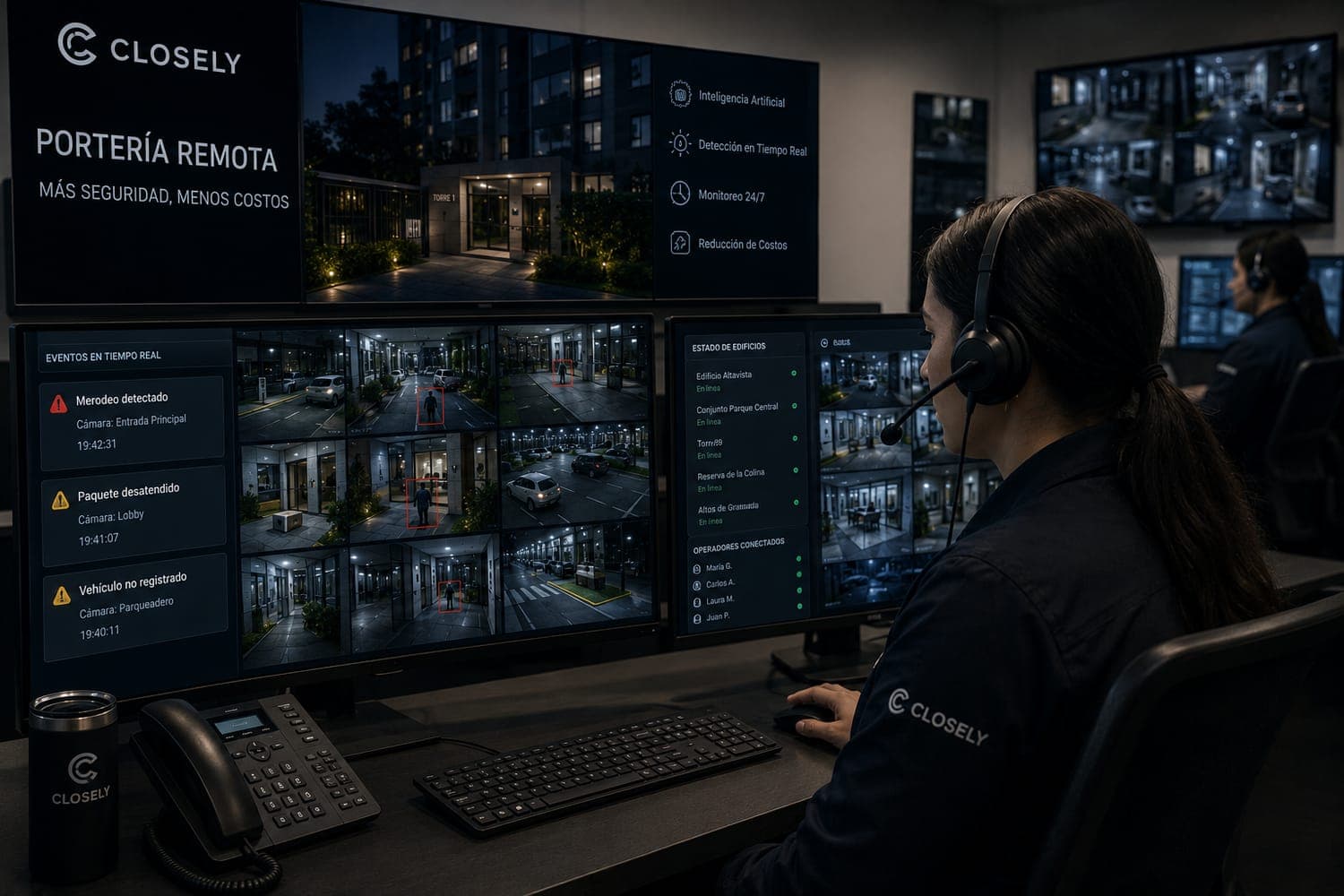
Remote doorman service replaces the physical doorman at each building with operators in a monitoring center that serves multiple properties at once — and AI is what lets it scale. Watchers that analyze every camera, a voice agent that answers the intercom and notifies the resident via WhatsApp and phone call, and automatic logs. Done well, it can cut a building's security costs by up to 70%. Here's how it actually works.
If you live in or manage a building or gated community in Bogotá, you've probably heard about remote doorman service. But what's happening now goes far beyond adding a camera and an intercom. Here's how it really works.
The real problem with the traditional doorman in Bogotá
Let's start with something everyone who lives in an apartment in Bogotá knows well: the doorman is the building's first line of security, and also the bottleneck for almost everything that happens at the entrance.
A delivery arrives at 11pm. The doorman has to verify the courier, call the resident, wait for a response, authorize access, log the visit — all while simultaneously watching forty cameras, answering the building phone, and possibly handling another situation at the front desk. In a 12-hour shift, that can repeat 80 or 100 times.
The result is predictable: mistakes get made. People get let in without proper verification. Records get lost. Incidents that could have been prevented happen. And the cost of the service — salaries, benefits, night shifts, replacements — keeps rising year after year.
What few property managers know is that automating the doorman function with artificial intelligence can cut a building's security costs by up to 70% — without sacrificing coverage or response quality. And that's not a theoretical number: it's the result of replacing repetitive manual work with AI agents that do those same tasks continuously, without breaks, and with full traceability.
Remote doorman service in Bogotá emerged as a response to that problem. The idea is simple: instead of a physical doorman at each building, a remote monitoring center can serve multiple properties simultaneously, with specialized operators handling all access from a single location. The doorman is no longer in the lobby — they're in a control room with multiple screens, serving 10, 20, or 30 buildings at the same time.
That only works well when technology does the heavy lifting. And that's where artificial intelligence comes in.
What a remote doorman system is and how it works
The base infrastructure: cameras, intercoms, and IP connectivity
A modern remote doorman system rests on three hardware elements that have to work together:
IP cameras at strategic points — vehicle entrance, pedestrian entrance, common areas, lobby, parking, loading and unloading zones. These cameras stream video in real time to the monitoring center. They can be brands like Hikvision, Dahua, Axis, or any manufacturer with RTSP output and ONVIF support, which is the industry's interoperability standard. What matters isn't the brand: it's that they have IP connectivity.
Video intercoms — the point of contact between whoever arrives at the building and the monitoring center operator. When someone presses the button at the entrance, the call goes directly to the remote operator, who can see the person through the integrated camera, verify their identity, talk to the resident, and authorize or deny access. All without being physically present.
Reliable data network — building automation depends on the video stream and intercom signal reaching the center without interruption. Fiber optic or ethernet inside the building, with a stable internet link to the outside, is the minimum requirement for the system to work well.
With that base infrastructure, the monitoring center can manage building access. But managing access manually from a center —without artificial intelligence— has the same scale problem as the physical doorman: a human operator can only handle a limited number of situations simultaneously.
AI is what turns a basic remote video-surveillance system into a real automated remote doorman system.
The AI detection systems changing remote doorman service
Watchers: the visual detection agents
The most visible component of the AI layer in a building automation system is the real-time detection agents — what we at Closely call Watchers.
A Watcher is a computer vision algorithm that continuously monitors a specific camera feed looking for predefined behavior patterns. Unlike a human operator who can get distracted, fatigued, or be watching another camera at the critical moment, the Watcher is watching all 1,440 minutes of the day.
The detection types most relevant for residential buildings in Bogotá include:
Loitering — a person who stays at the entrance or in common areas longer than would be normal for someone simply waiting or passing through. The algorithm detects that anomalous dwell time and alerts the operator before the situation escalates.
Perimeter breach — crossing a virtual line configured around restricted zones: parking access outside hours, entry to the machine room, loading zones at unauthorized times. The Watcher fires a real-time alert when that boundary is crossed.
Open door — detection of controlled access points that stay open longer than expected, which can indicate a closing failure or an unauthorized access being exploited.
Tailgating — detection of a second person entering the building following an authorized one without presenting their own credential. It's one of the most common unauthorized-entry vectors in residential complexes and one of the hardest to control without computer vision. The system detects when the number of people crossing an access point doesn't match the number of credentials or authorizations logged at that moment.
Bicycle theft — monitoring of bike storage zones with detection of tampering or removal outside usual hours or without the owner's characteristic behavior. In Bogotá, where bicycle theft in residential parking is a frequent problem, this Watcher can trigger within seconds of the theft beginning — enough time for the monitoring center to intervene.
Delivery identification — visual recognition of couriers and delivery people at the building entrance. The system identifies clothing, vehicles, and typical delivery behavior to automatically classify the visit type before it reaches the intercom, routing the interaction to the correct flow from the start without the operator having to manually determine what kind of visit it is.
Crowd formation — unusual groups forming in zones that normally don't have them, like the building entrance or lobby. It can indicate a situation that needs attention before it becomes obvious.
The key to how the system works is that it doesn't generate an alert for every movement — that only creates alarm fatigue and makes operators stop paying attention. Watchers use a three-layer system: first they filter basic motion, then classify whether there's a relevant object (person, vehicle), and finally apply AI reasoning to determine whether the behavior is anomalous given the context of that place and time. Only events that exceed that threshold reach the operator as a prioritized alert.
AI Doorman: the voice agent that answers the intercom
The voice agent for the doorman function is the component that has evolved most in the last two years and the one with the biggest impact on the daily operation of a monitoring center providing remote doorman services.
When someone reaches the building intercom — a delivery person, a cleaning crew member, a visitor, a vendor — instead of a human operator having to answer that call in real time, Closely's voice agent starts the interaction automatically.
The agent greets them, identifies the purpose of the visit, asks the necessary verification questions (which resident are they here for? do they have prior authorization? what's the company name?), and notifies the corresponding resident simultaneously through two channels: WhatsApp and a phone call. The resident can approve or deny access directly from their phone, in seconds, without a center operator having to manage that call at that moment.
Why the dual notification (WhatsApp + call) matters: if the resident is in a meeting and can't answer the phone, the WhatsApp message arrives anyway and they can respond with one tap. If they have no data at that moment, the call comes through regardless. Both channels in parallel guarantee the notification arrives regardless of the resident's situation.
The agent also handles more complex situations: foreign visitors who don't speak Spanish, instructions in another language, special flows for residents with pre-authorized access for certain people, or cases where the resident doesn't respond and an escalation protocol has to kick in.
What the center operator receives is the result — access authorized or denied, with a full record of the interaction — instead of the process. That frees up operating time for the situations that genuinely require human judgment: incidents, anomalies, emergencies.
Supervisor: the guard-patrol agent
For automated buildings that have physical guards complementing remote surveillance, Closely's Supervisor module automatically tracks security patrols.
The guard carries a device or logs checkpoints along their route. The system verifies in real time that patrols are being completed according to the defined schedule, detects when a checkpoint wasn't visited within the expected time, and alerts the monitoring center if there's a protocol deviation. If the guard logs no activity for an unusual period, the system can generate a personnel-wellbeing alert.
For property managers, this means automatic auditing of security rounds — without relying on manual logs that can be filled in without the round having actually happened.
Investigator: intelligent search across recordings
When an incident happens — a theft in the parking area, an unauthorized person in common areas, an accident — traditional investigation means someone has to review hours of footage looking for the relevant moment. In a building automation system with 20 or 30 cameras, that can be a full day of work.
The Investigator module lets you search recordings using natural language or specific parameters: "show me all the people who came in through the pedestrian door between 10pm and 2am on Tuesday," "find vehicles that stayed more than 30 minutes in the visitor area." The system returns the relevant clips in seconds, turning an investigation that took hours into a task of minutes.
Reporter: automatic logs and reports
Incident documentation at the front desk is an operational obligation that in most buildings is done manually and inconsistently. Closely's Reporter module automatically generates the access, incident, and alert log for each managed building — with timestamp, visual evidence, notification channel used, resident response, and resolution.
For the monitoring centers providing remote doorman service in Bogotá, this is critical: they have to prove to their clients that the service is being delivered correctly, and the automatic log is the structured evidence that proves it.
How the AI monitoring-center model works
The architecture of modern remote doorman service in Bogotá works like this:
The monitoring center is the company providing the service. It has its own operators, its own software infrastructure, and its own response capability. The buildings are its clients — they pay the center to manage their doorman function remotely.
What Closely does is provide that center the artificial-intelligence layer that multiplies each operator's effectiveness. Instead of an operator manually answering every intercom call from every building, AI Doorman's voice agent handles routine flows automatically — deliveries, pre-authorized visits, cleaning staff — and only escalates to the human operator when the situation requires it.
Instead of an operator watching 30 cameras waiting for something to happen, the Watchers analyze every feed simultaneously and alert them when there's something worth attention. The operator goes from being a passive observer to an active decision-maker, with all the information they need at the moment they need it.
The result is that a monitoring center using Closely's technology can manage significantly more buildings with the same team of operators — without sacrificing service quality. And every incident managed generates structured data that feeds the system's continuous improvement.
The model across LATAM and the US market
The remote doorman concept isn't exclusive to Bogotá. In Mexico City, Lima, Santiago, and Medellín, the centralized residential monitoring model is growing for the same reason: urban insecurity combined with the rising cost of labor makes the physical-doorman-per-building model increasingly unsustainable.
In the US market, the equivalent concept — remote doorman or virtual concierge — is already standard in high-end buildings in cities like New York, Miami, and Chicago. The difference is that in LATAM the security pressure is higher and security companies' operating margins are tighter, which makes the ROI of automation even more immediate.
The technology infrastructure is the same: IP cameras with RTSP and ONVIF, video intercoms, a stable internet connection, and an AI platform that makes everything connected intelligent. What changes are the specific flows, the language, and the escalation protocols adapted to each market.
How Closely automates your building's doorman function
If you're a property manager, a monitoring-center manager, or responsible for the security of a building in Bogotá or any city in Colombia, Closely works directly with monitoring centers that provide remote doorman services, helping them deploy the detection modules, the voice agent, and the automatic log on top of the camera infrastructure they already have installed — no hardware changes, no months-long projects, no risk.
Every visit managed, every Watcher alert, every access authorized or denied is logged automatically with timestamp, visual evidence, and outcome. The property manager can access that log at any time and verify the service is being delivered as agreed.
If you want to automate your building to cut costs, get in touch. At Closely we help you find the best automation and monitoring provider for your specific case — and deploy the artificial intelligence that makes it all work.
Frequently Asked Questions
What is a remote doorman in a building and how exactly does it work?
A remote doorman is a model where a building's access control and surveillance aren't managed by a physical doorman in the lobby, but by specialized operators in a monitoring center who serve multiple properties simultaneously and remotely. When someone reaches the intercom, the call goes to the center, where an operator — or an AI voice agent — verifies the visit, notifies the resident, and authorizes or denies access. IP cameras let the operator see in real time what's happening at the entrance without being physically present.
Is a remote doorman safe compared to a physical doorman in the building?
Well implemented, a remote doorman with AI can be more effective than a physical doorman, not less. A human doorman has obvious limitations: they get distracted, get tired, can't be in several places at once, and don't always follow protocol consistently. A monitoring center with AI detection systems analyzes every camera simultaneously, generates automatic alerts for anomalous behavior, and keeps a complete, auditable record of every event. The human factor is still critical — operators make the final decisions — but it's backed by technology that doesn't tire or get distracted.
What technology does a building need to migrate to a remote doorman?
The basic elements are: IP cameras at strategic points (entrance, lobby, parking, common areas), a video intercom at the front desk, a reliable data network inside the building, and a stable internet connection. The good news is that if the building already has IP cameras from brands like Hikvision, Dahua, or Axis, they're likely compatible with modern building automation platforms without needing to change the hardware. The AI layer connects on top of the existing infrastructure.
How does the resident notification system work when a visit or delivery arrives?
In the modern remote doorman model, the notification is dual: the system sends a WhatsApp message to the resident with the arriving person's information (name, company, photo if available) and simultaneously generates a phone call. The resident can approve or deny access directly from their phone in seconds, no matter where they are. The dual notification guarantees the message arrives even if the resident has no mobile data or can't answer the phone at that moment.
What happens with visits when the resident doesn't answer the notification?
The system follows a predefined escalation protocol. After a number of notification attempts without response, the case escalates to a human operator at the monitoring center, who can make the decision according to the building's protocol: automatically deny access, try to contact the resident by another means, or handle previously authorized exceptions (like visits with pre-approved access). The whole process is automatically logged.
What AI detection systems does Closely have for residential buildings?
Closely operates with several specialized modules: the Watchers detect anomalous behaviors on the cameras (loitering, perimeter breach, crowd formation, open doors), the AI Doorman manages access flows through a voice agent that answers the intercom and notifies residents automatically, the Supervisor tracks physical guard patrols, the Investigator enables intelligent search across recordings for incident investigation, and the Reporter generates the log and reports automatically. Together, these modules turn a conventional monitoring center into an intelligent security operation.
How much does it cost to deploy an AI remote doorman system in a building in Bogotá?
The cost depends on the building's existing infrastructure and the number of cameras and access points. If the building already has IP cameras installed, most of the cost is software — a monthly subscription to the building automation platform plus the service of the monitoring center providing the remote doorman. Compared to the cost of a 24/7 doorman (salary, benefits, replacements, overtime), the remote AI model is almost always cheaper in medium and large buildings. For a specific evaluation, it's best to contact the monitoring centers operating with Closely's technology directly.
Does a remote doorman work for small buildings or only large complexes?
The model is viable for any building with at least one controlled entrance to manage. In small buildings (fewer than 20 apartments), the fixed cost of the initial infrastructure can be proportionally higher, but the savings in doorman salaries offset it relatively quickly. For large or multi-tower complexes, the remote doorman model is especially efficient because the same infrastructure covers multiple access points and zones without requiring proportionally more operators.
How is vehicle access handled in a remote doorman system?
Vehicle access is managed the same way as pedestrian access — with remote video verification through the intercom, or automatically for registered resident vehicles (in which case the system can integrate with license plate recognition to open the barrier automatically). For visitor or vendor vehicles, the resident notification flow works the same as for people — the operator or voice agent verifies and notifies, and the resident authorizes from their phone.
How do I know if the monitoring center providing the remote doorman service is actually doing its job?
The difference between a monitoring center with and without AI technology is traceability. With Closely, every event — every visit managed, every Watcher alert, every access authorized or denied — is logged automatically with timestamp, visual evidence, and outcome. The property manager can access that log at any time and verify the service is being delivered as agreed. There are no manual logs someone can fill in after the fact: the system generates the documentation in real time, which turns service auditing into a trivial task instead of an investigation.