Construction Site Security with AI: How to Stop Material Theft
How to stop construction site theft with security cameras, AI site monitoring and access control, using the cameras you already have.
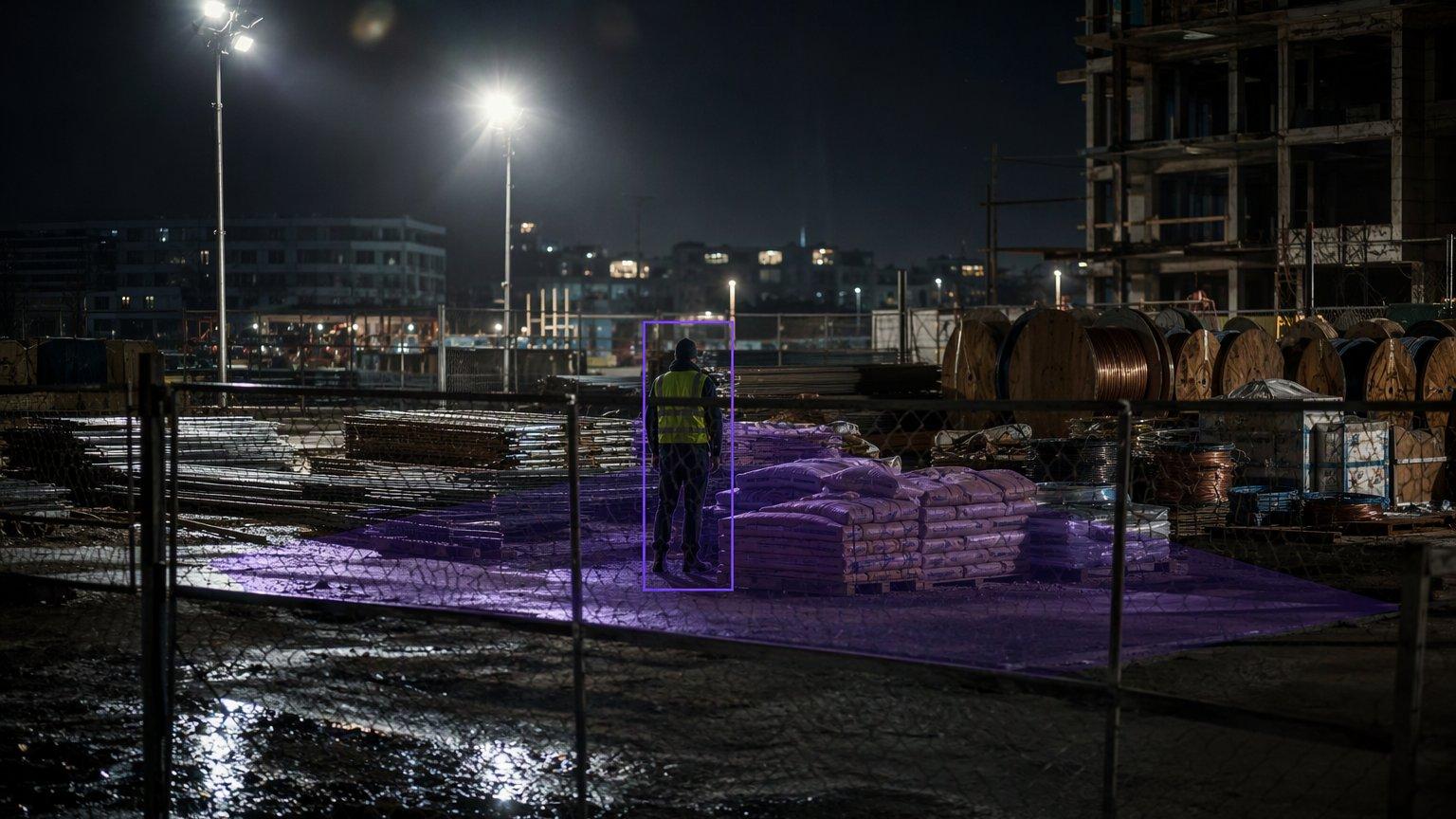
Short version: construction site theft rarely happens in broad daylight. It happens at night, on weekends and in the gaps nobody is watching. Good construction site security combines construction site cameras you may already own, AI site monitoring that alerts you while it's happening, and access control that knows who comes in, with whom and when.
Construction site security: why job sites are such easy targets
A job site is hard to protect almost by definition. The walls aren't finished, the perimeter changes every week, dozens of suppliers and subcontractors come and go, and the most valuable materials (copper wire, rebar, cement, power tools, pipe) sit stacked outdoors. To a thief, it's a supermarket with no checkout.
There's something site managers know well: a lot of what "goes missing" isn't taken by a stranger. It leaves through the front gate in a supplier's truck, with a delivery note nobody checked, or in the backpack of someone who does have a badge. That's why construction site security can't be solved with a fence and a guard alone.
In the United States, an academic study that looked at more than 15,000 NIBRS incidents estimated direct losses of roughly one billion dollars a year across equipment, materials and tools (ETSU, An Exploratory Look at Thefts from Construction Sites). For Colombia and Mexico we couldn't find a comparable national figure, and we won't make one up. What we do see are cases like the fake Bogotá Metro workers arrested while trying to take rails worth about 50 million pesos (Portafolio). The pattern repeats in every country: material theft on construction sites is frequent, quiet and very hard to recover from.
Where material goes missing: the five most common gaps
Before talking about technology, look at where the money leaks. On most sites, construction site theft concentrates in five places:
- The perimeter at night. Temporary fences, tarps and open gates "while the truck arrives."
- The gate or vehicle entrance. Trucks leaving with no count and no photo of what they carry.
- The site storeroom. Tools and cable with no inventory by person or shift.
- Weekends and holidays. The site sits empty and nobody checks the cameras until Monday.
- Shift changes. When many people come and go, nobody knows who is who.
If your site has two or three of these open, you already know where the material is going. The good news is that most of them close with order and AI site monitoring, without building anything new.
Construction site cameras: what works and what doesn't
Almost every mid-size site already has some cameras. The problem is that they record and nobody watches. A typical finding: the theft happened Saturday at 2 a.m., it was recorded, and we found out on Monday. Recording isn't preventing, and construction site cameras only help if someone (or something) is watching while the event happens.
Some practical rules for placement:
- Cover entrances before walls. One camera on the vehicle exit is worth more than four inside.
- Point at the value. Storeroom, wire and steel area, and the staging yard.
- Mind the lighting. A camera with no light at night only records shadows. A motion-sensor light often helps more than a pricier camera.
- Plan power and connectivity. Sites change; cameras with wired or wireless links need to move with the work front.
- Don't rely on local recording alone. If the recorder is stolen, so is the evidence.
And an honest warning: more cameras aren't the answer. Ten cameras nobody watches give the same sense of security as zero, just at a higher price.
AI site monitoring: from recording to alerting
This is where the game changes. AI site monitoring analyzes video in real time and alerts you when something that matters happens: a person inside a restricted area at 11 p.m., a vehicle in the yard on a Sunday, someone loading rolls of cable after hours. It doesn't replace the guard; it gives him eyes where he can't be.
The trick isn't detecting more, it's detecting better. Pure motion alerts go off with rain, cats and tarps moving in the wind, and the team ends up ignoring them. If that problem sounds familiar, we cover it in why AI motion detection creates false alarms and how to avoid them.
Closely runs on the cameras you already have, with no proprietary hardware: it connects through RTSP/ONVIF or your NVR (Hikvision, Dahua, Axis, Bosch, Reolink and others). The Watcher agent analyzes video in real time with multi-layer filters that cut false alarms by up to 88%, and an operator validates every alert before anyone is dispatched. You can try Closely on your site's current cameras with a free two-week demo.
Rules in plain language, not code
A job site isn't a warehouse: what's normal changes every week. So rules are written the way you'd say them out loud, for example: "alert me if a person enters the staging yard after 7 p.m." or "alert me if a vehicle leaves loaded outside dispatch hours." You don't need a technician to change them when the work front moves.
Access control on construction sites: who comes in, with what, and when they leave
Half the problem is solved at the gate. Construction site access control doesn't have to look like an airport turnstile; it has to answer three questions: who is this, why are they here, and what are they taking out?
A simple way to set it up:
- An authorized personnel list per contractor, updated weekly.
- A visitor and supplier log with photo, license plate and entry and exit times.
- Vehicle exit checks against the delivery note, with a photo of the loaded vehicle.
- An immediate alert to the site manager when someone not on the list shows up.
Closely's Gatekeeper agent helps right there: it logs visitors and access and notifies you by WhatsApp and phone call when someone arrives who needs authorization. The site manager finds out in the moment, not at month-end when the inventory doesn't add up. If you want to see how it connects to your cameras, request a Closely demo and we'll review it on your own site.
A four-step construction site security plan
You don't need a six-month project. This is a realistic path for a site already running:
- Map the risk. Mark entrances, storeroom, staging area and blind spots on a plan. Ask the storekeeper where he thinks material disappears.
- Use what you have. Check which cameras work, what they cover and whether the recorder has remote access. Often a good part of the work is already done.
- Turn on AI monitoring at critical points. Start with the night perimeter and vehicle exit, not every camera at once.
- Decide who responds. An alert with no owner is useless. Decide who validates, who gets called and how fast.
A concrete example: a contractor with three sites, each with about eight old cameras and one guard per shift. Instead of buying equipment, they connect the existing cameras, set four rules per site (night perimeter, staging area, vehicle exit, weekends) and route the alerts to a single operator. For a broader look at centralized operations, see how to replace part of the guard force with AI monitoring without leaving the site exposed.
What AI doesn't solve (and we should say so)
AI doesn't replace discipline. If the storeroom keeps no inventory, contractors don't hand in personnel lists, or nobody answers the 3 a.m. alerts, the best technology will only document that something happened. It doesn't replace a well-built police report or the police themselves. What it does is give you clear evidence, with time and place, and let you act while the event is happening, not three days later.
Worker privacy also matters: post notices that cameras are in use, limit who can view recordings and check your country's data protection rules before enabling advanced features.
Frequently asked questions about construction site security
How do I stop materials from being stolen from a construction site?
Combine three things: access control (knowing who enters and what leaves), cameras at high-value points, and someone or something watching the video in real time, especially at night and on weekends. A single measure on its own is rarely enough.
How many cameras do I need on a construction site?
It depends on the size and number of entrances, but start by covering entrances, vehicle exit, storeroom and staging area. A few well-placed, well-monitored cameras beat many that nobody checks.
Do cameras help if the thief is an insider?
Yes, because they record who was in which area and when. Combined with per-person access control and a storeroom inventory, they let you clear up losses without accusing anyone without proof.
Can I use the cameras I already have for AI monitoring?
In most cases, yes. If your cameras or recorder support RTSP or ONVIF, platforms like Closely connect without changing hardware. It's best to check image quality and night lighting first.
Can AI tell a person from an animal or a moving tarp?
Modern systems can, though none is perfect. What matters is that they combine several filters and a human validates the alert before anyone is dispatched, so the team doesn't get tired of false alarms.
How do I watch a site at night without paying for more guards?
With real-time alerts on your existing cameras and a remote operator who validates and calls the on-site guard only when something is real. That keeps your people responding instead of staring at screens.
What if the site has no internet?
It's common. A dedicated 4G/5G link on the recorder or an industrial router can solve it. What matters is a stable connection during the critical hours, which are usually at night.
Is it legal to record workers on a construction site?
Generally yes, as long as you post visible notices, use the footage for security and protect the data. Rules vary across Colombia, Mexico and the United States, so check with a local attorney.
How much does it cost to protect a site with AI?
It depends on the number of cameras and the type of monitoring. Working on existing cameras means you avoid a large upfront hardware spend and pay for the service. The best approach is to request a demo and compare it with what you currently lose in materials.
How do I get started if I've never used AI monitoring?
Request a free demo on your current cameras, pick one pilot site and define three or four basic rules. In a couple of weeks you'll see which alerts are useful and which to tune. You can start at closely.dev.
The bottom line
Construction site theft isn't stopped with more padlocks but with visibility: knowing who comes in, what leaves and what happens at night while nobody is looking. With the cameras you already own, clear rules and AI monitoring that alerts you in the moment, a site can go from finding out about losses on Monday to preventing them on Saturday. To see it on your own site, book your free demo at closely.dev.