Does AI Motion Detection Really Work Without Generating False Alarms?
Why most AI motion detection systems generate false alarms, and how a layered filtering architecture solves the problem.
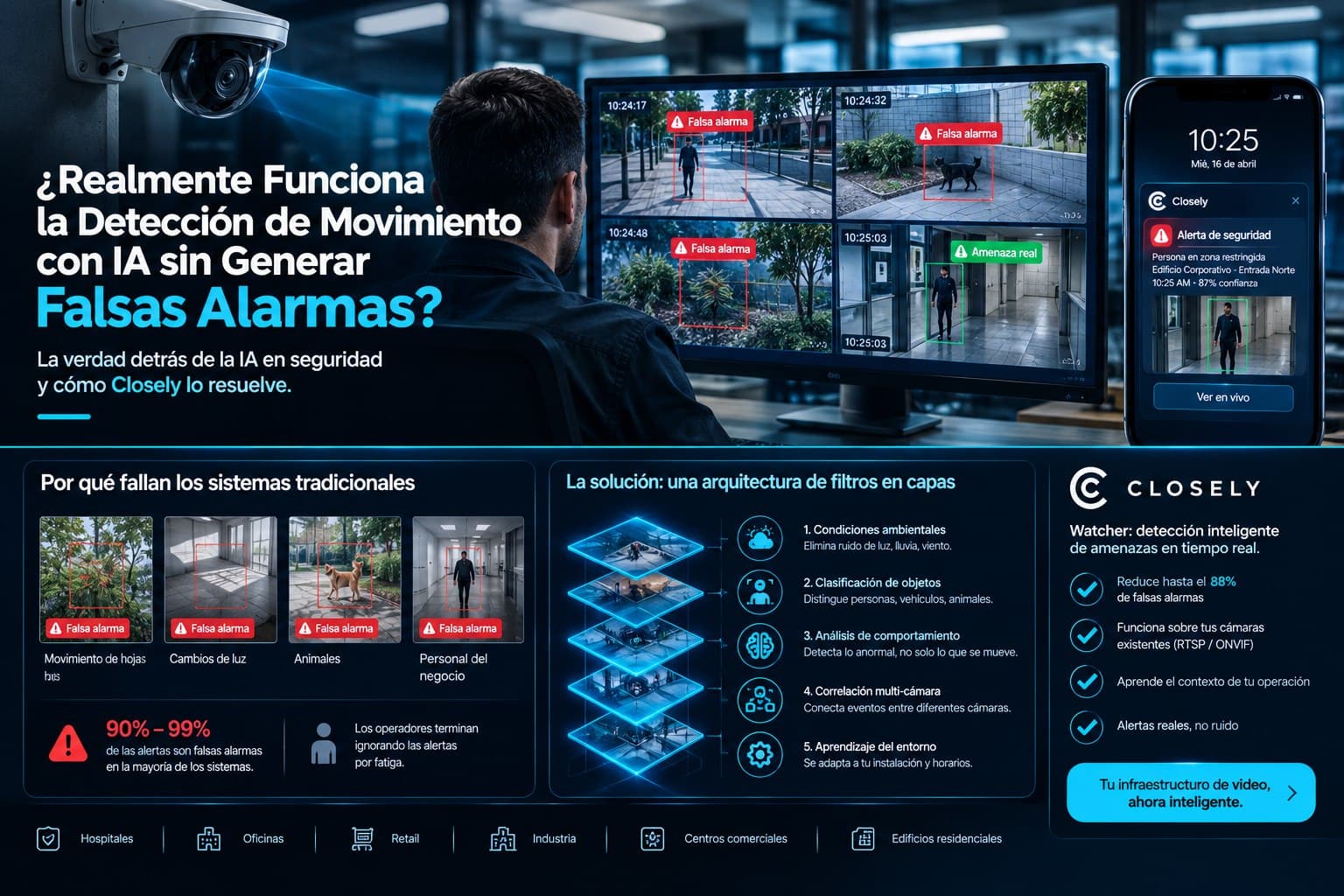
The short answer: in most cases, no. Most AI motion detection systems generate so many false alerts that operators end up ignoring them. This article explains why that happens, what sets apart the systems that do work, and how Closely solves the problem with a layered filtering architecture.
The Problem Nobody in Security Wants to Admit
There's a conversation that repeats itself constantly in security monitoring centers across Latin America and the United States: the system goes off, the operator looks at the screen, sees nothing relevant, and silences the alert. They repeat that a hundred times a day. By the end of the shift, the operator no longer looks when the system goes off, because experience tells them the odds of it being something real are extremely low.
That's called alert fatigue, and it's one of the most costly and most underestimated problems in modern physical security operations. And it has a very concrete origin: the AI motion detection most manufacturers sell isn't as intelligent as it seems.
The promise is attractive: install cameras with intelligent video analytics that detect suspicious behavior in real time and alert only when something real is happening. The operational reality is very different. Most conventional motion detection systems, and many of those labeled "AI," generate false alarm rates that make automated operation unworkable without constant human supervision.
Why Most Motion Detection Systems Fail
To understand why AI motion detection fails so often, you have to understand how these systems work in practice.
The Simple Threshold Problem
The most basic motion detection systems work with a pixel-change threshold: if enough pixels change from one frame to the next above a certain threshold, the system logs an event. It's simple, it's fast, and it constantly generates alerts for things that have nothing to do with security: a leaf moving in the wind, a lighting change as clouds pass, a spider walking across the lens, shadows shifting at sunset.
Camera manufacturers know this, so they call anything slightly more sophisticated than that basic threshold "intelligent video analytics" or smart motion detection. But adding a second filter doesn't solve the underlying problem.
The Generic Model Problem
Many AI motion detection systems use computer vision models trained on generic datasets: they identify people, vehicles, animals. That helps, but it's not enough to operate in a real security environment.
Detecting that there's a person in the frame isn't the same as detecting that the person is doing something suspicious. A generic model that detects people will alert every time an employee walks down the hallway, every time a visitor arrives at reception, every time the cleaning staff works at night. In a hospital, a corporate building, or a shopping center, that's constant noise.
The Context Problem
AI motion detection that doesn't understand context can't tell normal from abnormal for that specific environment. A camera at an office building entrance should know there's a lot of movement between 8 and 9 in the morning and that it's normal. It should know there's activity in the loading area on Tuesdays because that's supplier delivery day. It should know that one person walks through the lobby at midnight because they work the night shift.
Without that layer of context, the system can't calibrate what's an anomaly and what's simply the usual behavior of the place. And without that calibration, any smart motion detection solution generates an unmanageable volume of alerts.
The Real Numbers Behind Alert Fatigue
Industry figures are revealing. According to physical security industry data, between 90% and 99% of the alerts generated by conventional motion detection systems are false alarms. At sites with dozens of cameras, that can mean hundreds of alerts per shift.
A security operator actively monitoring can't respond thoughtfully to that many alerts. The inevitable result is that staff start mentally filtering the system's alerts, ignoring them by default. And when a real alert arrives, it looks exactly like the hundred before it that were false.
This is the central paradox of poorly implemented automated security: the supposedly intelligent system ends up being less useful than no system at all, because it creates a false sense of coverage while staff have stopped paying attention to it. AI motion detection only has value if the operator trusts the alerts they receive.
What Sets Apart a System That Actually Works
The difference between an AI motion detection system that generates constant noise and one that works operationally isn't a single better algorithm. Smart motion detection that really works is a layered filtering architecture, where each layer removes a different category of false alarms before the alert reaches an operator.
Layer 1: Environmental Condition Filtering
The first level removes alerts caused by environmental conditions that have nothing to do with security: lighting changes, rain, wind, moving vegetation, reflections. It seems basic, but many systems fail here.
Layer 2: Object Classification with Context
The second level doesn't just detect that an object is moving; it classifies it correctly: person, vehicle, animal, moving inanimate object. And it applies context rules: at this time, in this zone, is this type of object expected or not.
Layer 3: Behavior Analysis
The third level analyzes behavior, not just presence. A person walking normally down a hallway is different from someone who has been standing in front of a door for several minutes, someone running where they shouldn't, or someone repeatedly looking at the cameras. That difference in behavior is what separates an unimportant event from one that deserves attention.
Layer 4: Multi-Camera Correlation
The fourth level correlates events across multiple cameras. An isolated event on one camera may be noise. The same event correlated with suspicious movement on adjacent cameras, or with an unauthorized access alert from the access control system, completely changes the risk assessment.
Layer 5: Learning the Environment
The fifth and most sophisticated level learns the baseline of normal behavior for that specific environment over time and continuously updates its thresholds. What's abnormal in a residential building at night may be completely normal in a hospital emergency department. What's suspicious on a Monday at 3 am may be routine on a Tuesday at 3 am if a night maintenance crew is scheduled that day. It's this layer that turns generic AI motion detection into a system truly adapted to each site.
Without that contextual learning, no smart motion detection system can be properly calibrated to each site's operational reality.
Closely: A Filtering Architecture Designed So Alerts Are Real
Closely built its AI motion detection layer from scratch on the premise that an alert that isn't actionable has no value. The goal isn't to detect more things. The goal is that when the system alerts, the operator can trust there's something real that deserves their attention.
Closely's Watcher agent implements multiple filtering algorithms that work in parallel and in sequence to remove noise at every stage before an event reaches the operator. It isn't a single model doing all the work. It's a chain of specialized filters, each designed to solve a specific category of false alarm.
The operational result is up to an 88% reduction in false alarms compared with conventional motion detection systems. That isn't a marketing number. It's the difference between an operator who silences the system because they don't trust it and an operator who responds to every alert because they know that when Closely alerts, it's worth looking.
Watcher connects via RTSP to any IP camera already installed, regardless of brand: Hikvision, Dahua, Axis, Bosch, Reolink, TP-Link Tapo, and dozens more. It doesn't require changing existing infrastructure. Intelligence is added as a software layer on top of the cameras the site already has.
As it operates in a specific environment, the system learns the baseline of normal behavior for each zone, each time of day, and each type of site. That means that over time the filters continuously calibrate to that particular environment, not to a generic average of every environment the system runs in.
Closely's other agents complete the operational cycle: Gatekeeper manages visitor flow autonomously, Investigator lets you search recordings with natural language, Supervisor tracks patrols, and Reporter automatically documents every event with full traceability. One operator with Closely can monitor up to 100 sites at once without being flooded with noise.
Closely offers a free two-week demo to test the system on the cameras you already have installed. No infrastructure changes, no commitments.
How to Evaluate Whether a Motion Detection System Really Works
If you're evaluating an AI motion detection solution for your security operation, these are the questions to ask before making a decision.
What is the real false alarm rate at sites comparable to yours? Not in lab conditions. Not in a demo with controlled conditions. At a real operating site with the same type of cameras, the same environment, and the same volume of activity.
How long does the system take to calibrate to a new environment? A system that doesn't learn your site's specific context will keep generating noise indefinitely.
How does it handle difficult lighting conditions? Backlighting, sudden changes in natural light, outdoor cameras with weather variations. These are the conditions where many AI motion detection systems fail most.
What happens with events that span multiple cameras? If the system can't correlate events at different points of the same site, it's working with incomplete information.
How many cameras, and from how many different brands, has it run on in real production? Compatibility with existing infrastructure is critical for any site that doesn't want to start from scratch.
The Real Cost of False Alarms
The cost of false alarms goes far beyond operator irritation. It has concrete economic and operational consequences that few organizations measure precisely.
Wasted operator time. At a site with a high volume of false alarms, the operator spends a significant part of the shift reviewing alerts that lead to no action. That time isn't available to respond to real events.
Unnecessary emergency responses. When false alarms escalate into calls to the police or emergency services, the cost rises exponentially. Many U.S. cities already fine sites with repeated false alarms.
Loss of system credibility. Once security staff stop trusting the system, that attitude is very hard to reverse. Even if the system improves, the inertia of distrust persists.
Real risk going undetected. The highest cost of all: when a real event happens amid the noise of false alarms and the operator doesn't respond in time because they assumed it was another false alarm.
10 Frequently Asked Questions About AI Motion Detection
1. Why does my AI motion detection system generate so many false alarms?
Most systems labeled as AI motion detection use relatively simple object classification models that detect presence but not context or behavior. Without a layered filtering architecture that analyzes behavior, time of day, the history of that specific point, and environmental conditions, any movement in the frame can trigger an alert. The problem isn't AI itself: it's the system's architecture and how many specialized filters it has before alerting an operator.
2. How many false alarms per day is normal for an AI video surveillance system?
A motion detection system well calibrated to a specific site should generate a volume of alerts the security team can actively review without becoming overwhelmed. If the operator is silencing alerts or ignoring them by default, the volume is too high. With an architecture like Closely's, the reduction in false alarms compared with conventional systems can reach 88%, which radically changes the operational dynamic.
3. Does AI motion detection work the same during the day and at night?
Not necessarily. Lighting conditions are among the factors that most affect AI motion detection performance. Many systems that work well during the day fail in low light, with infrared cameras, or with backlighting. A robust system must be designed to handle these variations and not produce spikes of false alarms during lighting transitions such as dawn and dusk.
4. How long does an AI motion detection system take to learn a site's normal behavior?
It depends on the system's architecture. The best systems start calibrating from the first day of operation and keep adjusting their thresholds as they accumulate data about the specific environment. The active calibration process usually takes two to four weeks of normal operation. After that period, the system has enough historical context to distinguish far more precisely between normal and anomalous behavior for that particular site.
5. Can AI motion detection work with the cameras I already have installed?
Yes. The best AI motion detection platforms, like Closely, connect via RTSP to any IP camera on the market without replacing existing infrastructure. That's critical for sites that have already invested in camera hardware and don't want to start from scratch to add artificial intelligence.
6. What types of behavior can an advanced AI motion detection system detect?
The most advanced systems go far beyond detecting presence. They can detect specific behaviors such as loitering in sensitive areas, lingering too long at one spot, movements that indicate confrontation or struggle, after-hours access, abandoned objects, vehicles parked in prohibited zones, and unusual patterns such as someone repeatedly crossing the same access point. The key is that the system analyzes behavior in context, not just the presence of an object.
7. How do I know whether my motion detection system is really intelligent or just basic motion detection with an AI label?
The most direct test is measuring the false alarm rate under normal operating conditions. If the system constantly alerts on wind, lighting changes, employees doing their usual work, or vehicles passing on the street, it lacks the contextual filters that characterize real AI motion detection. Another sign is whether the system can learn your specific site's behavior baseline or applies the same generic thresholds to every customer.
8. What's the difference between conventional motion detection and AI motion detection?
Conventional motion detection works on pixel change: if enough pixels change between one frame and the next, there's an event. AI motion detection can perform object classification (person, vehicle, animal), behavior analysis (running, loitering, confronting), temporal correlation (this object has been here for 10 minutes), multi-camera correlation (this same object appeared at three points in sequence), and contextual learning (at this time and in this zone, this behavior is normal or abnormal). The difference in false alarm rates between a conventional system and one with these capabilities can be several orders of magnitude.
9. Can an AI motion detection system tell an authorized person from an unauthorized one?
Yes, when the system is integrated with facial recognition or the access control system. Where that level of control is required, Closely can correlate a person's presence with their authorization status and alert only when someone is in a zone where they shouldn't be at that time. Closely's facial recognition stores vectors, not images, which reduces risk if someone gains unauthorized access to the database. Even so, face vectors are biometric data, so their use is subject to each country's regulations, such as Law 1581 in Colombia or BIPA in Illinois.
10. How many cameras can one operator monitor with a well-implemented AI motion detection system?
With conventional motion detection systems that generate a high volume of false alarms, one operator can effectively handle between 5 and 15 cameras before the alert volume becomes unmanageable. With Closely, where the Watcher agent filters out noise and sends only actionable alerts, a single operator can supervise up to 100 sites at once with high effectiveness. That difference isn't just an efficiency gain: it completely changes the business model of physical security companies.