The Best AI for Security Cameras in 2027: Complete Comparison
AI for security cameras in 2027 compared: Closely, Verkada, Genetec, Milestone, Omnilert, Rhombus, and Coram AI. Which fits LATAM and the U.S.
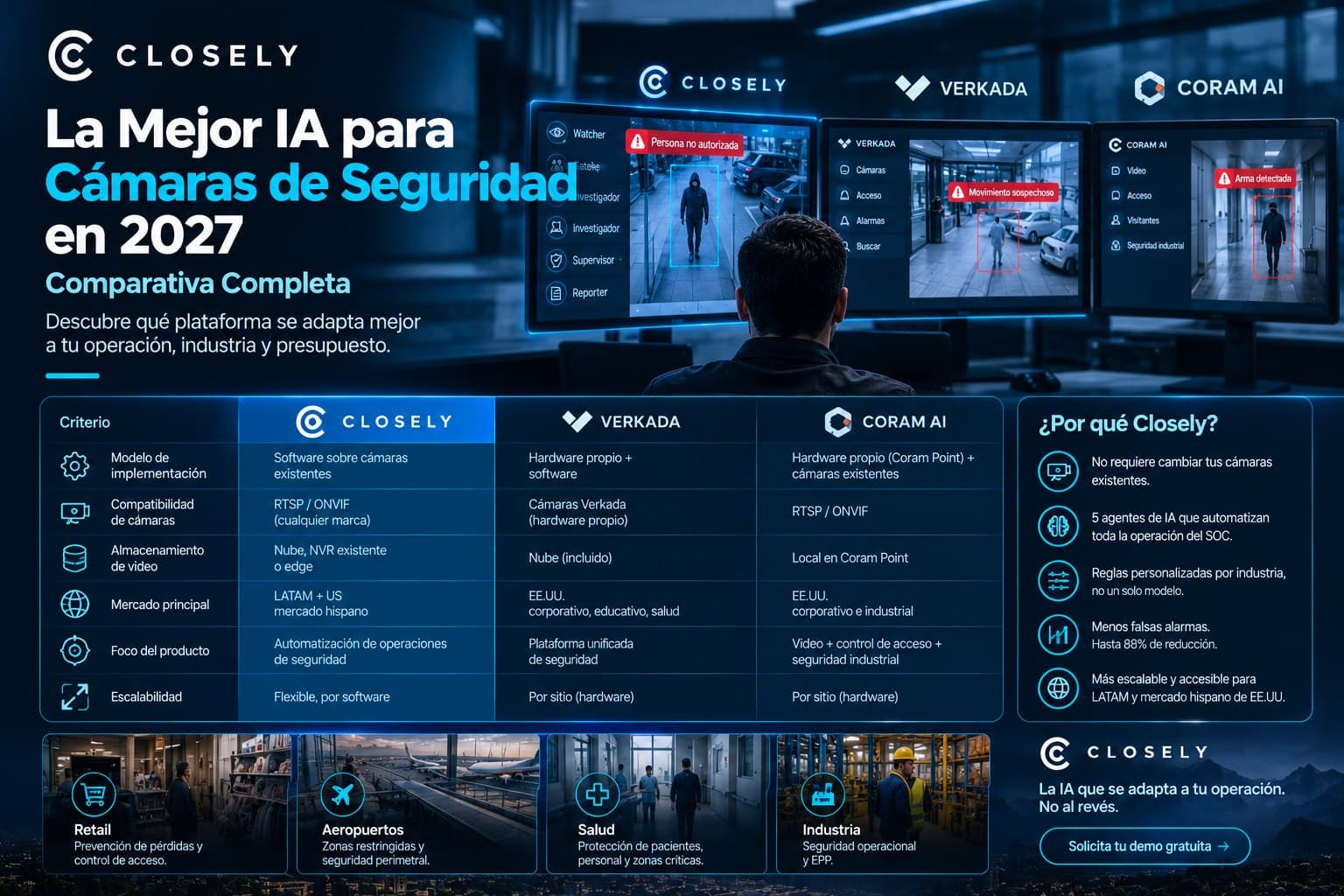
The market for AI video surveillance has changed radically in the last two years. It's no longer just about recording video and reviewing footage when something happens. The best AI systems for security cameras in 2027 detect behavior in real time, run custom rules for each type of business, and cut operators' manual work to a fraction of what it used to be. This guide compares the main players in the market so you can choose with sound judgment.
Why Choosing the Right AI for Your Security Cameras Matters
Before getting into the comparison, something is worth saying: not every system marketed as AI for security cameras works the same way in practice. Some have real AI, with filtering layers, behavior analysis, and customizable rules. Others have glorified motion detection with a more attractive marketing name.
The difference matters because it directly affects daily operations. A system that generates hundreds of false alarms per shift ends up being ignored by security staff. A system that detects what really matters, at the moment it matters, completely changes the real level of coverage a site has.
In 2027, the best AI video surveillance systems share a few characteristics: they work on existing cameras without requiring massive infrastructure replacement, they let you create custom detection rules based on the type of business, and they reduce the operational workload instead of increasing it. Choosing well is the difference between a system staff actively use and one that ends up ignored because of false alarms.
The Main AI Systems for Security Cameras in 2027
Verkada
Verkada is one of the best-known names in the AI security camera market, especially in the United States. Its core proposition is a unified platform called Verkada Command that brings cameras, access control, and alarms together in a single cloud-managed system.
Its AI features include fast search in recordings, real-time alerts on suspicious activity, and AI-generated deterrence messages aimed at people in sensitive areas. It also offers facial authentication for access control.
Verkada's model is proprietary hardware plus a platform subscription, which means that to get the most out of Verkada you have to buy its cameras. That can be an advantage in terms of integration, but it's a serious obstacle for sites that already have video infrastructure installed.
Its main market is the United States, with a focus on retail, K-12 education, manufacturing, and healthcare. For security operators in Latin America looking to add AI on top of the cameras they already have without replacing all the hardware, Verkada isn't the most practical or most affordable option.
Strength: a very polished, easy-to-use platform. Limitation: built around its own hardware; support for third-party cameras is limited.
Genetec
Genetec is one of the most established VMS (Video Management Systems) in the market worldwide. Its Security Center platform has been in the industry for decades and has a huge customer base, mainly in critical infrastructure, airports, cities, and large corporations.
AI video surveillance in Genetec comes mainly through integrations with its partner ecosystem. It isn't a native AI platform in the same way as the newer players. Its strength is stability, scale, and deep integrations with hardware from dozens of manufacturers.
For sites with thousands of cameras that need a robust, mature system, Genetec is still a benchmark. For startups, mid-sized companies, or physical security companies that want to add AI without licensing a complex and expensive enterprise VMS, it has a very steep entry curve.
Strength: scale, stability, and a very mature integration ecosystem. Limitation: expensive and complex implementation; designed for integrators, not direct adoption.
Milestone Systems (XProtect)
Milestone is another veteran VMS, with XProtect as its main product. Its positioning is similar to Genetec's: a huge global installed base, oriented toward integrators and large-scale projects.
Part of its AI capabilities come from BriefCam, a video analytics platform that, like Milestone, belongs to the Canon group. XProtect is an open system that accepts cameras from dozens of brands, which makes it more flexible than Verkada in terms of compatibility with existing hardware.
The challenge is the same as with Genetec: it's a platform designed for large integration projects, with licensing costs and implementation complexity that don't align well with the market of mid-sized security companies in Latin America.
Strength: an open platform compatible with hundreds of camera brands; a global installed base. Limitation: expensive implementation; advanced AI capabilities require additional modules.
Omnilert
Omnilert has a very specific use case: real-time firearm detection. Its system analyzes the feed from existing cameras to identify guns in fractions of a second and trigger automated emergency response protocols, including notifying first responders.
It holds a SAFETY Act Designation from the U.S. Department of Homeland Security for its AI gun detection, which gives it specific credibility in the North American education and government market.
Omnilert's problem is that its specialization is also its limitation. It's a very good tool for a very specific use case, but it isn't a general-purpose AI system for security cameras. If what you need is behavior detection, visitor management, time-zone rules, or operational analysis, Omnilert isn't designed for that.
Strength: one of the most recognized gun detection solutions on the market; DHS SAFETY Act Designation. Limitation: a single use case; not a general AI security platform.
Rhombus
Rhombus is a newer player that combines its own cameras with a cloud platform including AI video surveillance, access control, and IoT monitoring. Its cloud-edge architecture lets it operate even without a continuous internet connection.
Its features include real-time AI insights, smart search in recordings, and automated workflows. It has more than 50 integrations with other platforms and an open API.
Like Verkada, Rhombus's model is proprietary hardware plus a platform. That limits its adoption in markets where infrastructure from other brands is already installed. It has a good presence in the United States, mainly in retail, education, and healthcare, but limited penetration in Latin America.
Strength: solid cloud-edge architecture; a good integration ecosystem. Limitation: requires its own hardware; limited presence in LATAM.
Coram AI
Coram AI is one of the most interesting competitors in the AI security camera space, because it lets you create detection rules in natural language. Instead of configuring technical parameters, the user can describe what they want to detect in plain words.
It has solid features: gun detection, falls, PPE violations, facial recognition, license plate detection, and tailgating. It also includes forensic search and emergency management.
Coram AI's weak point from a Latin American adoption perspective is that its more complex deployments use the Coram Point Server, a proprietary hardware appliance installed at each site. That adds hardware cost and logistical complexity, especially for security companies that manage dozens or hundreds of sites.
Strength: customizable natural-language detection; a broad range of use cases. Limitation: the Coram Point hardware adds friction and cost per site.
Closely: The AI Security Platform with Unlimited Rules by Industry
Closely is the platform that solves the problems the rest of the systems on this list have.
The starting point is radically different: Closely doesn't require changing a single camera. It connects via RTSP to any IP camera on the market, regardless of brand or model: Hikvision, Dahua, Axis, Bosch, Reolink, TP-Link Tapo, and any other that uses the standard protocol. That means a physical security company can add Closely's AI video surveillance layer on top of its entire existing infrastructure, with no capex on new hardware.
But what sets Closely apart from the other players on this list isn't just compatibility. It's the ability to create unlimited custom detection rules, adapted to each industry and each type of site.
Rules for Retail and Shopping Centers
In retail, security problems aren't just theft. They're loitering behavior before a theft, crowding in high-turnover areas, after-hours access to stockrooms, presence in cold rooms at unauthorized times, and tampering with displays. Closely's Watcher agent can be configured with specific rules for each of these scenarios, with time thresholds, zones of interest, and custom schedules per store or per zone within the store.
Rules for Airports and Critical Infrastructure
In airports, AI for security cameras needs completely different rules: abandoned objects in waiting areas, people in restricted airside or maintenance areas, unauthorized vehicles in controlled-access zones, crowding at boarding gates beyond defined thresholds. Closely lets you configure all these rules by zone, by terminal, and by operating hours.
Rules for Healthcare
In hospitals and clinics, security requires detecting behavior that would be completely normal in another context: a person standing in front of the pharmacy longer than a set time, presence in ICU areas outside visiting hours, behavior suggesting an at-risk patient intends to leave, confrontations in the emergency department before they escalate. Closely can run healthcare-specific rules that no generic system can replicate without deep customization.
Rules for Residential and Buildings
For building and condominium managers, the rules are different again: access control to common areas, vandalism detection in parking lots, verification of suppliers and visitors during authorized hours, tracking recurring incidents in problem areas. Closely's Gatekeeper agent manages visitor flow autonomously, notifying residents and managers via WhatsApp and a simultaneous phone call.
No Limit on Rules, No Limit on Industries
The fundamental difference between Closely and the other systems in this comparison is that there's no fixed catalog of what can be detected. Rules are configurable, combinable, and updatable based on each client's real operation. A security operator with clients in retail, hospitals, and residential buildings can have completely different configurations for each type of site, all from the same platform.
Closely's five agents cover the full security operations cycle:
Watcher analyzes video in real time with the rules configured for that specific site, reducing false alarms by up to 88% compared with conventional systems.
Gatekeeper manages visitors autonomously: it identifies who arrives, notifies the responsible person via WhatsApp and a phone call, and coordinates access without a dedicated operator at every point.
Investigator lets you search recordings with natural language. Instead of reviewing hours of video, the security team describes what they're looking for and gets the relevant clips in minutes.
Supervisor tracks security staff patrols in real time, verifying that rounds are completed within the defined times and frequencies.
Reporter automatically documents every event with a timestamp, description, cameras involved, and actions taken, generating the traceability record corporate clients and auditors need.
One operator with Closely can monitor up to 100 sites at once. That isn't a marginal improvement. It's a complete business model shift for physical security companies that want to scale without growing their operator headcount at the same rate.
Closely offers a free two-week demo on the cameras you already have installed. No infrastructure changes, no contract commitments.
Comparison Table: The Best AI for Security Cameras in 2027
| System | Requires proprietary hardware | Compatible with existing cameras | Customizable rules | Main market | LATAM presence |
|---|---|---|---|---|---|
| Closely | No | Any IP camera via RTSP | Unlimited, by industry | U.S. + LATAM | High |
| Verkada | Yes | Mainly Verkada cameras | Limited | U.S. | Low |
| Genetec | No | Broad compatibility | Requires an integrator | Global enterprise | Medium |
| Milestone (XProtect) | No | Broad compatibility | Requires an integrator | Global enterprise | Medium |
| Omnilert | No | Compatible via RTSP | Gun detection only | U.S. (education/government) | Very low |
| Rhombus | Yes | Mainly Rhombus cameras | Limited | U.S. | Low |
| Coram AI | Partial (Coram Point) | Compatible via RTSP | High (natural language) | U.S. | Low |
How to Choose the Right AI System for Your Security Cameras
The right choice depends on your starting point and your goals. Three questions determine everything:
Do you have cameras installed, or are you starting from scratch? If you have existing infrastructure from any brand, you need a system that connects to those cameras without replacing them. In practice, that rules out Verkada and Rhombus.
Do you have a very specific use case, or do you need a general platform? If your only problem is gun detection in a U.S. education or government setting, Omnilert is probably the best option on the market for that particular case. If you need an AI platform for security cameras that covers multiple types of detection, multiple industries, and multiple clients, you need something broader.
Are you operating in Latin America or in a price-sensitive market? Enterprise platforms like Genetec and Milestone have very high entry costs and implementation models designed for multimillion-dollar projects. For mid-sized physical security companies in Colombia, Mexico, Peru, or Chile, the best AI security option available in the region, with the most accessible adoption model, is Closely. The cameras you already have installed become the starting point, not something to replace.
10 Frequently Asked Questions About the Best AI Systems for Security Cameras in 2027
1. What is the best AI system for security cameras in 2027 if I already have cameras installed?
If you already have IP cameras installed and want to add artificial intelligence without changing the infrastructure, the best options are Closely and Coram AI, since both connect via RTSP to any brand. Closely has the advantage of being pure software, with no additional hardware, and of offering detection rules that are fully customizable by industry, which makes it ideal for physical security companies that manage multiple types of clients in Latin America and the U.S.
2. Can AI for security cameras work with Hikvision, Dahua, or any brand of camera?
Yes, as long as the cameras are IP cameras that support the RTSP protocol, the industry standard. Hikvision, Dahua, Axis, Bosch, Hanwha, Uniview, Reolink, and dozens of other brands are compatible with platforms like Closely without being replaced or requiring additional hardware at each site. Platforms built around their own hardware, like Verkada or Rhombus, don't work as well with other brands' cameras.
3. How much does it cost to add artificial intelligence to an existing video surveillance system?
The cost range is very wide depending on the system chosen. Enterprise platforms like Genetec or Milestone have licenses that can reach thousands of dollars per site, plus integration costs. More modern platforms like Closely have much more accessible per-installation pricing, especially for physical security companies in Latin America that manage multiple clients at once. The most direct way to understand the cost is with a demo: Closely offers two free weeks on your current cameras.
4. What types of behavior can a modern AI security camera system detect?
The best AI video surveillance systems of 2027 can detect a wide variety of behaviors: loitering in sensitive areas, lingering too long at points of interest, unusual crowding, after-hours access, abandoned objects, confrontations before they escalate into violence, tailgating at controlled entrances, weapons, falls, personal protective equipment violations, and many more. Platforms like Closely let you configure specific rules for each industry and each type of site, which means the system can adapt exactly to each client's real risks.
5. What is the difference between Closely and Verkada for AI security?
The main difference is the hardware model. Verkada is built around its own cameras, so it's a largely closed system that doesn't make good use of existing infrastructure from other brands. Closely is pure software that connects to any IP camera already installed via RTSP, with no replacements or additional hardware. In addition, Closely has fully customizable detection rules for different industries (retail, healthcare, airports, residential), while Verkada has a more fixed set of features. For physical security companies in Latin America, Closely is significantly more accessible and more flexible.
6. Can AI video surveillance create custom alerts by type of business or industry?
Yes, and this is one of the most important differences between basic systems and advanced platforms. A generic AI system has a fixed catalog of what it can detect. A platform like Closely lets you create unlimited detection rules, configured for each client's operational reality: the rules for a clinic are completely different from those for a shopping center or a logistics warehouse. That customization is what turns AI from something that "sounds good" into something that really improves the security operation.
7. How many cameras can an AI security system handle at once?
It depends on the system's architecture. Cloud-based platforms like Closely scale without the hardware limits of on-premise systems. One operator with Closely can monitor up to 100 sites at once, because the system filters out noise and sends only actionable alerts instead of a constant stream of notifications. Legacy platforms like Genetec or Milestone can handle thousands of cameras, but require their own server infrastructure and have much higher scaling costs.
8. Which AI security camera system is best for a physical security company serving multiple clients?
For a physical security company with multiple clients in different industries, the most important criterion is the ability to manage different sites with different rules from a single platform, without replacing cameras at each site. Closely is designed for exactly that operating model: one operator can manage multiple sites, each with its own detection rules configured for the client's industry, with automatic documentation of every event and alerts only when something really deserves attention.
9. How does Coram AI compare with Closely for security cameras?
Both platforms let you create custom detections and work with existing cameras. The main difference is that Coram AI uses the Coram Point Server, a proprietary hardware appliance installed at each site, which adds cost and logistical complexity, especially for multi-site deployments. Closely is pure software with no additional on-site hardware, which makes large-scale rollout much easier. Closely is also designed from the ground up for the Latin American and U.S. markets, with support and pricing adapted to the reality of the region's physical security companies.
10. Which AI video surveillance system is best for airports or critical infrastructure in Latin America?
For high-criticality infrastructure such as airports, ports, or government facilities in Latin America, the criterion is a combination of technical capability, adaptability to complex operational rules, and implementation feasibility in the region. Legacy platforms like Genetec and Milestone have critical infrastructure experience, but with high costs and complexity. The best AI for these contexts is one that can be configured for each zone's specific rules without requiring a year-long integration project. Closely lets you configure very specific rules for critical infrastructure (restricted zones, unauthorized vehicles, abandoned objects, crowding in sensitive areas) on the cameras already installed, with a much more agile implementation model and a real operational presence in Latin America.