Closely vs. Rhombus: Which AI Security System Is Right for Your Operation
Closely vs. Rhombus: proprietary hardware versus AI on the cameras you already have. Pricing, licenses, features, and when each one makes sense.
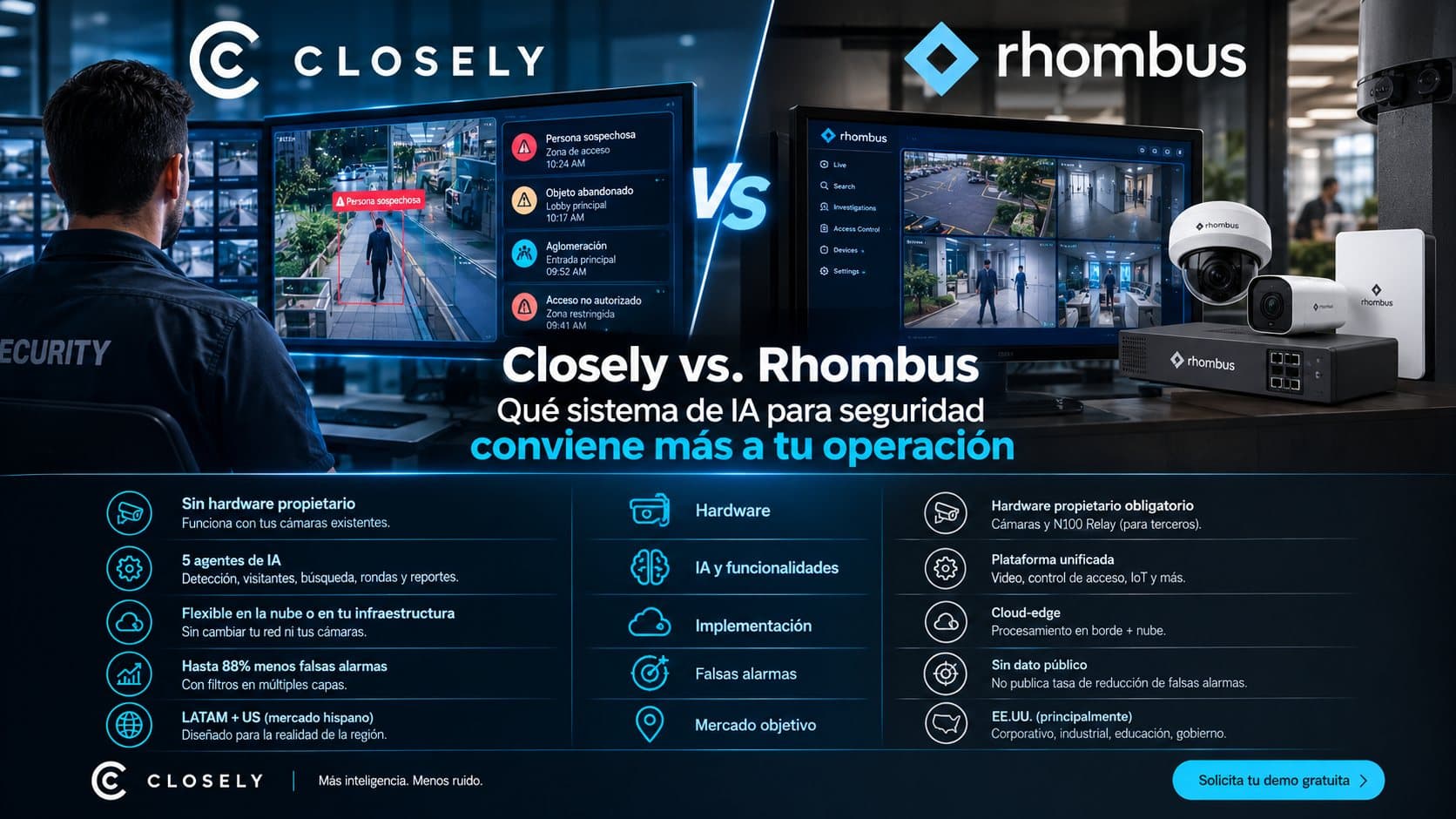
If you're evaluating AI security platforms, at some point you'll compare Closely and Rhombus. Both use artificial intelligence, both promise to reduce false alarms, both talk about scalability. But once you get into the details, the difference is fundamental: one was designed for you to buy its proprietary hardware, and the other was designed for you to use yours.
This Closely vs. Rhombus comparison isn't theoretical. It's an honest review of what each platform offers, what it does well, what it doesn't, and when it makes sense to choose one over the other. If you operate in Latin America or have sites with cameras already installed, this analysis will save you a lot of time and money.
What Rhombus Is and How It Works
Rhombus is a cloud-managed physical security platform developed in the United States. Its architecture is cloud-edge: cameras process part of the information locally and send data to the cloud, which allows them to operate with limited connectivity and lower latency.
The system includes its own cameras (dome, bullet, fisheye, multisensor), access control, IoT sensors, and alarm monitoring with human verification. It has more than 50 integrations and an API.
But there's a detail its pricing page states very clearly: "All of our cameras require an ongoing license to operate." That isn't a software model: it's a subscription model on top of proprietary hardware, which creates an ongoing dependence on the vendor.
The prices published on its site give a sense of the size of the financial commitment per camera:
- R120 dome camera (2MP): $399 in hardware + annual license. First-year total: $548
- R410 dome camera (8MP): $1,499 in hardware + license. First-year total: $1,648
- R600 multisensor camera: $3,299 in hardware + Enterprise license. First-year total: $3,948
- N100 Relay (to connect third-party cameras): $2,999 in hardware + a license per camera
For a site with 20 mid-range cameras, the first-year entry cost in hardware plus licenses can exceed $30,000 USD. And that's before configuration, installation, and integration.
Rhombus makes sense for large companies in the United States that are starting from scratch, have significant capex budgets, and want a unified solution with certified hardware. It wasn't designed to operate in markets where existing infrastructure is the norm and budget is a real constraint.
What Closely Is and How It Works
Closely is an artificial intelligence platform for physical security operations designed to work on the infrastructure that already exists. It doesn't sell cameras. It doesn't require proprietary hardware. It connects via RTSP and ONVIF to any IP camera on the market: Hikvision, Dahua, Axis, Bosch, Reolink, TP-Link Tapo, and any other that uses the industry's standard protocols.
That design decision is no small thing. It means a physical security company with 500 cameras installed can add Closely's artificial intelligence layer without changing a single camera, without investing in new hardware, and without the risk of being tied to a vendor to keep its own cameras working.
Closely runs on five autonomous agents that cover the full operating cycle:
Watcher analyzes video in real time and detects incidents before they escalate. With multi-layer filters for environmental conditions, object classification, behavior analysis, and cross-camera correlation, it reduces false alarms by up to 88% compared with conventional systems. The concrete operational result: one operator can monitor up to 100 sites at once.
Gatekeeper manages visitor and access flow autonomously. It identifies who arrives, notifies the responsible person via WhatsApp and a simultaneous phone call, and coordinates access without requiring a dedicated operator at every entrance.
Investigator transforms footage review. Instead of manually reviewing hours of video, the operator describes in natural language what they're looking for and gets the relevant clips in minutes.
Supervisor tracks security staff patrols in real time, verifying that rounds are completed within the times and frequencies each client defines.
Reporter automatically documents every event with a timestamp, description, cameras involved, and actions taken, generating the traceability record corporate clients and auditors need.
Closely vs. Rhombus: Head-to-Head
| Criterion | Closely | Rhombus |
|---|---|---|
| Hardware required | None. Works with any existing IP camera | Its own cameras; for third-party cameras, N100 Relay ($2,999) |
| Pricing model | Software on existing infrastructure | Hardware + mandatory per-camera license, from $548 per camera in the first year |
| Compatibility | Universal RTSP/ONVIF (Hikvision, Dahua, Axis, Bosch, Reolink, etc.) | Rhombus's own camera ecosystem |
| False alarm reduction | Up to 88% vs. conventional systems | AI detection, no published reduction rate |
| Capacity per operator | Up to 100 sites per operator | Not published |
| Autonomous agents | 5 agents (Watcher, Gatekeeper, Investigator, Supervisor, Reporter) | Alarm monitoring with human verification |
| Search in recordings | Natural language (Investigator) | AI-powered search |
| Notifications | WhatsApp + simultaneous phone call | Platform alerts |
| Rule configuration | Unlimited, configurable by industry and site | Predefined AI detections |
| Market | LATAM and U.S., operators with existing infrastructure | Mainly U.S., new installations with available capex |
| Free trial | 2 weeks on your current cameras | Free trial available |
The Difference That Matters Most in LATAM: The Hardware Model
In Latin America, the Closely vs. Rhombus comparison reaches a fairly clear conclusion from an economic standpoint.
Most physical security companies in LATAM operate mixed infrastructure that's already installed: Hikvision, Dahua, and other Asian-brand cameras with years of use, contracts with corporate clients who already own their hardware, and budgets where capex on new cameras isn't always viable or justifiable.
Rhombus requires proprietary hardware: buying its cameras, or paying $2,999 for an N100 relay at every site where you want to use third-party cameras, plus a license per camera. In an operation with 50 sites, that's an entry cost that can be prohibitive before any value has been proven.
Closely removes that problem by design. There's no hardware cost. There's no dependence on a manufacturer. There's no risk of your cameras depending on a license renewal to keep operating. The platform is installed on what you already have and starts generating value from the first week.
That doesn't mean Rhombus is a bad platform. For a company in the United States equipping brand-new sites from scratch, with available capex and a need for a certified hardware solution, Rhombus is a legitimate, well-built option.
But if you operate in LATAM, if you already have cameras installed, if you manage multiple clients with heterogeneous infrastructure, or if ROI needs to be provable in weeks rather than months, the equation changes completely.
Use Cases Where Each One Wins
When Rhombus makes more sense
- Companies in the United States equipping brand-new offices, campuses, or facilities
- Organizations that want hardware and software from the same vendor, with a 10-year warranty on cameras
- Multi-location operations with variable connectivity, where edge processing is critical
- K-12 or local government environments in the U.S. where hardware purchasing programs are already budgeted
When Closely makes more sense
- Physical security companies in LATAM with Hikvision, Dahua, Axis, or other brands already installed
- Operators managing multiple clients with heterogeneous infrastructure who need to scale without scaling headcount
- Sites where ROI needs to be proven quickly, with no capex on new hardware
- Any operation where false alarms are a real problem eating up operators' time
- Residential buildings, retail, hospitals, or airports that want intelligence on top of their existing infrastructure
- Security teams that need automatic documentation and traceability for audits
The Case for Existing Infrastructure
The Closely vs. Rhombus comparison makes one point very visible: in physical security, the hardware that already exists is an asset, not a problem.
Most platforms on the market treat existing cameras as an obstacle to work around with expensive adapters or replace with proprietary hardware. Closely starts from the opposite assumption: the cameras you already have installed are your infrastructure, and artificial intelligence should adapt to them, not the other way around.
That has huge practical implications for the sales process too. A security company presenting Closely to a corporate client isn't asking them to change their infrastructure. It's offering a layer of intelligence on top of what they already have. That conversation is much easier to have, faster to close, and cheaper to implement.
How to Evaluate Any AI Security Platform Before You Commit
Whether it's Closely, Rhombus, or any other AI security platform, these are the questions you should answer before signing:
- Does it require you to replace or buy the vendor's specific hardware?
- Do your cameras depend on an active software license to keep operating?
- How much does it cost to add a new site to the platform?
- Are detection rules configurable by industry, or a fixed catalog?
- How long does it take to become functional on existing infrastructure?
- What is the real false alarm rate at production sites?
- How many sites can a single operator monitor?
- Is there a no-commitment trial period on your current cameras?
Closely offers a free two-week demo on the cameras you already have installed. No infrastructure changes, no contract commitments, no new hardware.
Frequently Asked Questions: Closely vs. Rhombus
1. Can I use Closely with the cameras I already have installed?
Yes, as long as your cameras support RTSP or ONVIF. That's true of the vast majority of IP cameras on the market, including Hikvision, Dahua, Axis, Bosch, and Reolink. Closely connects to them directly, with no additional hardware.
2. Does Rhombus have autonomous agents like Closely's?
Rhombus offers alarm monitoring with human verification and AI detection for alerts. Closely has five autonomous agents (Watcher, Gatekeeper, Investigator, Supervisor, and Reporter) that cover the full operating cycle without requiring human intervention at every step.
3. Which has fewer false alarms, Closely or Rhombus?
Closely publishes a concrete figure: up to an 88% reduction in false alarms compared with conventional systems, thanks to several independent filtering layers. Rhombus doesn't publish a comparable rate on its site. For a real evaluation, the most useful thing is to test both in the same environment.
4. Does Rhombus work in Latin America?
Technically yes, but the proprietary hardware model with prices in U.S. dollars and the need for significant capex per site make the economics harder in LATAM. Closely was designed specifically to operate in markets where existing infrastructure is the norm and budget is a real constraint.
5. Do Rhombus cameras depend on the license to work?
According to its pricing page, all Rhombus cameras "require an ongoing license to operate." That means the cameras' operation is tied to keeping the subscription current, which creates an ongoing dependence on the vendor. With Closely, your cameras remain yours and work with or without the platform.
6. Can Closely replace Rhombus at a site?
If you already have IP cameras installed with RTSP or ONVIF support, Closely connects directly with no additional hardware. Implementation is faster and cheaper than with any platform that requires its own hardware.
7. How much does it cost to add a new site with Closely versus Rhombus?
With Closely, adding a new site with existing cameras has no hardware cost. With Rhombus, if the client already has cameras from other brands, they need at least one N100 Relay per site, at $2,999, plus a license per camera, in addition to Rhombus's own cameras if those are being installed.
8. Do both platforms allow searching historical recordings?
Yes, both offer AI search in recordings. Closely handles it through the Investigator agent, which lets you describe in natural language what you're looking for and get the relevant clips in minutes. Rhombus has AI-powered search built into its platform.
9. How quickly can Closely be deployed on existing infrastructure?
A basic deployment on existing cameras can be completed in days, not weeks. It doesn't require installing hardware, changing the network, or modifying existing cameras. Closely offers a free two-week demo so you can verify it on your own sites.
10. Which industries does each platform serve best?
Rhombus is especially positioned for multi-location retail, K-12 education, and government in the United States with its proprietary hardware. Closely is an AI security platform with specific configurations for retail, shopping centers, hospitals, residential buildings, airports, and critical infrastructure, operating in LATAM and the U.S. on any existing camera without additional hardware.
Want to see how Closely works on the cameras you already have installed? Request your free demo at closely.dev.