Security Guard vs. AI Cameras: What Each Option Really Costs in LATAM
A 24-hour guard post in Colombia costs over COP 17 million a month. Compare the cost of a security guard with AI cameras and remote reception.
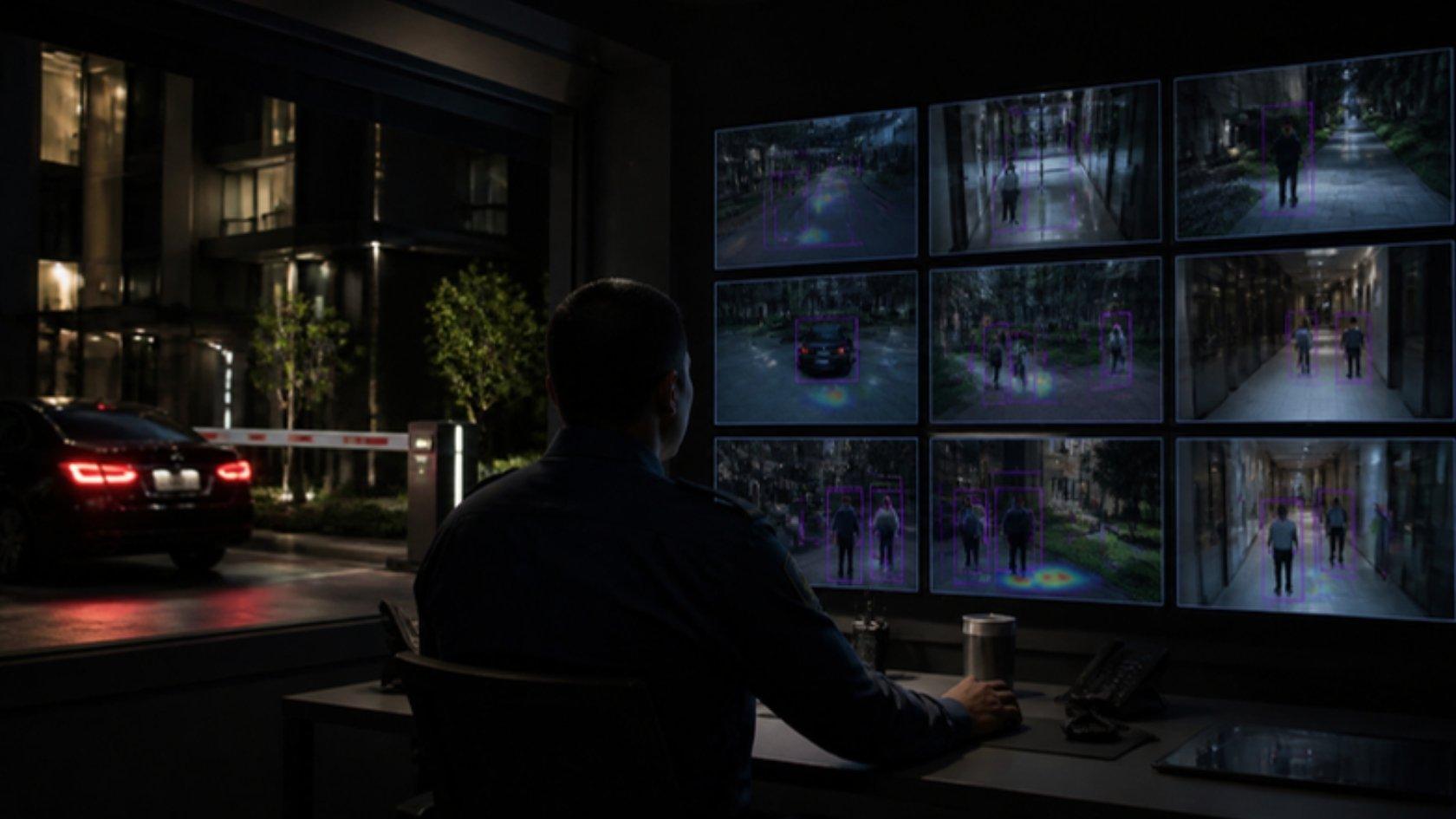
TL;DR: A 24-hour guard post in Colombia carries a 2026 minimum rate of more than 17 million pesos a month, over 205 million a year for a single post. AI cameras don't fully replace the security guard, but they change where it makes sense to have one: technology covers constant watching and the guard focuses on responding. Comparing the cost of guarding properly means looking at total cost, not just payroll.
How Much Does a Security Guard Cost in Colombia in 2026?
Let's start with what can be verified. Colombia's private security regulator, the Superintendencia de Vigilancia y Seguridad Privada, set minimum rates for 2026. As reported by outlets such as Noticias RCN, the base rate for a post in the first half of the year equals 9.77 monthly minimum wages, which comes to COP 17,106,341 per month, plus the life insurance premium. That figure is reported as the minimum rate for socioeconomic strata 4, 5 and 6.
Simple math: multiplied by twelve months, that is over COP 205 million a year. For one 24-hour post.
Why so high if the 2026 minimum wage is COP 1,750,905 plus a transport allowance? Because a 24/7 post can't be covered by one person. You have to cover shifts, nights, Sundays and holidays, rest days, uniforms, supervision, insurance and the security company's margin. That's why the cost of guarding weighs so heavily on the budget of a residential complex, a warehouse or a shopping mall.
And the trend points up. Publimetro reported early in the year that the cost of private guarding for residential complexes and businesses would rise more than 30% in 2026, and several outlets warned that the minimum wage increase would make private security services more expensive.
One important note: these are minimum reference rates. What you pay depends on your contract, your city, the type of post and the provider. Ask for formal quotes from companies licensed by the Superintendencia.
What About Mexico and the United States?
The pattern is similar across the region: labor is the heaviest component of a guard service. In the United States, the Bureau of Labor Statistics reported a median of US$17.82 per hour for security guards in May 2023, per its official occupational table. That's the employee's wage; what a contractor bills per hour is higher because it includes payroll costs, overhead and profit.
In Mexico, costs vary widely by state and by company, so we won't give you a single number. The honest approach is to get three quotes and compare them with the same scope (hours, number of guards, uniform, supervision).
The Real Problem Isn't Just What the Security Guard Costs
If you only look at the invoice, you miss the bigger point. A human security guard has limits that have nothing to do with effort:
- Can't watch everything at once. One person in front of a monitor with dozens of cameras doesn't see what's happening on most of them. Human attention runs out.
- Is in one place at a time. If there's an incident in the parking lot while they cover the entrance, they can't be at both.
- Gets tired of alerts. When a system produces false alarms all day, the operator stops believing it. That's the well-known false alarm fatigue.
- Costs more with every hour covered. More hours, more shifts, more payroll. There are no economies of scale inside a single post.
None of this is a criticism of guards; it's a design problem. We ask people to do machine work (stare without blinking) and also react like humans.
How Surveillance With AI Cameras Works
An AI camera platform works on top of the cameras you already have. You don't need to replace your system: it connects over RTSP/ONVIF or to your NVR, with brands like Hikvision, Dahua, Axis, Bosch or Reolink.
The idea is simple. The AI reviews every camera all the time, filters out what's irrelevant and alerts only when something deserves attention: a person where they shouldn't be, access at an unusual hour, a vehicle stopped in a restricted zone. A human operator validates the alert before anyone is dispatched.
With Closely, multi-layer filters cut false alarms by up to 88%, and a single operator can monitor up to 100 sites. Rules are written in plain language, for example "alert me if anyone enters the warehouse after 10 p.m." To see how that works, read our article on AI motion detection and false alarms.
There's an honest caveat: the AI detects and alerts, but it can't physically stop anyone. If there's an intrusion, someone has to respond. So the right question isn't "guards or cameras" but "where do I put each one."
Remote Reception: The Middle Ground Between Guard and Camera
For buildings and residential complexes, remote reception is the option discussed most. An operator at a central station handles several lobbies: sees who arrives, speaks with the visitor by intercom or video, checks with the resident and opens access. It replaces permanent physical presence with remote attention.
The potential savings are significant because a 24/7 post is replaced by a service shared across several properties. But it isn't automatic: it depends on infrastructure (access control, intercoms, cameras), the owners' assembly and local regulation. We go deeper in our piece on remote reception in Bogotá.
An Honest Comparison: What the Cost of Guarding Looks Like in Each Model
Here is a qualitative comparison. We don't show Closely prices because pricing depends on how many cameras and sites you have. The guard side is what we verified.
| 24/7 guard | AI cameras + monitoring | Hybrid model | |
|---|---|---|---|
| Main cost | Payroll per shift (Colombia: over COP 17 million/month per 24 h post, 2026 minimum rate) | Platform + monitoring, scales with cameras and sites | Fewer guard hours + platform |
| Visual coverage | Limited to what one person sees | Every camera, all the time | Every camera + physical presence where it matters |
| Physical response | Immediate, on site | Needs dispatch or a nearby guard | Guard at critical points or patrol |
| Deterrence | High (visible presence) | Medium (cameras + voice/alerts) | High where needed |
| Scalability | Linear: more posts, more cost | One operator, many sites | Intermediate |
When to Keep the Guard
- Sites with high risk of physical confrontation or very high-value assets.
- Access control where in-person attention is required by contract or rule.
- Places where visible presence is part of the service (hospitals, shopping malls).
When AI Makes More Sense
- Facilities with many cameras and too few people to watch them.
- Sites with long stretches of low activity, such as warehouses at night or parking lots.
- Multi-site operators who can't watch everything at once today.
In practice, what we see most often is a hybrid: fewer fixed guard hours during quiet periods, technology for constant watching, and people to respond when something happens. For the broader cost picture, see how AI lowers the cost of business security systems.
What to Calculate Before You Decide
Before changing anything, make this list of your current cost of guarding. It takes an afternoon and prevents bad decisions.
- Your actual current cost. Add up what you pay for guarding each month, including surcharges, insurance and supervision, and multiply by twelve.
- How many hours are truly critical. Do you need someone 24 hours, or are there windows where an AI camera and a patrol are enough?
- Which cameras you already have. If they exist, hardware investment can be zero.
- Who responds when an alert fires. Detection without response is useless. Decide whether it will be a guard, a monitoring center or the police.
- Your incident history. How many incidents, at what hours and where. That tells you where your risk is.
- Legal or contractual constraints. In some sites, regulation or the insurance policy requires physical presence.
How to Test It Without Compromising Security
You don't have to bet everything at once. The reasonable move is to test one site or one time window. Closely offers a free 2-week demo on your current cameras: you see how many false alarms get filtered, which real events it catches and how that compares with your current operation. To price it with your own numbers, book your demo at closely.dev.
Frequently Asked Questions
How much does a 24-hour security guard cost in Colombia in 2026?
The minimum rate set by the Superintendencia for the first half of 2026 is COP 17,106,341 per month for a 24-hour post, plus the life insurance premium, as reported by the press. Your contract may differ by stratum, city and provider, so it's best to ask for a formal quote.
Can AI cameras fully replace security guards?
Not entirely. AI watches and alerts, but it can't intervene physically. The most common setup is a hybrid: fewer fixed guard hours and more technology support, with someone to respond when a real alert comes in.
What is remote reception and is it cheaper than a 24-hour doorman?
It's a service where an operator handles several lobbies remotely from a central station. It can reduce cost compared with a permanent doorman, but it depends on the building's infrastructure, what the owners' assembly approves and applicable regulation.
How much does an AI camera solution cost?
It depends on the number of cameras, sites and level of monitoring. That's why we don't give a single figure: ask for a quote and compare it with your current annual cost of guarding.
Do I need to buy new cameras to use AI?
Usually not. Closely works on the cameras you already have, over RTSP/ONVIF or NVR, with no proprietary hardware. Quality depends on each camera's angle and resolution.
What happens with false alarms if I use AI cameras?
False alarms are one of the main problems of traditional systems. With multi-layer filters, Closely cuts false alarms by up to 88%, and the operator validates every alert before dispatch.
How many sites can one person monitor with AI?
With Closely, one operator can monitor up to 100 sites because the AI filters first and shows only what's relevant. Without that filtering, the practical limit is much lower.
Is it legal to replace a guard with cameras?
It depends on the type of site, the contract and local regulation. In some cases the law, the insurance policy or a property's bylaws require human presence. Check with your legal advisor and insurer before deciding.
How long does it take to deploy an AI camera system?
Because it connects to existing cameras, there's no construction or equipment replacement: we're talking weeks. With the free 2-week demo you can see results on your own operation.
How do I know if the hybrid model suits me?
Work out your current cost, identify your highest-risk hours and count how many cameras have no real supervision. If you have many cameras, long low-activity hours and someone able to respond, the hybrid model is usually the most reasonable starting point.
The Bottom Line
The debate isn't guard versus cameras; it's how to combine people and technology to spend better. With a minimum rate above COP 17 million a month for a 24-hour post in Colombia, it's worth reviewing where a security guard adds the most and where AI cameras can cover constant watching. To see the numbers on your own operation, start your free demo at closely.dev.