Business Security Systems: Why Costs Keep Rising — and How AI Is Finally Bringing Them Down
Physical security incidents cost companies an average of $9M in lost revenue. Budgets are rising — but the answer isn't more of the same. Here's how AI changes the cost equation.
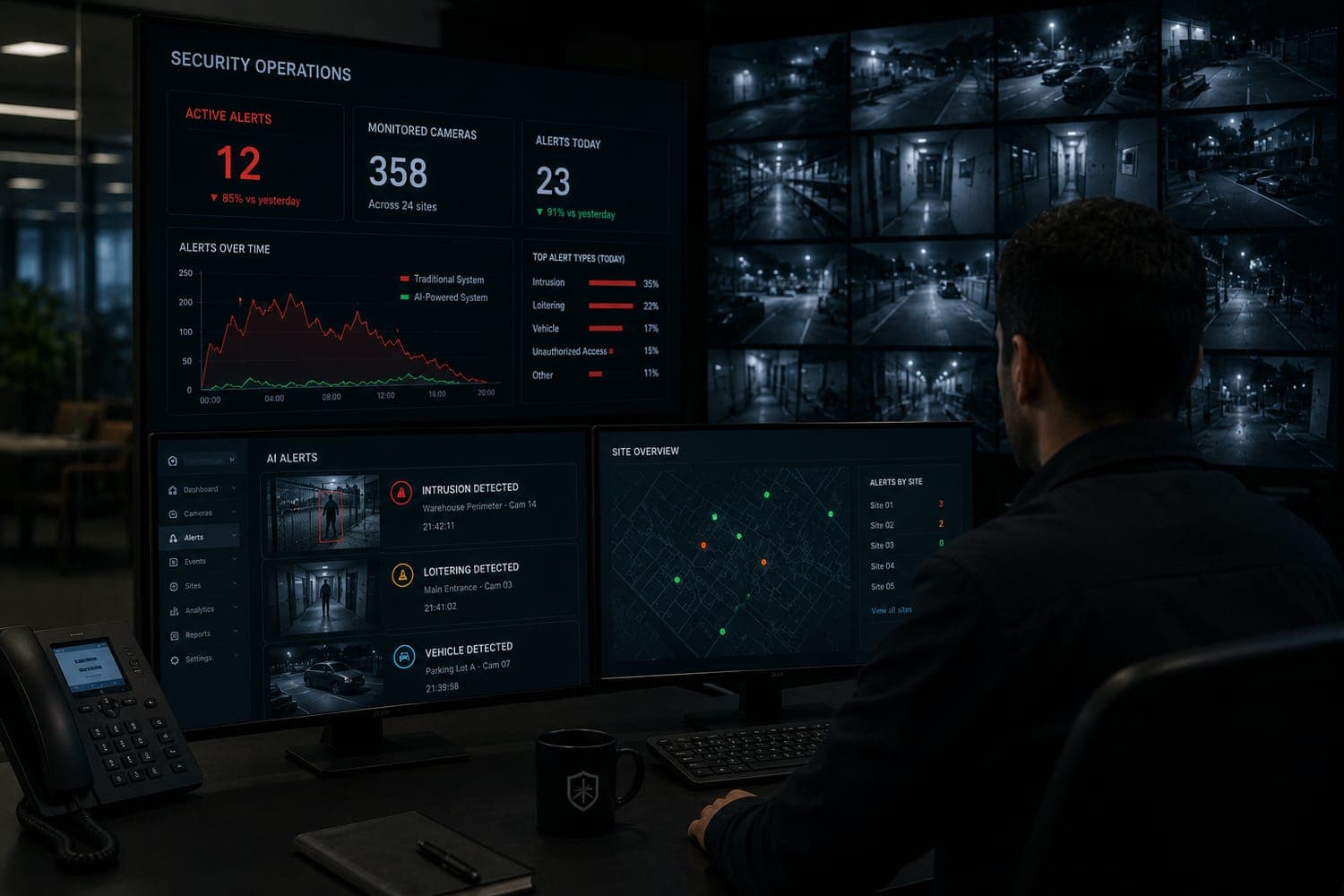
Companies that experience a physical security incident lose an average of $9M in revenue, and two-thirds of security chiefs expect their budgets to rise. But spending more on the same labor-heavy model isn't working. AI monitoring breaks the linear "more cameras = more operators" cost curve — letting one operator cover 3-5x more feeds by eliminating false positives. Here's what the 2026 data says and how the cost math actually works.
Security budgets are going up. Incidents are getting more expensive. And the old model of throwing more guards and cameras at the problem is running out of road. Here's what the data actually says — and what smart businesses are doing differently.
The uncomfortable truth about business security costs in 2026
Let's start with a number that should bother any business owner or security manager: companies that experience a physical security incident lose an average of $9 million in revenue, according to the 2026 World Security Report, which surveyed 2,352 chief security officers across 31 countries.
That's not the cost of fixing the damage. That's revenue — gone. And it gets worse for publicly listed companies: institutional investors surveyed in the same report say a significant security incident reduces company value by an average of 32%. That's a valuation hit that can take years to recover from.
The response most companies have to this reality? Spend more. Two thirds (66%) of CSOs globally say they expect their business security system budgets to increase in the next year. In Latin America, that number climbs to 72%. In the United States, 64%.
More spending on security makes sense when incidents are expensive. What doesn't make sense is spending more on the same approaches that weren't working well enough in the first place. And that's the trap a lot of organizations are stuck in — increasing headcount, adding more cameras, buying more monitoring software — without changing the fundamental model.
The businesses that are getting ahead of this aren't spending less. They're spending differently. AI and modern surveillance technology for business is changing the cost equation in ways that weren't possible three years ago.
Where business security money actually goes — and where it's wasted
The labor problem nobody wants to talk about
The dominant cost driver in any serious business security system isn't hardware. It's people. Security guards, monitoring operators, SOC staff — human labor is what makes a security operation run, and it's expensive, inconsistent, and fundamentally hard to scale.
Here's the operational reality: a security operator in a monitoring center can realistically watch 6 to 8 camera feeds with genuine attention at any given time. The average mid-sized security operation has 30 to 100 feeds running per operator. That means somewhere between 75% and 90% of what's on those screens at any given moment isn't actually being watched.
You're paying for 24/7 coverage. You're getting something significantly less than that.
The math gets even starker when you look at the LATAM market. A security employee in Latin America costs roughly $20 per hour. One operator monitoring 30 cameras works out to approximately $480 per camera per month in labor costs — just for the monitoring function, not counting management, equipment, or overhead. That's the baseline cost of the status quo.
The false positive problem compounds this further. Modern alarm systems and motion-triggered cameras generate enormous volumes of alerts — the overwhelming majority of which turn out to be nothing. A car in a parking lot. Wind moving a branch. A cleaning crew at 3am. When operators are drowning in meaningless alerts, two things happen: they get slower at responding to everything, and they start mentally discounting the alert stream — which is exactly when real incidents slip through.
The hidden costs that don't show up in the security budget
Beyond the direct costs of operating a security system for businesses, there's a layer of costs that tend to get absorbed elsewhere in the organization:
Incident response costs — When something does go wrong, the labor required to investigate, document, coordinate with authorities, and follow up is substantial. Without structured incident data, every investigation starts from scratch — reviewing hours of footage, reconstructing timelines manually, trying to piece together what happened from fragmented sources.
SLA failures and client churn — For security companies managing multiple client accounts, a missed incident or slow response can terminate a contract. The cost of that client loss — and the reputational damage that follows — dwarfs the cost of the incident itself.
Underutilized camera infrastructure — Most organizations have invested significantly in cameras and recording equipment. A large proportion of that infrastructure generates footage that is never reviewed, never analyzed, and generates no operational value unless something goes wrong. You've paid for the infrastructure; the AI analytics layer is what makes it actually work.
Compliance and documentation gaps — In regulated industries, incomplete incident documentation creates legal and financial exposure. Manual record-keeping is inconsistent, prone to error, and difficult to audit. Security monitoring for businesses that relies on manual logs frequently has gaps that create liability.
What 66% of security budgets are being redirected toward
The 2026 World Security Report is clear about where security investment is heading. The top three budget priorities for CSOs globally are:
New security technology and infrastructure — cited by 47% of CSOs as a top priority. In LATAM, that number rises to 49%. Sub-Saharan Africa leads at 71%.
Employee security training and upskilling — 45% globally, reflecting the growing recognition that technology is only as effective as the people operating it.
Security risk assessments and threat intelligence analysis — 44% globally, as organizations shift from reactive to proactive security postures.
And when asked what factors are driving technology adoption, cost reduction is one of the top answers — specifically reducing labor, equipment, and maintenance costs. The framing has shifted: AI security for businesses isn't a premium add-on for organizations with big budgets. It's increasingly the cost-reduction play for organizations trying to do more with what they have.
In Latin America, 46% of CSOs cite AI-powered video surveillance and analytics as a crucial technology for the next two years — above the global average of 45%. In North America, that figure is 43%, with the highest adoption anticipated in pharmaceuticals (56%) and real estate (56% for AI threat detection).
The signal is consistent across markets: the organizations that will have lower security costs in 2027 are the ones investing in AI and automation now.
How AI surveillance technology actually reduces business security costs
Fewer false positives, better alert quality
The single most direct cost reduction from AI surveillance technology for business is false positive elimination. A well-designed AI detection system doesn't alert on every motion event — it classifies what's happening, assigns a confidence score, and only escalates to a human operator when the event is genuinely anomalous given the location, time of day, and historical patterns for that site.
The practical result is that operators go from managing 200+ raw alerts per shift to managing 10-20 genuinely relevant events. That's not an incremental improvement — it changes what's possible. One operator can effectively cover more sites. Response quality improves because operators aren't fatigued by noise. Real incidents get caught because the signal is no longer buried in irrelevant triggers.
Scale without proportional headcount growth
Traditional business security systems scale linearly: more cameras and more sites require more operators, more managers, more shifts to cover. There's no efficiency gain from adding a 101st camera to a monitoring operation — it just means another person needs to watch another screen.
AI monitoring breaks that linear relationship. The platform monitors every feed simultaneously regardless of how many there are. Adding a new client site doesn't require hiring another operator — it requires onboarding another camera connection. For security companies managing large portfolios, this is the difference between a business that scales profitably and one that grows revenue while growing costs at the same rate.
Faster response, lower incident cost
The 2026 World Security Report found that 93% of security decision-makers plan to use technology to improve incident response — specifically to reduce impact and accelerate recovery. The economic logic is straightforward: a security incident caught in 30 seconds has a fundamentally different outcome than one caught 8 minutes later.
AI security for businesses compresses the detection-to-alert timeline from minutes to seconds. When a perimeter breach begins at 2:47am, the operator knows at 2:47am — not when they happen to glance at the right screen. That timing difference is what turns a foiled intrusion into a successful one, or a minor shoplifting incident into a significant inventory loss.
Structured data that creates operational leverage
Every AI-validated incident is a data point. Timestamp, location, type, severity, response, outcome. Individually, those data points are useful for investigation and documentation. Aggregated over months across dozens of sites, they become something much more powerful: a pattern intelligence layer that tells you which sites have the highest incident frequency, which time windows are highest risk, which detection types are overrepresented, and where preventive action would have the most impact.
This operational intelligence — which manual security monitoring for businesses never generates at scale — lets security managers make deployment decisions based on evidence rather than intuition. Guards go where the data says they're most needed. Camera angles get adjusted based on actual incident patterns. Client SLA commitments are backed by documented performance, not estimates.
The ROI calculation that makes AI security hard to argue against
Let's make the math concrete for a mid-sized security operation.
Assume a security company with 500 monitored cameras across 20 client sites. At $480 per camera per month in labor costs (the LATAM benchmark — lower but directionally similar in the US), that's $240,000 per month in monitoring labor alone.
AI monitoring doesn't eliminate the human operators — it makes each operator dramatically more effective. An operator using AI-assisted monitoring can cover 3 to 5 times the camera count of an operator doing purely manual monitoring, based on the alert-volume reduction alone. That translates to needing 60-70% fewer monitoring staff for the same camera fleet — a labor cost reduction of roughly $144,000 to $168,000 per month in that scenario.
The AI platform cost sits on top of that — but the gap between the platform cost and the labor savings is where the ROI lives. For most mid-to-large security operations, that gap is substantial from month one.
And that's before accounting for the incident-prevention value, the SLA improvement, the client retention benefit, and the structured data that opens up new revenue opportunities in insurance underwriting, logistics risk scoring, and government safety contracts.
How Closely is built around reducing security operating costs
Closely is designed from the ground up around the economics of security operations — not the technology for its own sake, but what the technology does to the cost structure and the revenue potential of a security business.
The platform connects to any existing camera infrastructure — Hikvision, Dahua, Axis, Hanwha, Avigilon, and any other manufacturer with IP connectivity — without requiring hardware replacement. It runs a three-tier detection pipeline: motion filtering, computer vision object classification, and AI behavioral reasoning. The result is that only events with genuine anomaly indicators reach SOC operators, eliminating the false positive volume that drives alert fatigue and operational inefficiency.
For security operators managing multiple client sites from a centralized SOC, Closely provides a unified interface across the entire portfolio. Every alert is pre-validated and contextualized. Every incident generates structured data — timestamped, classified, linked to visual evidence — that feeds into client reporting, SLA management, and over time, into the kind of risk intelligence layer that institutional clients like insurers and logistics companies are increasingly willing to pay for.
The business case is straightforward: Closely enables security operators to cover more cameras, more sites, and more clients with the same or smaller monitoring team — while delivering better detection quality and better documentation than the manual approach they're replacing.
For businesses evaluating whether to add AI to their security system, the question isn't whether the ROI is there. The 2026 World Security Report, the incident cost data, and the labor math all point in the same direction. The question is which platform to evaluate first.
Closely is running active pilots with security operators across Latin America and evaluating expansion into the US market. If reducing your security operating costs while improving detection quality is the goal, it's worth a conversation.
Frequently Asked Questions
Why are business security costs increasing even as technology gets cheaper?
The core issue is that most business security systems still rely heavily on human monitoring labor, which keeps getting more expensive regardless of camera or hardware costs. More sites, more cameras, and higher threat levels mean more operators are needed — and the cost scales linearly. AI and surveillance technology for business breaks that linear relationship by multiplying the effective coverage of each human operator, which is why organizations investing in AI are seeing costs stabilize or decrease even as their security capabilities improve.
How much does a physical security incident actually cost a business?
According to the 2026 World Security Report, companies that experience a physical security incident lose an average of $9 million in revenue. For publicly listed companies, the impact is even more severe — institutional investors say a significant security incident reduces company value by an average of 32%. The cost of proactive security investment almost always looks small relative to these figures, which is part of why 66% of CSOs globally expect their security budgets to grow.
What is the biggest driver of unnecessary cost in a business security monitoring operation?
False positives — alerts that turn out to be nothing. Traditional motion-triggered systems generate enormous volumes of irrelevant alerts that operators have to review and dismiss. This creates alert fatigue (operators start ignoring the alert stream), slows response to genuine events, and requires more operator hours per camera than an AI-filtered system. AI security for businesses that uses behavioral classification and confidence scoring — rather than raw motion triggers — reduces false alert volume by 50-80% in typical deployments, which is where the most immediate cost savings come from.
Can AI reduce the number of security guards or operators a business needs?
AI monitoring doesn't typically eliminate the need for human operators — it multiplies their effective coverage. An operator using AI-assisted security monitoring for businesses can cover 3 to 5 times the camera count of an operator doing purely manual monitoring, because they're only reviewing validated alerts rather than watching raw feeds. For a security company managing hundreds of camera sites, this means significantly fewer monitoring staff are needed for the same camera fleet — typically a 50-70% reduction in monitoring labor for equivalent or better detection quality.
What percentage of security budgets are going toward AI and new technology in 2026?
The 2026 World Security Report found that investment in new security technology and infrastructure is the top budget priority for 47% of CSOs globally — 49% in Latin America. Among the specific technologies, AI surveillance technology for business (AI-powered video surveillance and analytics) is considered crucial for the next two years by 45% of CSOs globally, 46% in LATAM, and 43% in North America. The consistent trend across both markets is a shift from labor-heavy reactive security toward technology-driven proactive security.
How does AI security technology pay for itself in a business context?
The ROI comes from three main sources: labor cost reduction (fewer operators needed per camera), incident cost reduction (faster detection means smaller incident impact), and operational leverage (structured incident data enables better deployment decisions and new revenue opportunities). For a security operation managing 500 cameras, reducing operator requirements by 60-70% through AI assistance represents hundreds of thousands of dollars per month in labor savings — typically well above the platform subscription cost. The specific ROI depends on current labor costs, camera count, and incident frequency, but the direction of the calculation is consistently favorable for operations above roughly 50 cameras.
What types of businesses benefit most from AI-powered surveillance systems?
Any business where security monitoring involves more cameras than a human team can realistically watch simultaneously. In practice, this includes: security companies and monitoring centers managing multiple client accounts, logistics and warehouse operators with large perimeters and limited guard coverage, retail chains with multiple locations, corporate campuses and office parks, residential building complexes in both the US and Latin America, and industrial facilities with extensive perimeter coverage requirements. The larger the camera fleet and the more sites involved, the more pronounced the ROI from AI security for businesses.
Does adding AI to a business security system require replacing existing cameras or equipment?
No — and this is one of the most important practical points. Modern AI surveillance technology for business is designed to connect to existing camera infrastructure via standard protocols (RTSP and ONVIF), which are supported by virtually all IP cameras from major manufacturers including Hikvision, Dahua, Axis, Hanwha, and Avigilon. The AI layer sits on top of existing cameras and recorders without requiring hardware replacement. For most businesses, adding AI monitoring is a software subscription decision, not a capital equipment project. Platforms like Closely are specifically built around this principle.
How does AI security help with compliance and incident documentation requirements?
Every incident processed by an AI security monitoring for businesses platform generates structured data automatically: timestamp, location, incident type, confidence score, camera evidence, operator response, and resolution time. This replaces manual log entries — which are inconsistent, incomplete, and difficult to audit — with machine-generated records that are complete, searchable, and verifiable. For regulated industries, this documentation quality reduces legal exposure. For security companies with contractual SLA commitments to clients, it provides the audit trail to prove compliance.
How does Closely help businesses reduce security operating costs specifically?
Closely reduces security operating costs through three mechanisms. First, it eliminates false positive volume — operators only review AI-validated events rather than raw motion alerts, multiplying effective coverage per operator. Second, it enables centralized monitoring of multiple sites from a single interface, reducing the per-site overhead for security companies managing diverse client portfolios. Third, every incident Closely processes generates structured data that accumulates into an operational intelligence layer — enabling evidence-based deployment decisions, automated client reporting, and new revenue opportunities from institutional data licensing. The combined effect is a business security system that costs less to operate and generates more intelligence than the manual alternative it replaces.