Holiday Security for Retail Stores and Shopping Malls: Get Your AI Cameras Ready for December
December multiplies crowds, temp staff and theft. What to check on your cameras now, and how AI cameras help with retail and mall security.
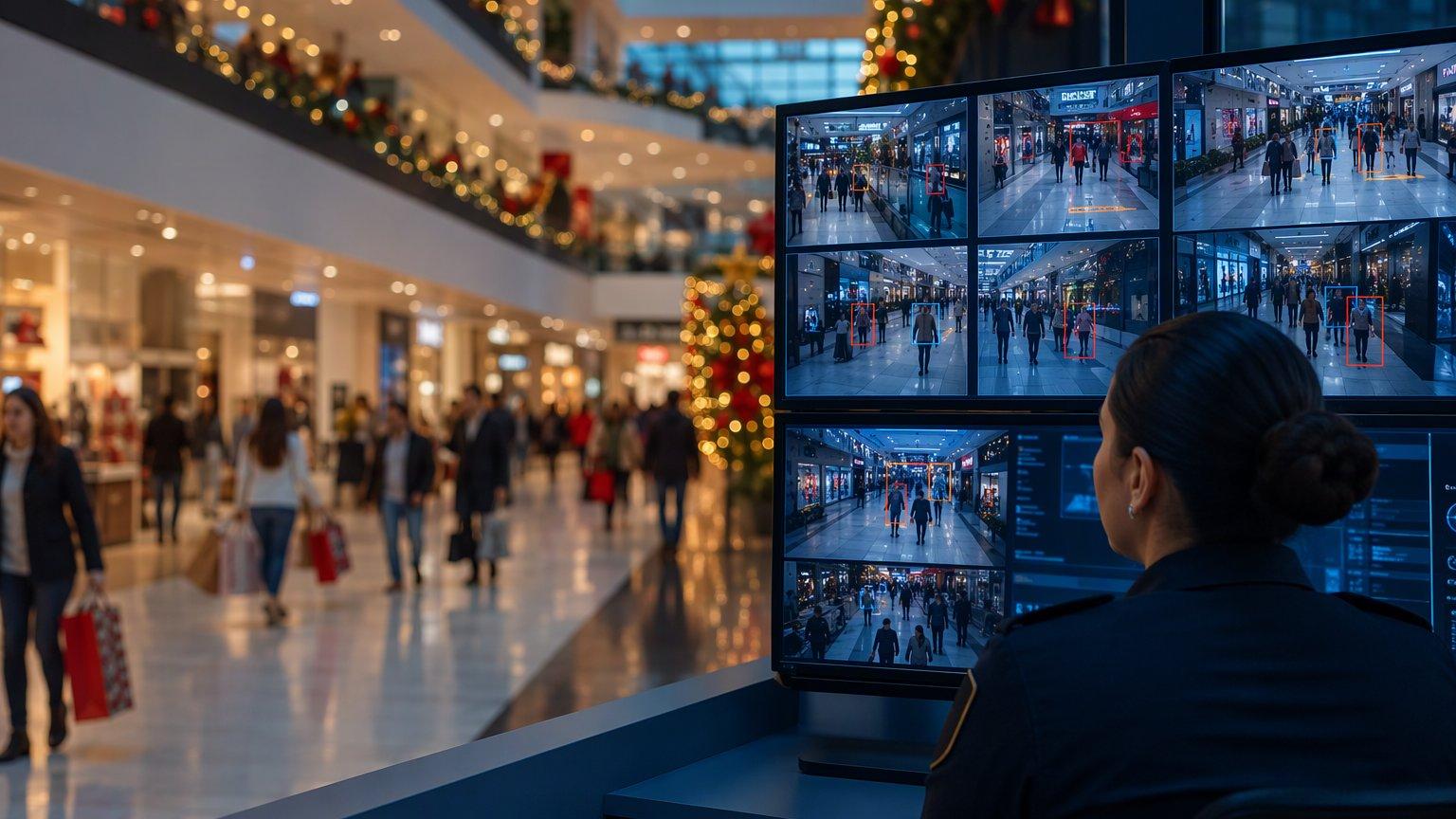
TL;DR: December is when retail and shopping mall security gets stretched the thinnest: bigger crowds, seasonal hires, longer hours and tired operators. The best use of the weeks you have left is to check that your cameras actually record, define what "normal" looks like in each zone, and use AI cameras so your team only looks at what matters. Here is a practical list of what to get ready before the holiday season starts.
Why holiday season security is different from the rest of the year
Anyone who has run a store or a mall in December knows it is not a normal month with more sales. It is a different operation.
Bonuses and gift shopping bring more people carrying bags, longer lines and more distraction. Opening hours stretch. Seasonal staff join before they know the store. And security teams, already lean, have to cover more with the same people. Authorities see it the same way: in Colombia the police regularly warn that reports of theft and fraud rise at this time of year, and in Mexico City authorities have stepped up presence at shopping centers in December.
So December theft is not a new crime. It is the usual crimes under conditions that favor them: crowds, noise and divided attention.
Three things change during the holiday season:
- Volume. An aisle that is usually empty is packed. One suspicious person is now one in two hundred.
- People. New guards, cashiers and stock clerks who cannot yet tell normal from odd.
- Attention. Operators watch more cameras, for more hours, with more noise.
If you want to see how foot traffic can be measured with the cameras you already own, read our guide for shopping malls at Christmas. Here we focus on security.
Before December: the camera check almost nobody does
The costliest failure in retail security is not a camera that dies in December. It is finding out in January, when you need the footage and it does not exist. So this month, run this basic check:
- Offline or blocked cameras. Look for cameras that are disconnected, dirty or moved. A camera pointing at the ceiling records nothing useful.
- Retention days. Confirm how many days your NVR really keeps. More cameras and more motion in December fill the disk faster.
- Date and time. It sounds silly, but footage with the wrong clock loses value as evidence.
- New lighting. Blinking holiday lights and reflective decorations confuse many cameras. Check how they look at night.
- Blind spots. Pop-up kiosks, sales islands and large decorations create areas that did not exist in October.
This takes a couple of days and prevents the worst surprise of the season. If you already have cameras and an NVR, you do not need to replace anything: you need to know what shape they are in.
How AI cameras help when crowds are bigger than usual
Here is the core problem. If an operator has to watch forty screens full of people, they see nothing. AI cameras do not replace human judgment, but they do the first pass.
Instead of asking your team to watch everything all the time, the AI analyzes the video and raises a hand when something falls outside what is expected: someone loitering near a high-value area, a person lingering too long in an aisle, someone entering a restricted zone, a service door open at odd hours. The operator reviews those alerts and decides whether to dispatch.
That is what Closely does. It runs on the cameras you already have (Hikvision, Dahua, Axis and others over RTSP/ONVIF), with no proprietary hardware. If you want to see it on your own cameras, you can try Closely on your current system before the season begins.
The key for December is filtering. A system that alerts on everything on a normal day becomes unmanageable at Christmas. Closely uses multi-layer filters and reports up to 88% fewer false alarms, precisely so the team does not end up ignoring alerts when it matters most. For more on this, see our article on why false alarm fatigue wrecks operations.
Which rules to set up for the holiday season
With AI you do not program anything complicated: rules are written in plain language. Useful examples for retail and shopping mall security during the holiday season:
- High-value zones (jewelry, electronics, liquor, toys): alert if someone stays beyond a set time without engaging with the merchandise.
- Warehouses and loading areas: alert on presence outside delivery hours. In December a lot of inventory comes in, and more leaves than is recorded.
- Emergency exits and service doors: alert if they open with no scheduled delivery or shift.
- Registers and checkout: review unusual events during peak line hours.
- Parking lots: alert on people walking rows of cars without entering a vehicle, common when cars are loaded with gifts.
- Closing: an automatic closing round to confirm nobody stayed inside.
A practical tip: do not switch on every rule on day one. Start with four or five, watch how many alerts they generate for a week and tune them. That way you arrive in December with a tuned system instead of calibrating it in the middle of peak sales.
Small-item theft and organized theft: two problems, one approach
Retail stores face two kinds of loss that look nothing alike during the holiday season.
Small-item theft is the little stuff: a shirt, a perfume, a product that leaves in a bag. Each case is small, but it adds up, and in December it hides better in the crowd.
Organized theft involves groups with roles: one distracts, one takes, one waits outside. It exploits the fact that seasonal staff and long lines hide the pattern.
Both share something: they are rarely caught by watching one camera at one moment. They are caught when someone connects that the same person walked through three zones and bought nothing, or that the same group came back in. That connection is hard for a human with forty screens, and it is what an AI platform does well. For a look at what this looks like in Mexico City retail, read business theft in CDMX.
When an incident happens: evidence is everything
If a theft occurs, what matters is proving it quickly. Two things help a lot:
- Natural-language search. Instead of scrubbing hours of video, you type "person in a red jacket who left through the side door around 7 p.m." and the system takes you to the relevant moments. That is the Closely Investigator agent.
- Automatic reports. An incident documented with date, time, camera and clip is easier to hand to an insurer and to the authorities. The Reporter agent builds it so nobody has to write it at the end of a twelve-hour shift.
Remember that any use of video must respect personal data rules in your country. If you operate in Colombia, review Law 1581 and AI video.
Quick checklist for the week before December
- Cameras checked, clean and aimed correctly.
- Retention days confirmed.
- Date and time synchronized.
- Four or five AI rules active and tuned.
- Seasonal staff briefed on which zones are critical.
- Clear protocol: who gets the alert, who validates, who goes to check.
- Insurer and authority contacts on hand.
If you want help prioritizing, request a free 2-week demo at closely.dev and see how it performs on your real cameras before the sales peak.
Frequently Asked Questions
When do retail thefts start rising during the holiday season?
Usually from late November, when promotions and year-end bonuses arrive, and they intensify through December. That is why it pays to review cameras and rules in November, not the first week of December.
What should I check first on my cameras before December?
That every camera is recording, pointing at the right place, has the correct time, and that the NVR keeps as many days as you think. It is the cheapest check and prevents the most problems.
Do AI cameras work if I already have a system installed?
Yes, if your cameras are IP and can connect over RTSP/ONVIF or through an NVR. Closely works on existing cameras from brands like Hikvision, Dahua or Axis, with no proprietary hardware.
How do I stop alerts from firing because of crowds in December?
With multi-layer filters and zone-specific rules instead of alerting on any motion, and by starting with a few rules you tune before peak traffic.
What is small-item theft and why does it rise at Christmas?
It is the theft of small, frequent items that add up to meaningful losses. It rises in December because crowds and lines make it harder for staff to notice.
Can I search recordings for an incident without watching hours of video?
Yes. With natural-language search you describe what you want (clothing, zone, approximate time) and the system takes you to the relevant clips.
Do I need more operators to cover December?
Not necessarily. The idea is that the same team sees only what is relevant. AI still does not replace human validation: the operator decides before anyone is dispatched.
How long does it take to get the system ready before the season?
The camera check takes a few days and tuning the first rules takes one or two weeks. Start now and you arrive with room to spare.
What do I do about seasonal security staff?
Give them a short list of critical zones, which alerts they may receive and who to notify. A one-page protocol beats a long training in the middle of the season.
How do I try Closely before deciding?
Closely offers a free 2-week demo on your current cameras. You can request it at closely.dev.
The Bottom Line
Retail and shopping mall security at Christmas is won in November, not December. Check your cameras, set a few clear rules and let AI do the first pass so your team reaches the holiday season peak in good shape. To see it running on your own system, book your free demo at closely.dev.