Business Theft in Mexico City: Why Robberies Keep Rising (and What Is Actually Working)
Business theft in Mexico City: INEGI data, employee theft, extortion and armed robbery, what the city is doing, and why AI video surveillance is changing it.
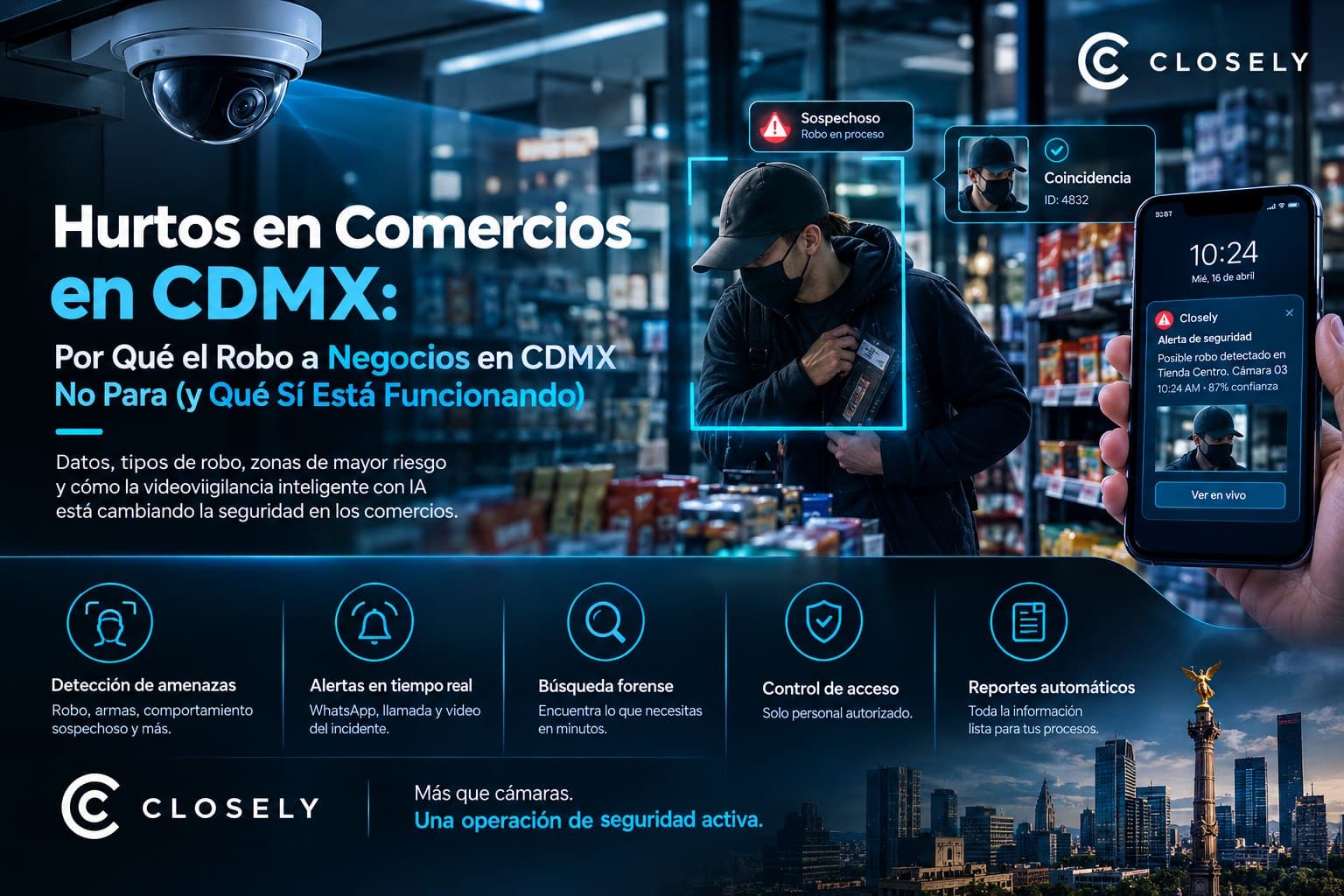
If you run a business in Mexico City, you probably already know what we're going to talk about before we say it. A neighbor whose cash register was emptied on a Sunday night. A cousin whose corner grocery store lost merchandise for months without anyone really knowing who was taking it. Or simply the news, which every week reports another case of business theft in Mexico City that ends in a viral video and, very rarely, in an arrest.
It isn't paranoia. The numbers confirm it. According to INEGI, Mexico's national statistics institute, in 2023 (the latest year with complete data from the National Survey of Business Victimization, the ENVE) 1.3 million businesses in Mexico were victims of a crime, and the total cost to companies exceeded 124.3 billion pesos. Coparmex, the Mexican employers' confederation, estimates that the current figure could be close to 277.6 billion pesos a year nationwide, with an average of 237 business robberies every day across the country.
In this article we'll look at what is really happening with business theft in Mexico City, which types of theft are most common, what the city is doing about it, and why more and more businesses in Mexico, Colombia, Peru, Chile, and the United States are replacing their old cameras with intelligent video surveillance powered by artificial intelligence.
How serious is business theft in Mexico City right now?
Let's go straight to the hard data, because impressions can be misleading and figures aren't.
Mexico City has one of the highest crime incidence rates in the country: 54,473 crimes per 100,000 inhabitants according to INEGI's ENVIPE 2025 survey, which measures what happened in 2024. And although several boroughs report reductions in high-impact crimes during 2025 and 2026, business owners themselves still perceive business theft in Mexico City as an everyday problem, not an isolated exception.
What's striking, and worrying, is that most of these cases are never even reported. INEGI estimates that only 12.2% of crimes against businesses end in a formal report. In other words, for every robbery we know about, there are more than eight that simply never appear in any official statistic. That means the real retail security problem in the city is probably bigger than any report manages to show.
The types of theft that hurt businesses most
Not all robberies look alike. And understanding the difference is key if you're thinking about improving your business's security, because each type of theft calls for a different solution.
Employee theft, the enemy nobody sees coming
According to INEGI, small-scale ongoing theft, known in Mexico as "robo hormiga" (ant theft), is the most frequent crime specifically within the retail sector, at 22.8% of cases. What exactly is it? It's the small, constant, silent removal of merchandise or cash, often committed by the business's own employees. There's no dramatic moment you can point to in a video. It's one product missing today, another tomorrow, and so on for months, until the inventory simply doesn't add up.
This kind of theft is probably the most expensive type of theft in the long run for a small or mid-sized business, precisely because it goes unnoticed. And it's exactly the kind of problem traditional cameras don't solve on their own, because someone would have to review hours and hours of footage to notice the pattern.
Armed robbery and merchandise theft
At the other extreme is violent robbery: direct holdups, forced security shutters, merchandise taken in minutes. Coparmex data indicates that more than 40% of business robberies reported in the first half of 2025 involved some degree of violence. And the timing isn't random: many of these robberies happen at night or in the early morning, when there are few people on the street and, often, when an employee is alone closing up.
Unlike employee theft, violent robbery does leave a clear trace on video: someone forcing a shutter, a holdup right at the register, a vehicle waiting outside. The problem isn't that it doesn't get recorded, but that it's almost always discovered too late to prevent it.
Where does business theft hit hardest in Mexico City?
Not every borough has the same experience. Iztapalapa consistently appears as one of the areas with the most violent robberies and the highest perception of insecurity among business owners, close to 71% according to figures cited by local media. The Cuauhtémoc area, which includes the Historic Center, has its own story: formal businesses coexist there with illegal trade networks that complicate any traditional retail security strategy.
On the other hand, boroughs such as Gustavo A. Madero, Azcapotzalco, and Álvaro Obregón have reported double-digit drops in high-impact crimes in 2025 and 2026, which proves something important: when there's sustained investment in surveillance and rapid response, the numbers do move. The problem is that this investment doesn't reach every business equally, especially small ones that can't afford full-time guards.
Extortion, the other side of the coin
Talking about business theft in Mexico City without mentioning extortion would leave half the story out. Nationwide, extortion was the most reported crime against businesses in 18 of Mexico's 32 states, and in business sector surveys it appears as the second cause of losses, right after theft of merchandise in transit.
Why does this matter for retail security? Because extortion almost never comes alone. First the extortionist watches the business, then come threats, and in many cases theft or property damage as a form of pressure. A business that can document who comes in, who is watching from outside, and what is happening in real time has an enormous advantage against this kind of threat, simply because it stops operating blind.
What the city is doing (and why that alone isn't enough)
Credit is due for what is being done. The Mexico City government launched the "Ojos que te cuidan" ("Eyes that watch over you") strategy, which includes installing more than 30,000 new C5 cameras and more than 15,000 surveillance totems with panic buttons across all 16 boroughs, with the goal of reaching 124,000 active cameras, a push that accelerated with the 2026 World Cup. There is also an agreement between the C5 command center and chains such as OXXO to connect private cameras to the public monitoring network, and programs that let any business add its own cameras to the city's response system.
All of this helps, no doubt. But it has a clear limit: by design, these cameras depend on someone on the other end watching the screen at the exact moment something happens. With thousands of cameras connected to the same monitoring center, it's mathematically impossible for a human operator to pay attention to each one, all the time. And that's exactly where AI video surveillance changes the conversation.
Why "regular" cameras are no longer enough
Let's be honest: having a camera recording is not the same as having security. A traditional camera stores video, but nobody reviews it until the robbery has already happened, and by then the merchandise is gone and whoever took it has escaped. It's prevention in theory, but reaction in practice.
That partly explains why employee theft is so hard to stop with conventional cameras: nobody has time to watch 10 hours of footage to notice that an employee took two products every shift for three months. And why violent robberies are often only fully discovered the next day, when the owner reviews the video "to see what happened," instead of being able to stop it while it was happening.
This is where AI video surveillance agents come in, like the ones built by Closely. Instead of recording and waiting, an AI agent like Watcher watches the cameras in real time, 24 hours a day, and alerts immediately when it detects something out of the ordinary: someone loitering in front of the business before it opens, a door left open when it shouldn't be, a hooded person standing where nobody normally stays that long. It doesn't wait for the robbery to happen to tell you what happened. It alerts while it's happening, so something can still be done.
After the fact: why fast investigation matters, not just recording
There's another side of the problem almost nobody mentions: once the robbery has happened, the business owner loses hours (sometimes days) searching for the exact moment in the video to understand what happened, identify whoever was responsible, and file a report. And as we saw above, only 12.2% of crimes against businesses in Mexico end in a formal report, largely because gathering evidence is slow and exhausting.
An agent like Investigator, part of the Closely ecosystem, solves exactly that headache: instead of manually reviewing hours of footage, you can search by describing what you need to find ("the person in the red jacket who came in after 9 pm") and the system finds the moment in minutes. That doesn't just save time. It turns a report that would normally be abandoned because the process is tedious into something that can actually be completed.
What this means if you run a business in Mexico City (or any city in LatAm or the United States)
Business theft in Mexico City isn't a problem that will solve itself just because there are more government cameras on the street. The figures show a city where extortion, violent robbery, and employee theft coexist every day, and where most cases never even become an official statistic.
What is in your hands is how you decide to protect your own business. And the difference between cameras that simply record and a retail security system that actually watches in real time, with artificial intelligence that detects suspicious behavior before it turns into a loss, is exactly the shift that monitoring companies and retailers in Colombia, Mexico, Peru, Chile, and the United States are already making.
If you run a store, a retail chain, or manage security for several locations, it's worth seeing how Closely's AI agents work and how they integrate with the cameras you already have installed, without changing your infrastructure. You can request a free demo here and see real-time detection working live on your own cameras.
Frequently asked questions about business theft in Mexico City
How many business robberies are there each year in Mexico City?
There's no exact, official figure published only for Mexico City, but nationwide INEGI reported 2.9 million crimes against businesses in 2023, and Coparmex estimates an average of 237 business robberies per day across the country. With one of the highest crime incidence rates in Mexico, Mexico City accounts for a significant share of those cases.
What is the most common type of theft at businesses in Mexico City?
According to INEGI, small-scale ongoing theft ("robo hormiga") is the most frequent crime specifically within the retail sector, at 22.8% of cases. It's followed by theft or robbery of merchandise and extortion, which in several Mexican states is actually the number one crime against businesses.
Which Mexico City boroughs have the most business robberies?
Iztapalapa and the Cuauhtémoc area (which includes the Historic Center) consistently appear as the areas with the highest incidence of violent robbery and the highest perception of insecurity among business owners. Boroughs such as Gustavo A. Madero, Azcapotzalco, and Álvaro Obregón, on the other hand, have reported significant reductions in 2025 and 2026.
Why don't businesses report the robberies they suffer?
INEGI estimates that only 12.2% of crimes against businesses end in a formal report. The most common reasons are distrust that reporting will achieve anything, how long the process takes, and the difficulty of gathering clear evidence, something an AI video surveillance system solves by making it easy to find the exact moment of the incident in minutes.
Do regular security cameras help prevent business theft?
They help, but only to a point. A traditional camera records, but nobody is watching the live feed all the time, so you end up using it to see "what happened" after the robbery, not to stop it while it's happening. That's where AI video surveillance makes the difference, because it analyzes video in real time and alerts before the incident is over.
What is employee theft and why is it so hard to detect?
Employee theft, or "robo hormiga," is the small, constant removal of merchandise or cash, usually by the business's own employees, in amounts that don't stand out from one day to the next. It's hard to detect because there's no single moment to review; the pattern only shows up when comparing many hours of footage over weeks or months, something artificial intelligence can do automatically.
What is the Mexico City government doing about business theft?
The city government launched the "Ojos que te cuidan" strategy, which includes more than 30,000 new C5 cameras and 15,000 surveillance totems with panic buttons across all 16 boroughs, plus agreements with retail chains to connect private cameras to the public monitoring network.
How can I protect my business in Mexico City from theft and extortion?
The first step is having well-placed cameras in good condition, but the step that really changes things is adding an intelligent monitoring system that analyzes that video in real time and alerts you immediately to suspicious behavior, instead of relying on reviewing recordings after something has already happened.
Does AI security work with the cameras I already have installed?
Yes. Platforms like Closely are designed to integrate with a business's existing camera infrastructure (brands such as Dahua, Hikvision, or Axis, or video management systems such as Milestone, among others), without replacing existing hardware. In practice, they turn the cameras you've already paid for into an AI video surveillance system, with no construction work or new equipment.
Is this kind of AI security only for businesses in Mexico?
No. The same kind of problem (theft, extortion, employee theft, lack of real-time monitoring) repeats itself at businesses in Colombia, Peru, Chile, and the United States, which is why monitoring and security companies across the region are adopting AI agents like Closely's to fill that gap, regardless of the country they operate in.