Gunshot Detection and Weapon Detection Technology: How AI Is Stopping Threats Before the First Shot in 2026
Gunshot detection responds after a shot is fired. AI weapon detection identifies firearms before they're used — giving security teams time to prevent, not just respond.
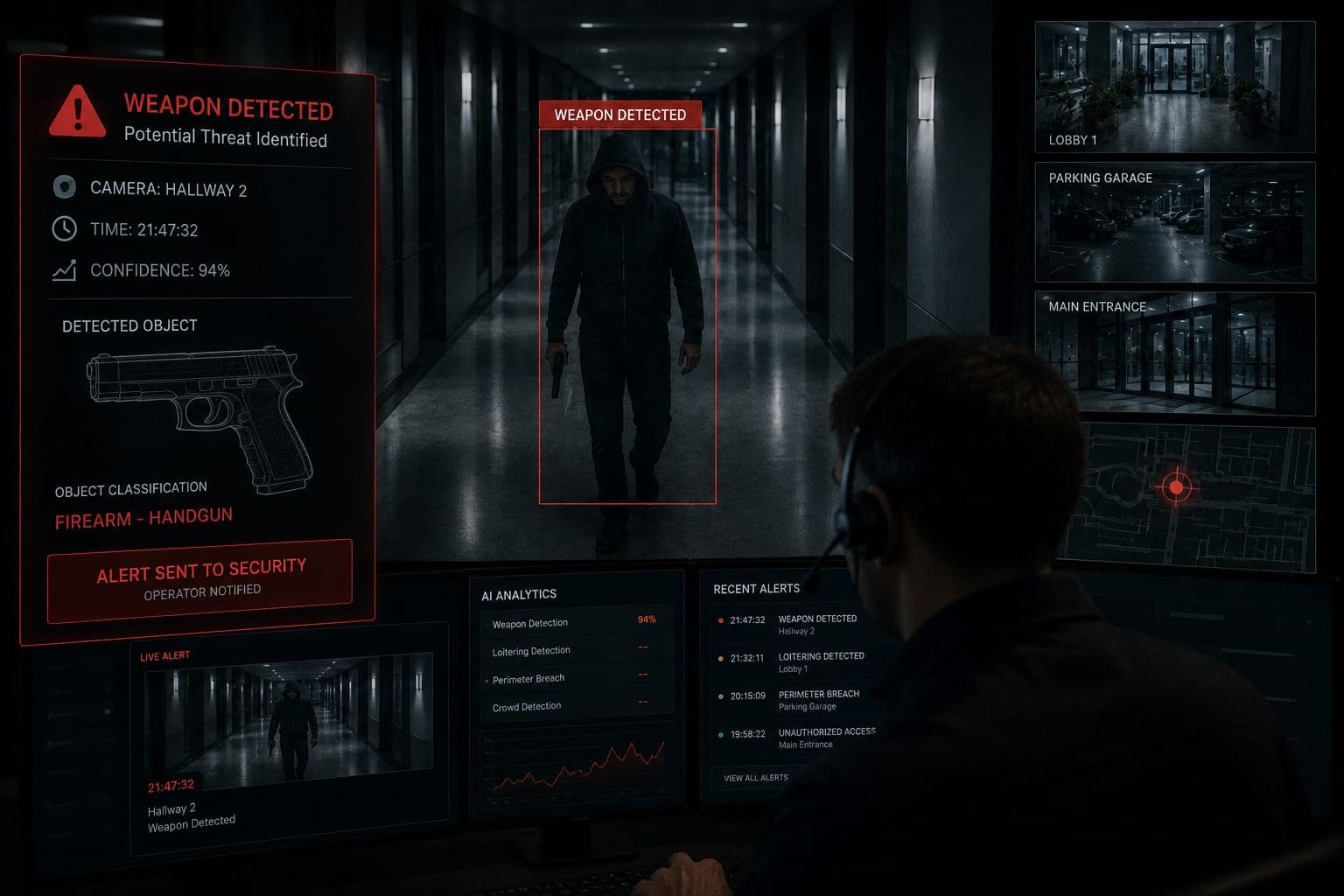
Gunshot detection tells you something terrible already happened. AI weapon detection gives you the chance to stop it before it does. Acoustic systems detect at T+0 — the moment of discharge. Visual AI weapon detection identifies a firearm in a camera frame before it's fired, opening a response window for evacuation, lockdown, or interception. In any facility with cameras, that window is the difference between preventing an incident and managing an aftermath.
The problem with detecting a gunshot
Let's be direct about something that the security industry doesn't always say out loud: by the time a gunshot detection system fires an alert, you've already failed to prevent the incident.
Acoustic gunshot detection systems — technology that uses microphones to identify the sound signature of a firearm discharge and alert security or law enforcement — are a genuine advancement over doing nothing. They reduce response time after a shooting begins. They help coordinate emergency response faster than traditional 911 calls. In urban environments where shootings occur in areas without security personnel, they provide coverage that wouldn't otherwise exist.
But they're fundamentally reactive. The detection event is the gunshot itself. The harm has already begun.
The more consequential question — the one that AI and computer vision are now making answerable in real time — is: can you detect the weapon before it's used? AI gun detection through cameras answers that question with a yes.
AI weapon detection using security cameras addresses exactly this. Instead of listening for a gunshot after it happens, computer vision analyzes camera feeds for the visual presence of firearms — a gun being carried openly, a weapon being drawn, an armed individual entering a facility. The detection happens before any shot is fired, giving security operators and response teams time to act during the window between weapon visibility and weapon use.
That window is what saves lives.
How acoustic gunshot detection systems work
The technology behind audio-based detection
Understanding acoustic gunshot detection is important context before explaining why visual weapon detection often provides a more actionable signal in controlled environments.
Traditional gunshot detection systems use a network of microphones — either fixed installations across a geographic area or sensors mounted within a building — that continuously monitor for sound patterns matching firearm discharge. The acoustic signature of a gunshot is distinctive: a sharp pressure wave with specific frequency characteristics that differs from other loud impulsive sounds like car backfires, fireworks, or construction noise.
When a sound event matches the gunshot signature above a confidence threshold, the system triangulates the location using the timing differences between multiple microphone detections, generates an alert, and notifies security personnel or law enforcement with the approximate location and time.
The leading platforms in this space — ShotSpotter (now SoundThinking), Motorola Solutions' PremierOne, and others — are widely deployed in urban environments across the United States and increasingly in Latin American cities. In the US, over 150 cities have deployed gunshot detection technology in high-crime areas, with the largest deployments in Chicago, New York, and Los Angeles.
Where acoustic detection works well:
- Open urban environments where gunshots occur in areas without security coverage
- Large geographic areas where fixed sensor networks can triangulate location
- Outdoor spaces where the acoustic environment is relatively predictable
- Law enforcement applications where the goal is faster response after an incident begins
Where acoustic detection has limitations:
- Indoor environments where sound reflections make triangulation unreliable
- High-noise environments (industrial facilities, traffic corridors) with elevated false positive rates
- Settings where the goal is prevention rather than response
- Buildings where security personnel are already present and need pre-incident warning, not post-incident location data
AI weapon detection: catching the threat before the trigger
How computer vision detects weapons in camera feeds
AI weapon detection using security cameras is a computer vision application: a deep learning model trained on thousands of images and video sequences of firearms — handguns, rifles, shotguns — in a wide range of environments, angles, lighting conditions, and levels of concealment.
The model learns to identify the visual characteristics of weapons: shape, proportion, reflective properties, the way a weapon changes the silhouette and posture of the person carrying it. It doesn't need to see a weapon in perfect focus, in perfect lighting, or from a perfect angle. It needs enough visual information to exceed its confidence threshold — and at that point, it generates an alert.
In Closely's implementation, AI weapon detection runs as a dedicated Watcher on configured camera feeds — the same pipeline architecture used for loitering detection, perimeter breach, and smoke detection. The camera feed is analyzed continuously. When a weapon is detected above the confidence threshold, the system generates a real-time alert with the timestamped video clip as evidence and pushes it to the SOC operator or security manager immediately.
What the operator receives isn't just an alarm — it's a classified event: which camera, exact timestamp, confidence score, and the visual evidence clip showing what triggered the detection. That information is what makes the alert actionable — the operator can assess the situation from the evidence immediately rather than having to navigate to the relevant camera feed and orient themselves.
The critical difference: pre-event vs. post-event detection
The operational distinction between acoustic gunshot detection technology and AI weapon detection by camera is the moment of detection relative to the incident timeline.
An acoustic system detects at T+0 — the moment of discharge. The harm has occurred. The response is containment and emergency management.
A visual AI weapon detection system detects at T-N — some time before discharge, when the weapon becomes visible in a camera frame. The response window is prevention: evacuating the area, locking down the facility, alerting law enforcement before an attack begins, or having security personnel intercept before the situation escalates.
For any secured environment where cameras are deployed — a school, a corporate campus, a hospital, a government building, a transportation hub — the pre-event detection window is the difference between intervening in a threat and responding to an aftermath.
This doesn't mean acoustic gunshot detection has no role. In open urban environments without camera coverage, acoustic detection remains the primary tool. In secured facilities with camera infrastructure, visual AI weapon detection provides the earlier warning signal — and acoustic detection, if deployed, provides backup confirmation if the visual detection is missed or if an incident begins in a camera blind spot.
Where AI weapon detection matters most
Schools and educational campuses
School security in the United States has evolved significantly over the last two decades, driven by the reality that schools represent one of the most emotionally significant target environments for mass violence events. Metal detectors at school entrances, armed security personnel, access control systems — all are responses to a threat environment that continues to evolve.
AI weapon detection adds a layer that none of these measures provide: continuous visual monitoring of every camera-covered area of the campus for the presence of a firearm, in real time, without requiring a human to be watching every feed simultaneously.
AI gun detection in a hallway during class hours triggers an immediate alert to school security — with a video clip, a camera location, and a timestamp. The time between detection and lockdown initiation, between detection and law enforcement notification, is compressed from minutes (in a system dependent on a human spotting the weapon on a monitor) to seconds. In active threat scenarios, that time compression is measured in lives.
In Latin America, school security has become an increasingly urgent issue as violent crime patterns in urban areas — particularly in Colombia, Mexico, Brazil, and Central America — have intersected with school environments. AI-powered weapon detection cameras that work on existing school camera infrastructure represent a cost-effective security enhancement that doesn't require new hardware investment.
Corporate offices and business parks
Workplace violence is the third leading cause of occupational fatality in the United States, according to the Bureau of Labor Statistics. Most workplace violence incidents involve an individual with a premeditated grievance — a terminated employee, a domestic situation that follows someone to work, an external individual targeting a specific person or organization.
AI weapon detection in corporate environments — monitoring building entrances, lobbies, parking structures, and common areas — provides the earliest possible warning when an armed individual enters the premises. For security teams operating a corporate SOC, an AI gun detection alert with visual evidence while the armed individual is still in the lobby is an entirely different operational situation than discovering there's an armed person in the building after an incident has begun.
Hospitals and healthcare facilities
Healthcare facilities in the United States and Latin America face elevated violence risk — against staff, against other patients, and from individuals in acute mental health crisis. The emergency department, in particular, is a consistently high-risk environment where weapons are sometimes brought in by patients, visitors, or individuals accompanying patients.
Weapon detection cameras covering ED entrances, waiting areas, and access corridors provide continuous monitoring that supplements or reduces dependence on manual security checks at peak patient volumes. A weapon detected at the entrance to an emergency department triggers an alert that gives security personnel time to respond before the armed individual reaches clinical staff.
Transportation hubs and public spaces
Airports, train stations, bus terminals, and major public spaces are high-priority targets for detection technology in both the US and LATAM. While primary screening at these facilities (metal detectors, X-ray screening) handles the main entry checkpoint, AI weapon detection cameras in post-screening areas, platforms, and public concourses provide secondary coverage for weapons that bypassed initial screening or were introduced through non-screened access points.
In Latin American transportation hubs — where formal security screening is less universally applied than at US airports — AI weapon detection using existing camera infrastructure provides meaningful coverage without the operational cost of deploying security personnel at every access point. Combined with gunshot detection technology at key perimeter points, this creates a layered threat awareness system that doesn't require a full hardware overhaul.
Government buildings and public institutions
Government facilities, courts, municipal buildings, and public institutions in the US and Latin America face consistent threat profiles from individuals with grievances against public agencies. Many of these facilities have security screening at primary entrances but limited monitoring of secondary access points, parking areas, and exterior perimeters.
AI weapon detection technology running on perimeter and access point cameras provides continuous coverage of these secondary zones — generating alerts when a weapon is detected in any camera frame, regardless of whether that camera is being actively monitored by a human operator at that moment.
How Closely's AI weapon detection works in practice
Closely deploys AI weapon detection as a native Watcher within its security monitoring platform — the same architecture used for loitering detection, perimeter breach, smoke and vape detection, and access control monitoring.
The weapon detection model runs continuously on configured camera feeds — analyzing every frame for the visual characteristics of firearms. When the confidence threshold is exceeded, the system generates an immediate alert to the SOC operator or security manager: camera location, timestamp, confidence score, and the triggering video clip.
Because Closely connects to existing IP camera infrastructure — Hikvision, Dahua, Axis, Hanwha, Avigilon, and any camera with RTSP and ONVIF support — adding AI weapon detection to a facility doesn't require new hardware. The cameras already deployed at school entrances, corporate lobbies, hospital emergency department access points, and transportation hub concourses become weapon detection cameras with a software configuration.
For security operators managing multiple client sites from a centralized SOC, weapon detection alerts flow into the same unified dashboard as all other detection types. An armed individual detected at a school entrance at 8:47am appears as a prioritized alert alongside the operator's other active monitoring responsibilities — with the evidence already assembled and the escalation protocol pre-defined.
Every weapon detection event generates a structured incident record: camera, timestamp, confidence score, evidence clip, operator response, and outcome. That record is auditable, documentable, and usable for incident investigation, insurance claims, law enforcement cooperation, and operational review.
If you're evaluating weapon detection cameras for a facility in the US or Latin America — a school, corporate campus, healthcare facility, or any environment where preventing armed incidents matters — get in touch. We'll walk through how visual weapon detection integrates with the camera infrastructure you already have.
Frequently Asked Questions
What is the difference between gunshot detection and AI weapon detection?
Gunshot detection systems use microphones to identify the acoustic signature of a firearm discharge — they detect that a shot was fired, after it happened, and help locate the source. AI weapon detection uses security cameras and computer vision to identify a firearm visually — before it's fired. The critical operational difference is the timeline: acoustic detection is post-event, visual weapon detection is pre-event. In secured facilities with camera coverage, visual AI weapon detection provides the earlier warning signal that enables prevention rather than just faster response.
How does AI weapon detection through security cameras actually work?
AI gun detection works through a computer vision model trained on thousands of images of firearms in real-world settings that analyzes camera feeds continuously, looking for the visual characteristics of weapons — shape, proportion, reflective properties, the way a weapon affects the posture and silhouette of the person carrying it. When the detection confidence exceeds the threshold, the system generates an alert with the camera location, timestamp, confidence score, and video evidence. In Closely's implementation, this runs as a dedicated Watcher — the same detection architecture used for other AI monitoring functions.
Can AI weapon detection cameras work with the security cameras already installed in my building?
In most cases, yes. Closely's AI weapon detection connects to existing IP cameras via standard RTSP and ONVIF protocols — supported by virtually all current-generation IP cameras from major manufacturers including Hikvision, Dahua, Axis, Hanwha, and Avigilon. The weapon detection Watcher is a software configuration on cameras already installed, not a new hardware deployment. For facilities with existing camera infrastructure in entrances, lobbies, corridors, and perimeter areas, adding AI weapon detection is a software decision, not a construction project.
What is the false positive rate for AI weapon detection, and how is it managed?
False positives — detecting a weapon when none is present — are an acknowledged challenge for any computer vision detection system, and weapon detection is no exception. Objects with similar visual characteristics to firearms (certain tools, some electronic devices, camera equipment) can trigger detections in some environments. Closely manages this through confidence scoring: only events above a defined confidence threshold generate an immediate alert. Events below the threshold can be logged for lower-priority review. Over time, the model is calibrated to the specific visual environment of each camera — reducing false positive rates as the system learns what the normal visual baseline looks like at each location.
Where are gunshot detection systems most commonly deployed in the US and Latin America?
In the US, acoustic gunshot detection technology is most widely deployed in urban areas with elevated gun violence rates — primarily by law enforcement agencies covering open-air public environments. Over 150 US cities have deployed acoustic detection networks. In Latin America, several major cities including Bogotá, Medellín, and Mexico City have deployed or are evaluating gunshot detection as part of municipal security infrastructure. For secured facilities (schools, offices, hospitals, government buildings), visual AI weapon detection through cameras is increasingly the preferred approach in both markets because it provides earlier warning and works in indoor environments where acoustic detection is less reliable.
How quickly does AI weapon detection alert security when a firearm is detected?
Detection and alert generation is near real-time — typically within seconds of the weapon appearing in the camera frame. The alert reaches the SOC operator or security manager immediately through the Closely platform, with the evidence clip already captured. The response begins while the armed individual is still in or near the detection zone — a fundamentally different situation than discovering a weapon is on premises after an incident has already begun.
Is AI weapon detection through cameras legal to deploy in schools, offices, and public spaces?
AI weapon detection cameras operate on the same legal basis as the underlying camera installation. In the US, cameras monitoring non-private spaces (hallways, lobbies, entrances, common areas) are generally legal with appropriate notice posted. The detection model analyzes the visual feed for weapons — it doesn't collect biometric data or identify individuals by face (which has separate regulatory considerations in some states). In Latin America, data protection frameworks (Colombia's Ley 1581, Mexico's LFPDPPP, Brazil's LGPD) apply to the camera system generally — the weapon detection function doesn't add additional legal complexity beyond what applies to the cameras themselves. For any specific deployment, legal counsel familiar with local jurisdiction requirements should be consulted.
Can AI weapon detection work alongside existing acoustic gunshot detection systems?
Yes — and in many secured environments, the combination provides complementary coverage. Visual AI weapon detection provides the earlier pre-event signal in camera-covered areas. Acoustic gunshot detection provides backup coverage in camera blind spots or if an incident begins before a weapon is visually detected. The two systems generate different types of alerts (visual identification vs. acoustic event) that can both feed into a SOC operator's unified monitoring dashboard — providing layered threat awareness rather than dependence on a single detection method.
What happens after AI weapon detection generates an alert — what's the response protocol?
The response protocol is defined by the facility operator and configured in the platform — Closely surfaces the alert, the operator or security manager executes the response. Typical response protocols for a weapon detection alert include: immediate notification to on-site security personnel with camera location; facility lockdown initiation; notification to law enforcement; and if applicable, PA system announcement. The alert from Closely includes the video evidence clip so the responder can assess the situation before entering the area. Every response action is logged automatically as part of the incident record, creating a complete audit trail for after-action review.
How does AI weapon detection fit into a broader security system for schools or corporate campuses?
AI weapon detection works best as one layer of a multi-layer security approach — not as a standalone solution. In a school, it complements access control (who can enter), visitor management (authorizing visitors before they enter), and emergency response protocols (what happens after a detection). In a corporate campus, it works alongside perimeter monitoring, access control, and security personnel deployment. In Closely's unified platform, weapon detection alerts share the same SOC interface and incident data layer as all other detection types — so a weapon detection event can be correlated with concurrent events (a perimeter breach, an unauthorized access attempt) rather than evaluated in isolation. That integrated picture is what enables fast, informed response decisions rather than isolated reactions to individual alerts.