Shopping Malls at Christmas: How to Use Your Security Camera Data to Drive More Sales
December brings your mall its biggest crowds of the year. Here's how the security cameras you already own can measure traffic, lift sales and keep people safe.
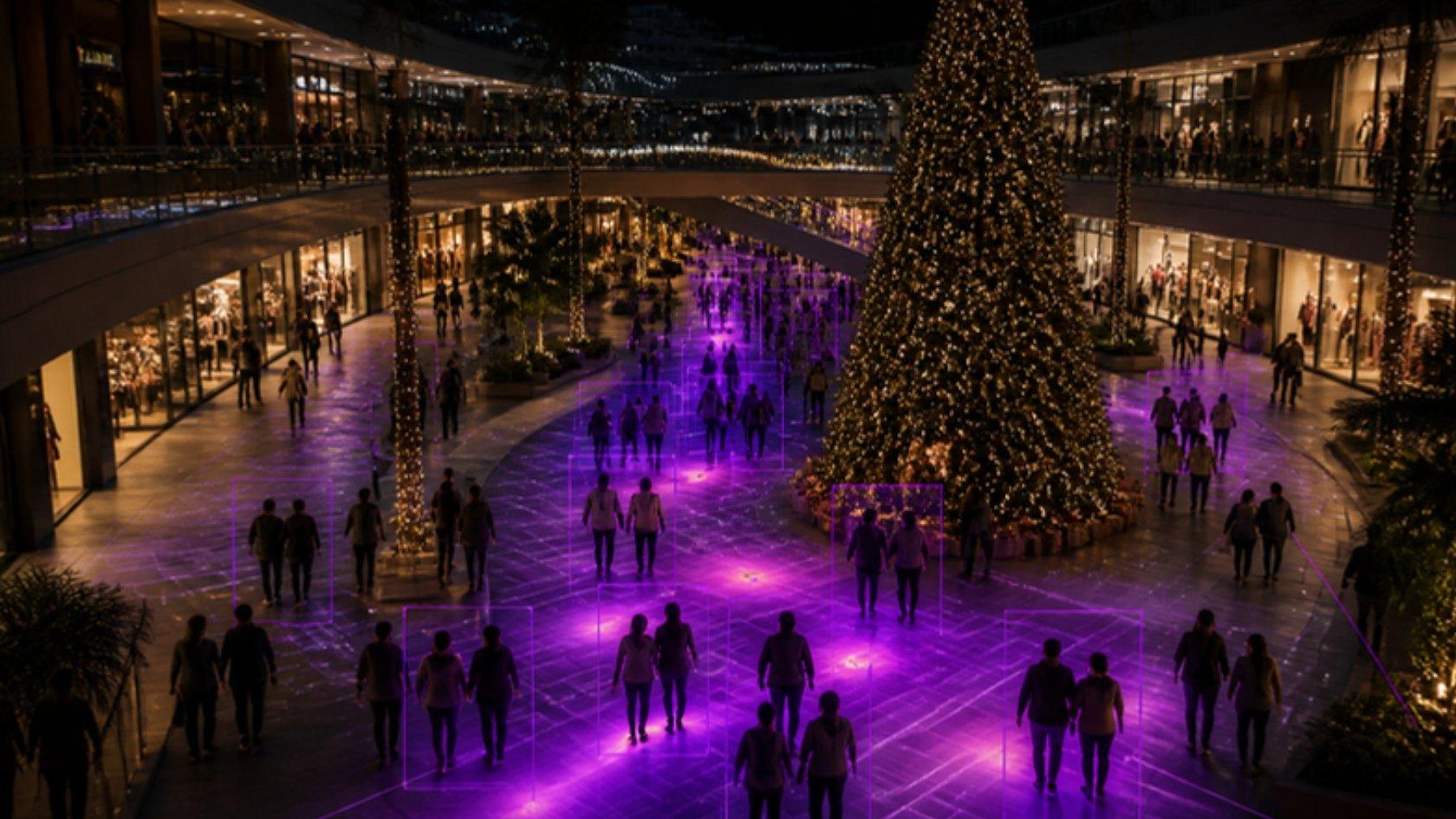
TL;DR: During the holiday season a shopping mall gets more people than at any other time of the year, yet most malls still run half-blind: they know how many cars came in, but not how many people used each entrance, which corridors are dead, or how long visitors stay. The security cameras you already have can measure all of that with no new hardware. With that data you can place activations, schedule staff, justify your promotion budget and price your spaces better. Security stays the foundation; intelligence is what you add on top.
The same cameras that watch. Now they also measure.
The Holiday Season Problem for Shopping Malls: The Biggest Month of the Year, Measured With a Broken Ruler
December is when a mall wins or loses a big part of its year. Gift shoppers arrive, families come to stroll, others just want to see the lights and the tree. There are more people, more cars and more chaos.
Now ask something simple: how many people came through the north entrance last night between 6 and 8 p.m.? Most mall managers can't say. What they have is an estimate: sensors on a couple of doors, parking ticket counts and, if they're lucky, a monthly report from the commercial team.
A shopping mall is measured worse than any online store. A web shop knows how many visitors it had, where they came from, what they looked at and where they left. Your mall moves far more money, yet it doesn't know which corridors people actually walked. Tenant sales are often self-reported, so negotiating a lease with hard numbers is difficult.
That has a real cost during the holiday season:
- Placement decisions by gut feeling. Where Santa, the tree, pop-up stands and screens go gets decided by intuition, not by where people really walk.
- Staff in the wrong places. Security and cleaning run on fixed shifts, even though December peaks don't follow office hours.
- A promotion budget without evidence. It's hard to prove whether a campaign moved traffic.
- Renewal talks without numbers. A tenant with low traffic and one with high traffic get treated the same because no data separates them.
What You Can Measure Today With the Security Cameras Already in Your Mall
Here's the good part: you don't need to buy new sensors. Your mall already has dozens or hundreds of cameras. Add an AI layer on top and those same cameras can deliver operational information, not just footage.
An AI platform that connects over RTSP or ONVIF to your existing cameras (Hikvision, Dahua, Axis, Bosch, Reolink and others) can measure, for example:
- Foot traffic by entrance, floor and hour. How many people come in and out, and when. No more guessing whether the south entrance fills up faster than the north on Saturday afternoons.
- A heat map of your corridors. A heat map shows where people walk and where they don't. Dead corridors become visible, and the heat map tells you which to relocate or reactivate.
- Dwell time at storefronts and activations. Not just how many people pass, but how many stop.
- Table occupancy in the food court. Useful for knowing when it's overloaded and when seats sit empty.
- Higher-traffic events. Compare a promotional weekend against a normal one, or lighting-ceremony day against a random Tuesday.
- Vehicle distribution in the parking lot. Which zones fill first and which stay empty.
A word on privacy, because it matters: this kind of measurement uses anonymous, non-biometric detection. It counts people; it doesn't identify them. Closely does not do facial recognition, demographic information is handled only in aggregate, and in restrooms only the entrance is measured, never the interior. For the legal side in Colombia, see our guide on Law 1581 and AI video.
How to Turn That Data Into Holiday Sales
Measuring for its own sake is pointless, even in the holiday season. What matters is which decisions change. Here are six that a mall can make with real foot traffic data.
1. Put activations, Santa and stands where people actually walk
A seasonal stand in a corridor almost nobody walks through is wasted money. A heat map shows the highest-flow zones so you put activations there. And if a premium space isn't moving people, you find out before the second week of December, not in January.
2. Charge for media and pop-up spaces based on measured audience
Many malls still price screens, kiosks and pop-up spaces at a flat rate. With foot traffic data by zone and hour, you can price by real audience: a spot that thousands of people pass on Saturday at 5 p.m. is worth more than one few people reach. Advertisers understand that language; it's close to how they already buy digital ads.
3. Schedule guards and cleaning around real hourly traffic
This is one of the most practical wins. If you know the holiday season peak runs from 4 to 9 p.m. and weekday mornings are quiet, you don't need the same staffing all day. You put people where and when they're needed: better visitor service and better use of budget. We go deeper on this angle in our article on how shopping malls make money with AI.
4. Help each tenant match staffing to real traffic
A tenant who knows the foot traffic at their store hour by hour can staff to match. Shorter lines at peak, fewer shoppers walking away. It's a service the mall manager can offer tenants, and it strengthens that relationship.
5. Measure whether holiday season campaigns moved traffic
The promotion fund is often an uncomfortable conversation: a lot gets spent and return is hard to prove. With foot traffic data you can compare before and after a campaign. Did traffic rise? At which entrances? At what hours? That evidence supports (or corrects) next year's investment.
6. Spot low-traffic stores early
A store with consistently low traffic is an early signal of possible vacancy. If you see it in November, you have time to talk, offer a relocation or adjust terms. And when renewal comes, you negotiate with data instead of anecdotes.
Does this work? Independent research points the same way. McKinsey reported that mall operators using advanced analytics have achieved double-digit increases in leasing revenue, and it describes an Asian operator on track to capture a 20% increase over five years using an analytics tool to set rent targets (see Boosting mall revenues through advanced analytics). To be clear: those are other operators' results, not Closely promises.
Holiday Security Is Still the Foundation
We won't pretend this is only marketing. In December, more people means more risk: shoplifting, lost children, crowding at entrances and stairs, abandoned vehicles in the parking lot, arguments that escalate.
The classic problem is that an operator can't watch hundreds of cameras at once. In practice most screens have nobody looking at them, and traditional alert systems generate so many false alarms that staff end up ignoring them. We wrote about that in false alarm fatigue.
With AI the logic flips. The system reviews every camera all the time, filters out the irrelevant (with multi-layer filters, Closely cuts false alarms by up to 88%), and the human operator only sees what matters. The operator also validates every alert before anyone is dispatched. Security first, intelligence second.
And the nice part is that it's one system: the cameras that detect an incident are the same ones that count people. You don't pay twice to look at the same thing.
From Landlord to Operator: Where the Shopping Mall Industry Is Heading
For decades the mall business was real estate: build square meters and collect rent. That model is shifting. Shoppers have online options, so the mall now competes on what happens inside: experiences, events, dining, service.
BCG makes this case in AI Will Anchor Tomorrow's Shopping Malls: artificial intelligence can give mall operators sharper insights, better decisions and faster execution. In real life that means the operator who best understands what happens inside the mall decides better. The one running blind reacts late.
That shift from landlord to operator needs data. And the richest data a mall owns is, today, asleep inside its security cameras.
How to Start Without Buying Hardware or Slowing Operations
The good news: you don't have to wait until January. Closely installs on top of the cameras you already have, with no proprietary hardware, over RTSP/ONVIF or by connecting to your NVR. No construction, no camera replacement, and operations keep running.
The typical path:
- We review your current cameras and which ones cover entrances, corridors and parking.
- We connect the platform to those cameras.
- You set rules in plain language, no code and no technical consultants.
- You start seeing foot-traffic data and security alerts in the same place.
We offer a free 2-week demo on your current cameras. If you want to reach December with data instead of estimates, book your demo at closely.dev.
Frequently Asked Questions
Can I measure my mall's foot traffic with the security cameras I already have?
In most cases, yes. If your cameras cover entrances and corridors from a reasonable angle, an AI platform can count people by entrance, floor and hour without installing new sensors. The best first step is reviewing which cameras you have and where they sit.
What is a heat map in a shopping mall and what is it for?
It's an image that uses color to show where people gather and where they barely pass. It helps you decide where to put activations, stands and advertising, and to spot dead corridors that need attention.
Does this involve facial recognition or identifying visitors?
No. Foot-traffic measurement uses anonymous, non-biometric detection: people are counted, not identified. Demographic information, when used, is aggregate only, and in restrooms only the entrance is measured, never the interior.
How long does it take to start seeing foot-traffic data?
Because it connects to cameras that already exist, there's no construction or equipment replacement. The process takes weeks, not months. With a 2-week demo you can already see how your mall behaves.
Does it work with any camera brand?
Closely connects through RTSP/ONVIF and NVR, so it works with brands like Hikvision, Dahua, Axis, Bosch and Reolink, among others. Measurement quality depends on each camera's angle and resolution.
How does video analytics help cut security costs during the holiday season?
It shows you when and where crowds build so you can schedule guards around real traffic instead of fixed shifts. The AI also filters false alarms so the operator handles only what's relevant. It's the same logic we explain in our article on AI cameras in Colombian shopping malls (Spanish).
Can I charge more for advertising spaces using this data?
You can better support your rates. With audience data by zone and hour, an advertiser sees why one space is worth more than another. It's not a price guarantee, but it turns a subjective conversation into one with numbers.
How do I know if my Christmas campaign really moved traffic?
By comparing foot traffic by entrance and hour before, during and after the campaign. Without a baseline it's very hard to know; with one you can see whether the effect was real and at what times it happened.
Is this useful for small or mid-size malls?
Yes. The value doesn't depend only on size; it depends on how much you don't yet know about your operation. A mid-size mall with few entrances can start with entrance and parking cameras and grow from there.
What happens to security if I focus on commercial metrics?
Nothing is sacrificed. The same system that counts people also watches the mall, and a human operator validates every alert before dispatch. Security is the foundation, and the commercial metrics are added on top of what you already do.
The Bottom Line
December is the month a shopping mall most needs to know what's happening inside. The cameras you already own can watch and measure at the same time, and that data lets you make better decisions about placement, staffing and negotiation. If you want to see it running on your own cameras, start your free demo at closely.dev.