AI for Shopping Centers: When Security Cameras Start Making Money
AI converts existing cameras into 20-38% security cost reduction and up to USD 3.7M annual operational value.
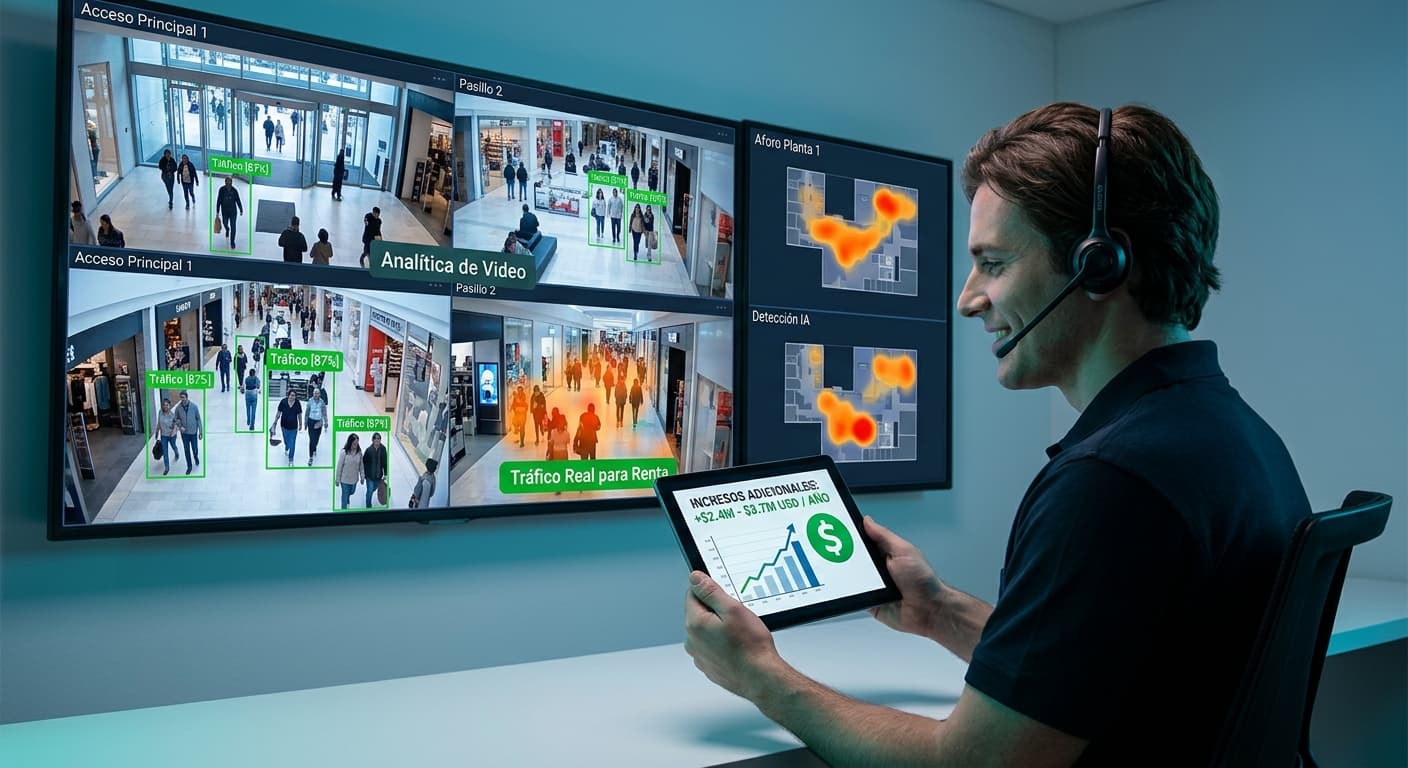
TL;DR: Leading shopping centers across the United States and Latin America are capturing between USD 2.4M and USD 3.7M in additional annual value by connecting artificial intelligence to cameras already in place. No hardware replacement required. Security cost reduction ranges from 20-38%, while commercial levers (traffic-based rent, vacancy alerts, measured media) multiply the impact. Implementation takes weeks, not quarters.
The Problem No One Wants to Admit in Monitoring Rooms
There's a data point in human physiology that should completely change how shopping centers think about security: after 22 minutes watching a surveillance screen, an operator loses up to 95% of what's happening around them. It's not negligence. It's not a bad attitude. It's physiology. The human brain wasn't designed for sustained surveillance.
AI for shopping centers exists to change exactly that model. Yet the current standard in shopping centers worldwide—including those in the United States, Colombia, Mexico, Peru, Chile, Brazil, Argentina, and the rest of Latin America—remains unchanged: people in front of screens, 12-hour shifts, 30 to 40 cameras per operator.
The predictable result: incidents slip through. An operator who's technically monitoring but physiologically processing 95% less visual information isn't protecting anyone.
The second problem is that when something does happen and investigation is needed, reconstructing what occurred takes 20 to 50 hours of video review per case. A security analyst's entire work week, consumed reviewing footage of a single incident.
The third is structural: security is one of the largest controllable elements of maintenance fees, and rises with labor costs every year in every market. There's no visible ceiling.
Artificial intelligence for shopping centers exists precisely to solve these three problems simultaneously. And it does so with the cameras the shopping center already has installed.
The Cameras Are Already There. The Problem Is What They Don't Do
This is the point that changes the conversation: the camera infrastructure that any medium or large shopping center has installed today—in Bogotá, Miami, Mexico City, Lima, Santiago, or any city in Latin America and the United States—is sufficient to do something radically more useful than record unwatched video.
A medium or large shopping center might have 200 to 400 cameras. Each captures video continuously. Right now, those cameras are seeing how many people enter through each access point, which corridors are full and which are empty, how long people stay in front of each storefront, which stores open late, where queues form, and dozens of security events no single human operator can process simultaneously.
That information exists. It's being captured. And it's being wasted. AI for shopping centers is what converts that waste into the most valuable asset of the operation.
That's why security with artificial intelligence doesn't require replacing cameras. It requires connecting a brain to what the cameras are already seeing. Smart cameras for shopping centers aren't new hardware: they're the cameras you already have, empowered by software.
How the System Works in Practice
Closely operates on four steps that transform the operations of any shopping center, whether located in the United States or Latin America:
1. Detects. The AI agent monitors all cameras simultaneously and identifies every relevant event instantly. It learns what's normal in each zone at each time of day, then detects deviations. A fight on the third floor. A person wearing a helmet indoors. An abandoned object in a corridor. A crowd forming where groups don't normally gather. Each generates an alert within seconds.
2. Verifies. The operator at the monitoring center confirms the event within seconds, with the video clip and full context already prepared. A person always decides. AI filters and prioritizes. Humans judge and act. Instead of an operator watching 40 screens hoping to see something, an operator sees only what matters and decides with complete information.
3. Responds. The team on the floor receives an alert with exact location and the shortest route to get there. They don't search. They don't ask. They go directly to where the AI detected the event.
4. Measures. Each event is also data. Traffic by access point and hour. Dwell time by zone. Real visitor paths. Real-time occupancy per floor. This commercial data layer runs on the same infrastructure and same cameras as the security layer. It's not an additional system. It's the same engine applied to two purposes.
What Your Shopping Center Isn't Measuring (And Should Be)
This is the part of the conversation that surprises shopping center operations directors most when they see it for the first time, whether in New York, Bogotá, Mexico City, or Lima.
Today's shopping centers operate measuring less than any basic online store. An e-commerce store knows exactly how many visitors came, where they came from, what they saw, how long they spent in each section, what they bought, and what they didn't. A shopping center with 300 physical stores, millions of annual visitors, and decades of operations often doesn't know dynamically how many people enter through each access point per hour, which corridors drive more conversion, or which tenants are at risk of vacating before they announce it.
Video analytics for shopping centers close that gap. The same cameras that detect a fight also count people, measure dwell time in front of storefronts, generate heat maps by zone, identify peak hours by area and estimated visitor profile, and record whether a store opened late or closed early.
That data isn't hard to capture. It's data nobody had captured because nobody had the system to do it. Video analytics for shopping centers are exactly that system. And smart cameras for shopping centers generate it without changing a single camera.
The Seven Value Levers That Change a Shopping Center's Numbers
The financial argument for Closely in shopping centers isn't built on security savings alone. It's built on seven value levers the system activates simultaneously:
1. Traffic-based rent. When a shopping center has real data on traffic, capture, and dwell time by tenant, renewal negotiations change. Instead of debating anecdotes, the operator arrives with evidence. The tenant who says "I don't get enough foot traffic" and the operator who thinks otherwise now have the same data. AI for shopping centers turns rent into a conversation based on evidence. According to McKinsey, this lever represents a 10-15% increase in rent at renewal.
2. Anticipatory vacancy alert. The system detects tenants with sustained traffic decline months before they decide to leave. This allows intervention, relocation, or finding a replacement with time, instead of managing emergency vacancy.
3. Media with measured audience. Screens and activation spaces within the shopping center can be priced by actual measured audience by zone and time, not flat rates. The difference between selling advertising space by estimated occupancy and selling it by proven audience is significant.
4. Monitoring center productivity. AI filters false positives. Each operator supervises more cameras and only handles real events. In Closely-measured deployments, this represents 30-60% productivity gain per operator.
5. Security and cleaning programmed by real traffic. Guards and cleaning staff are assigned based on where people actually are, not fixed shifts that ignore flow variability. This reduces labor costs by 3-6% without sacrificing coverage.
6. Incremental tenant sales. When tenant mix and location are optimized by actual visitor paths, tenant sales grow 7.9-15.8%, according to BCG. If there's variable rent, the operator shares that improvement.
7. Optimized in-store staffing. Each tenant with access to real hourly traffic data can adjust their staff: fewer idle hours during low-traffic periods, more coverage during real peaks. This reduces in-store labor costs by 6-10%.
Financial Numbers for an Illustrative Center
For an illustrative 60,000 m² gross leasable area shopping center, with 93% occupancy and fixed rent of USD 26 per square meter monthly—a representative profile for medium and large centers in Latin America and the United States—the total impact of implementing AI for shopping centers on existing infrastructure is as follows:
The annual additional value captured directly by the operator, considering rents based on traffic, security reduction, vacancy alerts, and measured media, is between USD 2.4 million and USD 3.7 million per year.
Capitalized at an 8.5% cap rate, that additional cash flow represents USD 28 million to USD 43 million more in asset value.
On the security line specifically, the center's security cost, with guards and operators at USD 2,500 per month, is reduced by 20-38%, because AI monitors all cameras and guards handle only real events.
This doesn't require more guards. It requires the guards you already have to act with information, at the right time, in the right place.
Why Leading Shopping Centers Are Already Making This Move
Shopping center operators growing worldwide—from the United States to Colombia, Mexico, Chile, Brazil, and Peru—aren't growing by adding square meters. They're growing by improving productivity of the square meters they already have. 12 of the 14 global leading operators grow more than 5% annually, primarily through productivity improvements, not area expansion.
The shopping center stopped being just a rent collector. Today it competes on what happens inside. The anchor isn't the center with the biggest tenants anymore—it's the one that generates most traffic, captures most purchase occasions, and can prove it with data.
Security with artificial intelligence in shopping centers isn't the industry's future. It's what leaders in the United States and Latin America are doing right now, with existing infrastructure, in weeks.
How Closely Implements All This in Your Center
Closely connects its AI agents to the cameras your center already has installed, without replacing hardware or running months-long projects. If your cameras are Hikvision, Dahua, Axis, Hanwha, Avigilon, Bosch, or any other manufacturer with IP protocol, Closely runs on top of them. The platform actively operates with shopping centers and security operators in Latin America and the United States.
The first layer entering production is security with artificial intelligence: detecting loitering, crowding, aggressive behavior, people wearing helmets indoors, weapons, smoke and fire, abandoned objects, falls, people running, among others. This layer operates from the first week.
On the same platform and same cameras, the AI layer for shopping centers activates in weeks, not quarters: heat maps, occupancy per floor and access point, dwell time by zone, storefront conversion, demographic estimation, peak hours, queues, and all the data layer that converts each visit into actionable insight for your commercial and operations teams.
Every security incident detected by AI is automatically documented. Every traffic data point is structured into ready-to-use reports for tenant negotiations, marketing fund justifications, and staffing and cleaning schedule decisions.
Frequently Asked Questions
What is artificial intelligence for shopping centers and what does it do specifically?
AI for shopping centers is a software layer that connects to existing security cameras and converts them into a real-time analytics system. It does two things simultaneously on the same infrastructure: active security, detecting incidents like fights, weapons, people wearing helmets indoors, crowding, falls, smoke and fire, among others; and commercial intelligence, measuring traffic, dwell time by zone, heat maps, storefront conversion, occupancy per floor, and visitor profile. It requires no new cameras or construction projects.
How can AI reduce security costs by 20-38%?
Cost reduction comes from changing the guard's role. With video analytics for shopping centers, the monitoring center covers all cameras simultaneously with AI. Floor guards stop being distributed observers in fixed posts and become active responders: they go exactly where the AI detected a real event. This allows reducing guards per shift without reducing effective coverage, and scheduling staff based on real traffic rather than fixed shifts that ignore flow variability.
How much can shopping center rent improve with real tenant-level traffic data?
According to McKinsey, operators using traffic, capture, and dwell data to negotiate renewals achieve rent increases of 10-15% per renewal, with potential up to 20% over five years. Negotiation stops being a perception debate and becomes a conversation about verifiable data—how many people passed the store, how many entered, and how long they stayed.
Do I need to replace my existing cameras to implement Closely?
No. Closely connects to any IP camera with RTSP protocol and ONVIF support, which includes virtually all common brands in Latin American and US shopping centers: Hikvision, Dahua, Axis, Hanwha, Bosch, and others. AI runs on top of existing infrastructure. The first security layer can be in production within weeks.
What types of security incidents can AI detect in a shopping center?
A system like Closely can detect: loitering in sensitive zones, unusual crowding, aggressive behavior and fights, people wearing helmets indoors, firearms and bladed weapons, abandoned objects, person falls, signs of distress, people running in anomalous zones, smoke and fire, people sleeping in common areas, liquid spills in corridors, vehicles blocking exits or in wrong direction, excessive queues at payment points, among others. Each detection generates a validated alert with video clip and exact location.
Does implementing video analytics for shopping centers make sense in secondary markets outside major capitals?
Absolutely. The business case for smart cameras in shopping centers is equal or stronger in secondary markets than major capitals, because security budgets are tighter and every percentage point of savings matters more. In the US, this applies to regional centers in Houston, Phoenix, or Miami as much as properties in New York or LA. In Latin America, the same logic applies from Bogotá and Mexico City to Medellín, Guadalajara, Lima, Santiago, and Monterrey. Cameras are already installed. The pain is the same. The solution scales the same.
What commercial data can AI generate using shopping center security cameras?
The same cameras doing security also generate: real-time traffic by access point and hour, traffic heat maps by zone, dwell time in front of storefronts, occupancy per floor, demographic estimation by zone and time, peak hour identification, walk-by to store entry conversion, automatic store opening registration, and queue detection at service points. This data is the foundation for evidence-based renewal negotiations, optimizing tenant mix, justifying marketing funds, and programming staff and cleaning by real traffic.
How long does Closely implementation take in a shopping center?
The security layer can be in production within weeks, not quarters. There's no additional hardware installation if cameras already have IP connectivity. Closely's team conducts an infrastructure compatibility assessment before starting. The commercial layer activates on the same platform in the same implementation process.
Does AI completely replace shopping center security guards?
No, and that's not the proposition. AI replaces the passive observation model, which doesn't work well anyway since operators lose 95% of what's happening after 22 minutes watching screens. Smart cameras for shopping centers don't eliminate the human role. Guards remain essential for physical response, presence deterrence, and situations requiring human judgment. What changes is how many are needed and how they act: with information, in the right place, at the right time, coordinated from a center that sees everything in real time.
What's the total financial impact Closely can have on a medium or large shopping center?
For a 60,000 m² GLA center with 93% occupancy, the total estimated impact—combining traffic-based rent, security cost reduction, anticipatory vacancy alerts, and measured media—is USD 2.4 million to USD 3.7 million in additional annual value. Capitalized at market cap rate, this represents USD 28 million to USD 43 million more in asset value. The security component specifically generates 20-38% cost reduction. For impact calculation specific to your center, contact us at closely.dev with three data points: number of guards and operators, number of cameras, and GLA.
The Conclusion
Your shopping center generates data every day. Your operations ignore it. This changes when that changes. Leading operators in the United States and Latin America are using artificial intelligence to convert the cameras they already have into an active security system and a simultaneous commercial intelligence generator. It's not a future proposal. It's what's happening now, with existing infrastructure, in weeks.
Change doesn't require replacing cameras. It requires connecting a brain to what cameras are already seeing. That reduces security costs 20-38%. It unlocks USD 2.4 to USD 3.7 million in additional annual value. And it converts every visit into actionable data for your operations and commercial teams.
Want to know what this would mean for your center specifically? Contact us at closely.dev. With three data points—number of guards and operators, number of cameras, GLA—we'll calculate your projected security savings and estimated impact on commercial levers. No cost. No commitment.