Extortion of Shop Owners: How to Use Video Surveillance to Document and Respond
If you're being asked for protection payments, your cameras can help you document every visit and report with organized proof. What to save and what to avoid.
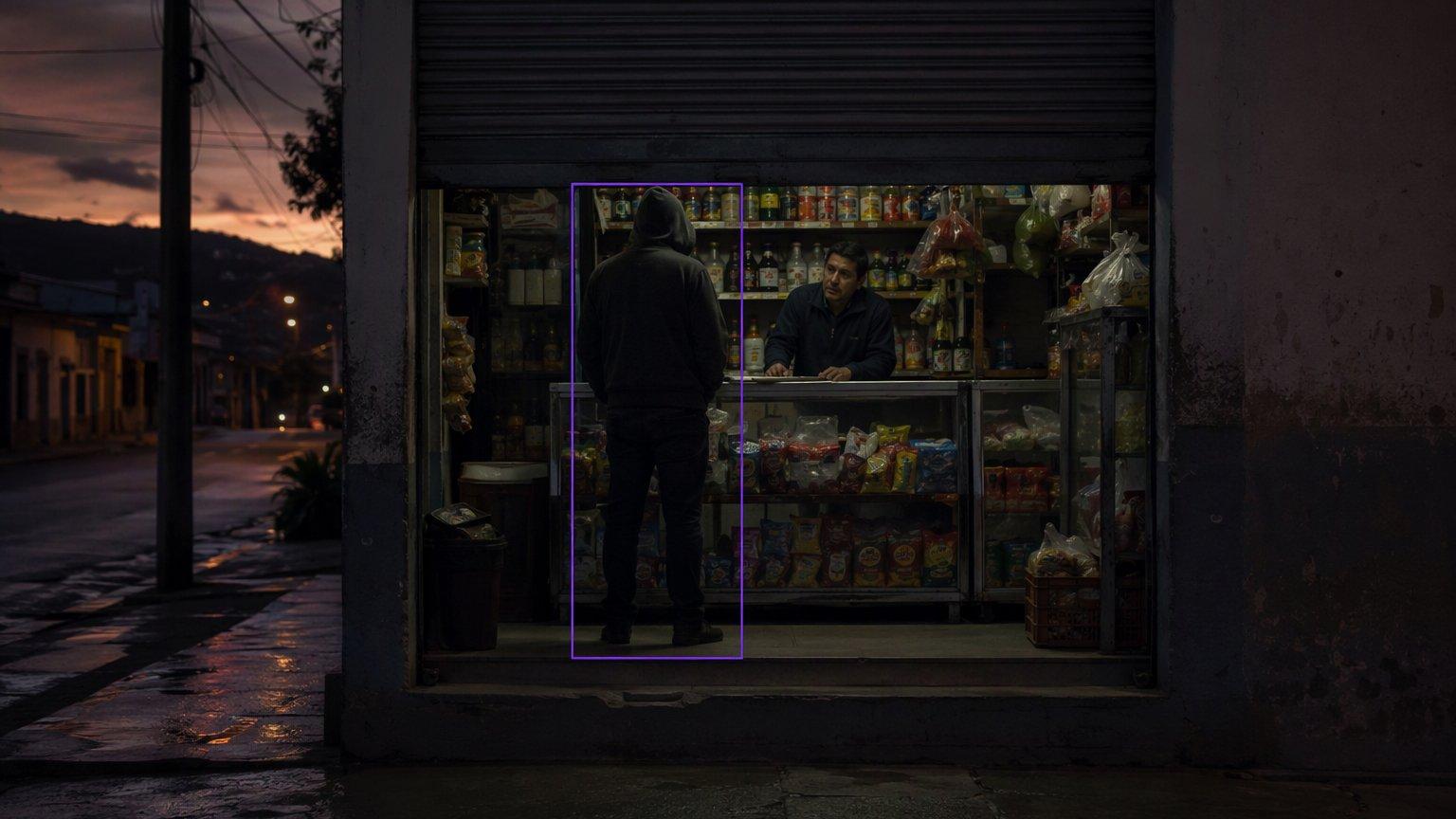
TL;DR: If you're being extorted, don't pay and report it (in Colombia, call the Gaula police line at 165). Cameras won't stop extortion on their own, but they help you document who shows up, when, and what they say, and hand organized evidence to the authorities. With AI on top of the cameras you already own, finding that footage takes minutes instead of hours.
Extortion of Shop Owners: A Problem Few People Talk About
If you run a store, restaurant, pharmacy or warehouse in Colombia or Mexico, you probably know someone who has had "the visit." Someone shows up, friendly or threatening, and explains that to keep working in peace you need to pay a weekly or monthly fee. On the street it goes by different names: vacuna, gota a gota, or just "the collaboration."
The available numbers are uncomfortable. In September 2024, the head of Fenalco Bogotá said 8% of the city's merchants had been extortion victims in the previous six months, up from 6% in the February survey (Infobae). The same round of results indicated that only about 33 of every 100 victims filed a report. That is 2024 data from a trade-association survey, not a current official statistic, but the signal is clear: many people stay silent out of fear.
This article is not legal advice and it doesn't promise that a camera will solve the problem. It's a practical guide, operator to operator, on how to use video surveillance for small businesses for what it can actually do: document, help you decide calmly, and support a report with proof.
First Things First: Don't Pay, Report
Colombian authorities are consistent on this: don't pay, report. The national Gaula police line is 165, and Bogotá's city government explains you can also report online through the Police website. The Attorney General's office takes reports at its offices and online. Fenalco's stated position is to never pay and always report.
Paying rarely ends the problem and often leads to higher demands. Reporting is what lets authorities build a case.
If your cameras only tell you what happened after the fact, try Closely on your current cameras and see what a system that alerts you and helps organize evidence looks like.
What Your Cameras Can (and Can't) Do
Let's be honest about what cameras do in a case of business extortion:
- They can: record who enters, when and with whom; show repeated visits; show whether someone is watching the entrance from the street; keep a record of in-person threats.
- They can't: identify an extortionist by themselves or replace a prosecutor's investigation. They also don't stop a crime just by existing.
The gap between a camera that records and useful extortion evidence is organization. Three weeks of undated, unedited footage helps no one. A log with marked visits, timestamps, camera angles and a backup copy does.
How to Document Extortion With Your Cameras, Step by Step
These are common-sense practices. When you report, ask the Gaula how they prefer to receive videos and other evidence.
1. Save the footage of every suspicious visit
As soon as a visit, call or threat happens, note the exact date and time and export that segment. Don't wait: many recorders overwrite older footage after a few days.
2. Make a copy outside the recorder
Copy clips to an external drive or cloud storage. If the recorder breaks, is stolen or tampered with, the proof is gone.
3. Cover the door and the street
Make sure at least one camera captures the entrance and the sidewalk in front of the business. People scouting before a visit often pass by several times.
4. Check the system date and time
Footage with a wrong clock loses weight as evidence. Sync your recorder's clock and review it regularly.
5. Keep what isn't video too
Bogotá's city government advises recording calls and saving screenshots of messages. Video complements that evidence; it doesn't replace it.
The Real Problem: Finding the Exact Moment in Hours of Footage
This is where most owners get stuck. You have 15 days of recordings from six cameras and you remember "the guy in the red jacket came Tuesday afternoon, or maybe Wednesday." Reviewing that by hand takes hours, and when you're stressed, you often don't.
That's why AI video search changes the equation. With Closely, the Investigator agent lets you search recordings in natural language, like "person in red jacket entering the store." The platform works on the cameras you already have, connected via RTSP, ONVIF or your NVR, with no hardware changes. To see how it works at your business, request your free 2-week demo.
One caveat: AI helps you sort and find, but what to present and to whom is always up to you and the authorities.
Respond With a Protocol, Not With Nerves
When a threat arrives, stress causes mistakes. A simple written protocol helps everyone react the same way. An example extortion response protocol:
- Stay calm. Don't argue or promise payments.
- Alert a trusted person on your team and the owner or manager.
- Mark the moment in your video system: incident start and end times.
- Export and back up the footage right away.
- Call the Gaula (165) or the line your city's authorities provide.
- Don't confront the person or investigate on your own. It's a risk to you and your staff.
With several locations, every manager should know the protocol. If a camera suddenly goes offline or someone tampers with equipment, treat it seriously. To learn how to cut alert noise and focus on what matters, read about false alarm fatigue.
What AI Can Do While You Run Your Business
An owner can't watch screens all day. A platform like Closely runs several agents on your cameras. The Watcher detects behavior in real time, such as loitering in front of the store. The Reporter documents what happened automatically, so you don't depend on memory. And with a human in the loop, an operator validates before anything is acted on.
This doesn't replace reporting or the authorities. It gives you a clear, timely record if something happens. You can try Closely on your current cameras to see how it fits your location.
Recording also has a legal side. For how video data and images of people are treated in Colombia, see our guide to Law 1581 and AI video. To see how business cameras connect with police, read cameras connected to police in Colombia.
Final Recommendations
- Talk to other merchants nearby: extortion is rarely aimed at only one business.
- Check that cameras record, have the right date and have no blind spots at the entrance.
- Decide who on your team can access and export videos.
- If you feel in immediate danger, call emergency services first.
Frequently Asked Questions
What should I do if someone is demanding protection payments from my business?
Don't pay, and report it. In Colombia you can call the Gaula police line at 165. Before reporting, save call recordings, messages and video of the visits.
Can security camera footage be used as evidence in an extortion report?
It can support a report by showing visits, times and people loitering near the shop. How evidence is weighed is up to the authorities, so ask the Gaula or prosecutors how they prefer to receive it.
How long should I keep footage of an extortion incident?
For as long as the case is open and until authorities say it's no longer needed. Make a copy outside the recorder, since many devices overwrite old footage within days.
What cameras do I need to cover my store entrance?
One IP camera on the door and another on the sidewalk is a good start. What matters is a clear image and the correct time. With Closely you don't need to replace them: it works on Hikvision, Dahua, Axis and other brands.
Can I search my footage for a specific person without watching hours of video?
Yes, with AI video search. Closely's Investigator agent lets you search with phrases like "person in a black cap entering the store" and takes you to relevant clips.
How common is extortion of merchants in Colombia?
According to Fenalco Bogotá, in September 2024 8% of the city's merchants said they had been victims in the previous six months. It's a trade-association survey, not an official figure, but it shows this isn't an isolated problem.
Why don't many merchants report extortion?
Mostly fear of retaliation. Fenalco has noted that only a share of victims report. That's why going to the authorities with organized evidence, ideally alongside other merchants, helps.
Will an AI camera prevent me from being extorted?
No technology can guarantee that. It can help you document, detect suspicious behavior in front of your store and respond with more information.
Does this work the same in Mexico as in Colombia?
The technology does. Reporting channels vary by country and state, so check with local authorities. In Mexico, your state prosecutor's office can tell you how to file and what evidence to bring.
How do I try Closely at my business?
Closely offers a free 2-week demo on your existing cameras. You can request it from the Closely home page.
The Bottom Line
Extortion isn't solved by technology alone, and certainly not by a camera nobody watches. But a business owner with organized video, backup copies and a clear protocol reports with more strength and reacts with less fear. If you want your cameras working for you and not only for after the fact, request your free demo at closely.dev.