Critical System Protection: Why Physical Security Is Now a Board-Level Conversation
Power grids, water treatment plants, data centers, financial networks. These are the systems that everything else depends on. And their physical protection has never been more complex or more consequential.
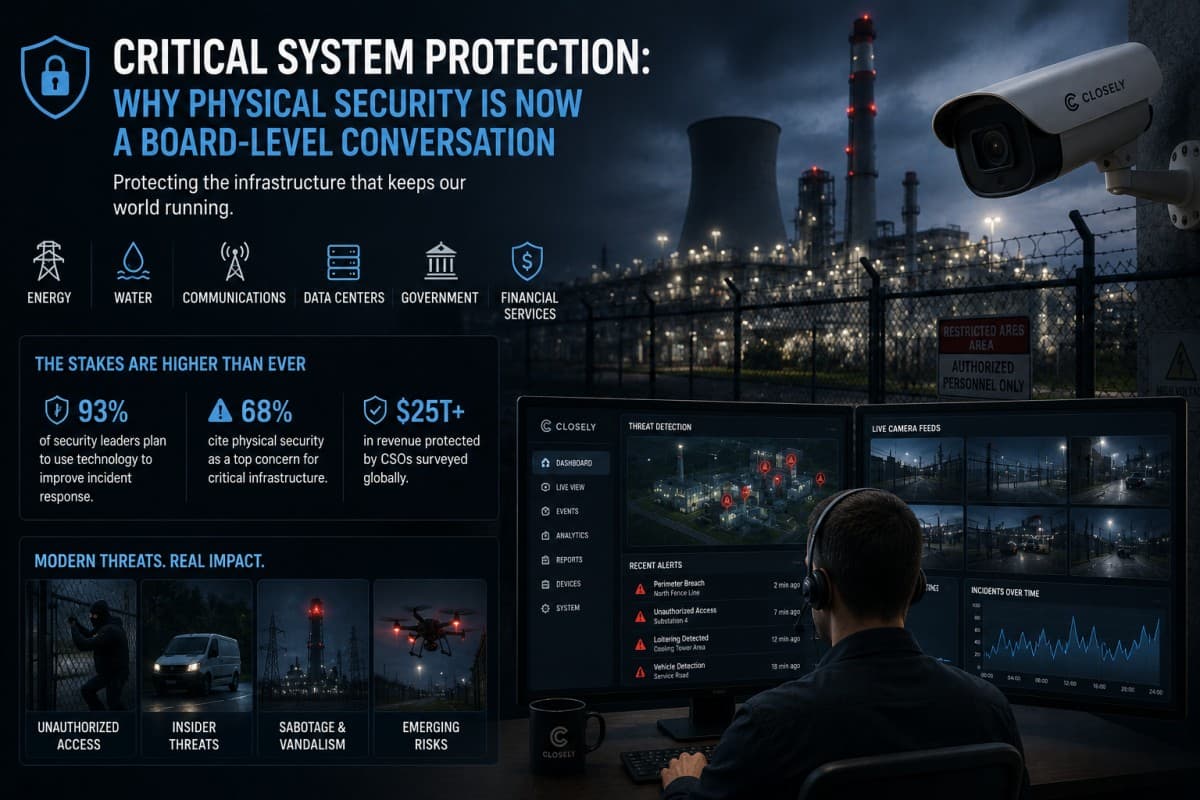
Power grids, water treatment plants, data centers, financial networks. These are the systems that everything else depends on. And their physical protection has never been more complex or more consequential.
The Stakes Have Changed
There was a time when critical system protection meant a fence, a guard post, and a camera at the gate. That era is over. The systems that underpin modern society, energy infrastructure, telecommunications networks, water and sanitation facilities, transportation hubs, financial institutions, government facilities, have become both more interconnected and more exposed. An attack on one does not stay contained to one.
The 2026 World Security Report surveyed 2,352 chief security officers across 31 countries representing companies with combined revenues exceeding $25 trillion. The picture that emerges is consistent: the aperture of security risk has widened dramatically. CSOs are being asked to answer for business continuity, operational resilience, and physical security simultaneously, often to boards that now treat security incidents as material risks to shareholder value.
For organizations managing critical infrastructure security, the question is no longer whether to take physical protection seriously. It is whether the tools and processes in place are adequate for a threat environment that has fundamentally changed.
The answer, for a large proportion of organizations across the United States and Latin America, is that they are not. The gap between the sophistication of modern threats and the capability of deployed physical security systems is real and growing.
What Makes a System Critical and Why Physical Security Matters
Defining Critical Infrastructure
Critical infrastructure protection covers systems whose disruption would have cascading consequences across society. In the United States, the Cybersecurity and Infrastructure Security Agency (CISA) identifies 16 critical infrastructure sectors including energy, water and wastewater, transportation, communications, healthcare, financial services, government facilities, and defense industrial base.
In Latin America, the definition varies by country but the underlying logic is the same: certain systems are so foundational to economic and social functioning that their failure or compromise creates consequences well beyond the immediate incident. A water treatment facility that stops operating affects public health across an entire city. A power substation that fails affects hospitals, communication networks, traffic management, and emergency services simultaneously. A data center that is physically compromised can expose sensitive data for millions of people.
What connects all of these is that physical security is not just a secondary concern after cybersecurity. In many cases, physical access is the prerequisite for a digital attack. A sophisticated intrusion into a utility control system often begins with someone gaining unauthorized physical access to a facility. Critical system security starts at the perimeter, at the access point, and at the security operations center monitoring it all.
The Physical Attack Surface Is Larger Than Most Organizations Admit
For most organizations managing critical infrastructure, the physical attack surface is larger and more complex than their security programs acknowledge.
Consider a regional electrical utility. The generating stations get attention. The main control facility gets security investment. But the transmission infrastructure, the substations scattered across hundreds of kilometers, the communications towers that link the control systems, the access roads that maintenance crews use, these are all part of the physical attack surface. Securing the headline facility while leaving the supporting infrastructure inadequately monitored is a common pattern in critical infrastructure security programs across both the US and Latin America.
The same pattern appears in telecommunications. The data center gets hardened. The network operations center gets access control. But the physical cable routes, the street-level junction points, the field equipment housing, these often sit in environments where the monitoring is minimal and the response time after a physical incident is long.
The Modern Threat Landscape for Critical Infrastructure
Physical Threats Are Becoming More Sophisticated
Critical infrastructure protection has to contend with a threat landscape that is qualitatively different from what existed a decade ago. Physical attacks on infrastructure are no longer limited to opportunistic vandalism or single-actor incidents. Organized criminal activity targeting supply chains, coordinated attacks against utility infrastructure, insider threats from personnel with legitimate access, and sabotage attempts that are designed to look like accidents are all documented threat patterns across both the US and LATAM.
The 2026 World Security Report found that 93% of security decision-makers plan to use technology to improve incident response, specifically to reduce impact and accelerate recovery. That figure reflects an organizational recognition that preventing every incident is not realistic. The strategic goal is detection speed and response effectiveness.
For critical system protection, detection speed is particularly consequential. An intrusion that is detected within 30 seconds while the attacker is still at the perimeter has a fundamentally different outcome than one detected after the attacker has reached the target system. The time between physical breach and discovery is what determines whether a security incident becomes a resilience-testing event or an operational crisis.
Insider Threats and Access Control Complexity
Insider threats represent a specific and particularly difficult challenge for critical infrastructure security. Personnel with legitimate access to critical systems are, by definition, more difficult to detect through perimeter security measures. The threat is not the unauthorized person at the fence. It is the authorized employee who accesses a restricted area outside their normal schedule, who visits systems they have no operational reason to interact with, or who removes materials that should not leave a secure zone.
This is where continuous monitoring and behavioral analytics change the calculus for critical infrastructure security programs. The question is not just "who is allowed to be here" but "does the behavior of this authorized person match the expected pattern for their role and their schedule." That distinction requires monitoring capability that goes beyond access logs and periodic audits.
AI Monitoring in Critical System Protection
Why Human-Only Monitoring Falls Short
Critical system security has historically relied heavily on human monitoring: guards at perimeter points, operators watching camera feeds, periodic patrols of vulnerable sites. This model has a fundamental limitation that becomes more acute as facilities grow larger and camera networks expand.
A single operator can realistically monitor six to eight camera feeds with genuine attention. A major utility installation might have hundreds of cameras covering generating equipment, perimeter fencing, access roads, substations, and control facilities. A water treatment complex might span multiple sites across a geographic area. No realistic guard staffing model closes that coverage gap through human monitoring alone.
AI-powered critical system monitoring closes it differently. Computer vision systems that analyze every camera feed simultaneously, continuously, do not have the attention limitations of human operators. They can monitor all feeds at once, identify behavioral anomalies against learned baselines for each location, and surface validated alerts to human operators who then make response decisions. The human judgment remains in the loop. What changes is that human judgment is directed toward genuine anomalies rather than spent monitoring feeds where nothing is happening.
What AI Detection Looks Like for Critical Infrastructure
For organizations managing critical infrastructure protection, the AI detection capabilities that matter most include several overlapping layers.
Perimeter and zone monitoring uses virtual boundaries configured around sensitive areas to detect entry or approach by unauthorized individuals or vehicles. For large utility sites, this means continuous monitoring of fence lines, access roads, and buffer zones around critical equipment, flagging anomalous presence at any point along those perimeters in real time.
Behavioral anomaly detection identifies activity that deviates from learned baselines for each camera location. An authorized employee accessing a restricted equipment area during normal working hours is baseline behavior. The same employee accessing the same area at 2am on a weekend with no scheduled maintenance logged is a behavioral anomaly worth surfacing immediately.
Access control correlation links physical access events with camera-based identity verification. When a card is used at an access point, the system can verify that the person entering matches the credential used, flagging cases where a credential is being used by someone other than the authorized holder, one of the primary physical security indicators of insider threat activity.
Vehicle monitoring at critical infrastructure sites tracks vehicle access patterns, identifies vehicles that do not match expected profiles for the site, and detects vehicles that park or stop in locations that suggest surveillance or positioning rather than legitimate operational activity.
After-hours and off-schedule monitoring applies heightened detection sensitivity during periods when authorized activity should be minimal. Many attacks on critical infrastructure occur during off-hours specifically because security attention is reduced. AI monitoring systems that maintain consistent detection quality around the clock address this directly.
Critical System Protection in the US and LATAM Context
The United States Regulatory and Threat Environment
In the US, critical infrastructure protection operates within a well-developed regulatory framework. CISA coordinates national policy. Sector-specific agencies govern individual verticals: the Department of Energy for the energy sector, the EPA and AWIA for water systems, the FCC for communications. Most critical infrastructure sectors have developed or mandatory cybersecurity frameworks, and physical security standards are increasingly tied to regulatory compliance requirements.
The practical reality for security operators serving US critical infrastructure clients is that documentation and audit trails are not optional. Every access event, every security alert, every incident response action needs to be logged in a format that supports regulatory review. AI monitoring systems like Closely that generate structured, auditable incident records are not just operationally useful. They are a compliance requirement.
For US critical infrastructure operators evaluating AI monitoring, NDAA compliance is also a consideration. Camera hardware from Hikvision and Dahua is restricted for federal procurement under Section 889. AI monitoring platforms that work with NDAA-compliant camera alternatives, including Axis, Hanwha, Avigilon, and Bosch, ensure that the AI layer does not create procurement complications for federally connected facilities.
The Latin American Context
In Latin America, critical infrastructure security faces a different combination of challenges. The threat environment is characterized by higher baseline physical insecurity in many regions, significant variation in regulatory frameworks across countries, and physical infrastructure that in many cases predates modern security design principles.
The water systems, power grids, telecommunications networks, and transportation infrastructure across Colombia, Mexico, Peru, Chile, Brazil, and other LATAM countries are simultaneously critical to economic functioning and, in many cases, physically accessible in ways that comparable infrastructure in the US or Europe would not be. Substations located in areas with elevated crime and limited law enforcement response time, communication infrastructure positioned in remote areas with minimal monitoring, water treatment facilities with perimeters that reflect budget constraints rather than threat assessments, these are real conditions in many LATAM critical infrastructure deployments.
AI monitoring technology that connects to existing camera infrastructure without requiring full hardware replacement has particular relevance here. The economics of deploying full new security infrastructure across large distributed critical infrastructure networks in LATAM are not viable for most operators. Activating AI detection on existing cameras, improving alert quality to focus human attention where it matters, and generating structured incident data that supports better response protocols, this is the practical path to improved critical system protection in many LATAM environments.
How Closely Supports Critical System Protection
Closely is designed to work as the AI intelligence layer above existing physical security infrastructure, which makes it directly relevant to critical infrastructure protection programs where hardware replacement is not feasible and where the monitoring challenge is fundamentally one of coverage quality rather than coverage quantity.
The platform provides AI-powered critical system monitoring by connecting to existing IP cameras, NVRs, and DVRs via standard RTSP and ONVIF protocols, across any manufacturer ecosystem. AI-powered critical system monitoring runs continuously across every connected feed, applying learned baselines for each camera location and flagging anomalies in real time to security operators in a centralized interface.
For critical infrastructure sites with multiple facilities across a geographic area, Closely provides unified visibility from a single SOC interface rather than requiring operators to manage each site independently. A security operator monitoring a water utility's treatment facilities, pumping stations, and storage sites from a single interface, with AI detection running across all camera feeds and validated alerts flowing into one prioritized queue, has fundamentally different situational awareness than the same operator checking into individual site systems sequentially.
Every validated alert generates a structured incident record: timestamp, camera location, detection type, confidence score, visual evidence, and operator response. That audit trail supports regulatory compliance requirements, after-action review, and the kind of pattern analysis that reveals whether a site is experiencing isolated incidents or a systematic pattern that warrants escalated response.
For security operators and critical infrastructure managers in the US and Latin America evaluating how to improve physical security monitoring without full infrastructure replacement, Closely is worth a direct conversation about how AI detection maps to your specific facility profile and threat environment.
10 Frequently Asked Questions About Critical System Protection
1. What is critical system protection and which facilities does it apply to? Critical system protection refers to the physical and operational security measures applied to infrastructure whose disruption would have significant cascading consequences across society. In the US, CISA identifies 16 critical infrastructure sectors including energy, water and wastewater, communications, transportation, healthcare, and financial services. In Latin America, the classification varies by country but the underlying concept is consistent: facilities and systems that are foundational to economic and social functioning require a higher standard of security than conventional commercial properties. Physical protection is a core component alongside cybersecurity and operational resilience.
2. Why is physical security so important for critical infrastructure if cybersecurity gets most of the attention? Physical access is frequently the prerequisite for successful attacks on critical systems. Many cyber intrusions into operational technology or industrial control systems begin with unauthorized physical access to a facility, a server room, or a field equipment enclosure. Critical infrastructure security programs that focus heavily on cyber defenses while leaving physical monitoring inadequate create a gap that sophisticated attackers know how to exploit. Physical and cyber security are not competing priorities. They are interdependent layers of the same protection program.
3. How does AI monitoring improve critical infrastructure security compared to traditional guard-based approaches? Traditional guard-based monitoring has a fundamental attention limitation: a human operator can effectively watch six to eight camera feeds at once. Large critical infrastructure sites with hundreds of cameras across multiple zones cannot be adequately covered by human monitoring alone at any realistic staffing level. AI-powered critical system monitoring processes every camera feed simultaneously and continuously, identifying anomalies against learned baselines for each location and surfacing validated alerts to human operators in real time. The human judgment and response capability remains central. What AI changes is how efficiently that judgment is directed.
4. What specific behaviors does AI detect that traditional motion-triggered cameras miss? Traditional motion detection fires on any movement, generating enormous false positive volumes that operators learn to ignore. AI behavioral detection identifies specific patterns that are genuinely anomalous given the context of each location: unauthorized presence in a restricted zone, access outside of expected schedule patterns, a vehicle stopping in a location that suggests surveillance rather than legitimate operational activity, a credential being used by someone who does not match the authorized holder's visual profile. For critical infrastructure protection, the distinction between an alert that fires for every passing car and an alert that fires because an unrecognized vehicle has stopped outside a substation for 45 minutes is the difference between alert fatigue and actionable intelligence.
5. How does AI monitoring handle insider threats at critical infrastructure facilities? Insider threats are particularly difficult because the individual has legitimate access to the facility. Critical system security programs address this through behavioral monitoring rather than access control alone: looking not just at who is present but at whether their behavior matches expected patterns for their role, their schedule, and the specific area they are accessing. An authorized maintenance technician accessing a restricted equipment area during their scheduled shift is normal. This is exactly the kind of context that separates effective critical system security from generic access logging. The same individual accessing the same area at 2am with no maintenance logged is a behavioral anomaly. AI detection systems that apply learned baselines for each camera location and each time window can surface these behavioral deviations in real time rather than discovering them in retrospective log reviews.
6. What are the documentation and audit requirements for physical security at critical infrastructure facilities? Documentation requirements vary by sector and jurisdiction. In the US, CISA provides sector-specific guidance and many critical infrastructure sectors have regulatory frameworks that include physical security documentation requirements. Water systems are governed by AWIA, the energy sector has NERC CIP standards for certain facilities, and financial institutions have physical security requirements under various regulatory frameworks. In Latin America, requirements vary significantly by country and sector. Across both markets, the trend is toward more systematic documentation rather than less. AI monitoring systems like Closely that generate structured, timestamped, auditable incident records address compliance documentation requirements as a byproduct of normal operations rather than as a separate reporting function.
7. How does critical infrastructure security differ between the US and Latin America? Both markets face the same fundamental challenge: protecting systems whose failure creates broad societal consequences. The differences are in regulatory frameworks, threat environments, and infrastructure conditions. The US has more developed sector-specific regulatory standards and a more sophisticated baseline security infrastructure. Critical infrastructure security in LATAM operates in environments where physical insecurity is often higher, regulatory requirements are less standardized across countries, and the physical condition of infrastructure and its security installations reflects budget constraints that limit what is practically achievable. AI monitoring that activates on existing camera infrastructure rather than requiring full hardware replacement is particularly relevant in LATAM, where the economics of full infrastructure upgrades are often not viable.
8. Can Closely work with the camera systems already installed at critical infrastructure facilities? In most cases, yes. Closely connects to IP cameras via standard RTSP and ONVIF protocols, which are supported by virtually all current-generation cameras from major manufacturers including Axis, Hanwha, Bosch, Avigilon, and others that are commonly deployed at critical infrastructure facilities in the US. For LATAM installations using Hikvision and Dahua cameras, which are common given the cost profile of the region, the same connection approach applies. The AI detection layer sits above the existing camera infrastructure without requiring hardware replacement or changes to existing recording configurations.
9. What is the role of a Security Operations Center in critical infrastructure protection? A Security Operations Center is the centralized function responsible for monitoring, detecting, and coordinating response to security events across a facility or portfolio of facilities. For critical system protection, the SOC is where physical monitoring, access control events, alarm management, and AI detection alerts converge. The effectiveness of a SOC depends on the quality and relevance of the information flowing into it. An SOC that receives hundreds of undifferentiated motion alerts per shift operates very differently from one that receives a curated stream of validated, contextually rich anomaly alerts. AI detection significantly improves SOC effectiveness by filtering the alert stream and surfacing only genuine anomalies with visual evidence attached.
10. How does AI monitoring for critical infrastructure handle large geographic coverage across distributed sites? This is one of the most practically important questions for utilities, telecommunications operators, and transportation networks with infrastructure spread across large geographic areas. Closely provides a unified monitoring interface that consolidates camera feeds and alerts across all connected sites into a single SOC view. A security operator monitoring a regional water utility with treatment facilities, pumping stations, and storage sites spread across a metropolitan area sees all camera feeds and all alerts in one interface rather than switching between individual site systems. AI detection runs continuously across all feeds, maintaining consistent monitoring quality across all sites simultaneously rather than requiring operators to allocate attention site by site.