Closely vs. Verkada: Which AI Security Platform Is Right for Your Operation?
Verkada requires proprietary hardware. Closely activates AI on cameras you already have. An honest comparison of both platforms to help you make the right decision.
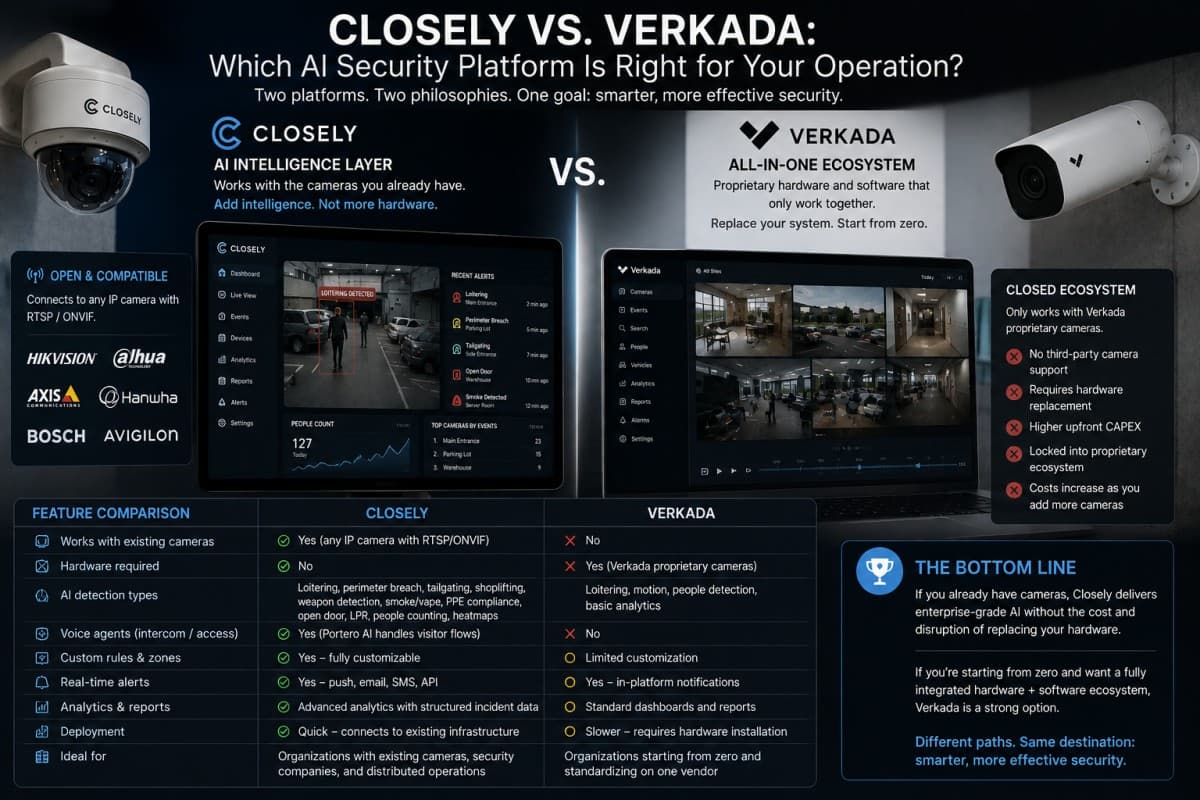
If you are evaluating an AI security camera platform, you have probably come across both Closely and Verkada. They solve similar problems in fundamentally different ways. Here is an honest breakdown to help you decide.
Two Different Philosophies, One Goal
Both Closely and Verkada exist to make security monitoring more intelligent and more effective. If you are looking for a Verkada alternative that works on your existing cameras, or evaluating Verkada for the first time, this comparison covers both scenarios honestly. That is where the similarities largely end. The two platforms reflect two fundamentally different philosophies about how AI-powered security should work.
Verkada is a vertically integrated security platform. It sells proprietary hardware, specifically its own cameras, and software that only works with that hardware. The system is designed to be replaced rather than built on top of existing infrastructure. Verkada's business model depends on you buying their cameras.
Closely is an AI intelligence layer. It connects to cameras you already have installed, from any manufacturer, and adds detection capabilities on top without requiring hardware replacement. The business model depends on delivering value through software, not selling you new equipment.
When evaluating any AI security camera platform, neither approach is inherently wrong. The right choice depends on your situation. This comparison is designed to help you understand both honestly.
The Core Difference: Hardware vs. Software Intelligence
Verkada: Closed Ecosystem, Proprietary Hardware
Verkada's approach is to own the full stack. Their cameras have onboard processing. Their software platform works exclusively with their cameras. When you buy into Verkada, you are committing to their hardware ecosystem for the life of those cameras.
For organizations starting from zero with no existing camera infrastructure, this can be a clean, well-designed option. Verkada's cameras are modern, their interface is polished, and the integrated experience has real appeal for teams that want everything from one vendor.
The trade-off is significant for anyone who already has cameras installed. Verkada does not integrate with third-party cameras. If you have a 200-camera installation from Hikvision, Dahua, or Axis, Verkada's value proposition requires you to throw that away and start over. That is a capital expenditure decision that goes well beyond the software evaluation.
In Latin America, where large existing CCTV deployments are the norm and hardware replacement represents a significant and often impractical investment, this limitation is particularly relevant. Most security operators in Colombia, Mexico, Peru, and other LATAM markets manage camera fleets that were installed over years, across multiple manufacturers, and the idea of replacing all of it to access a new analytics platform is not realistic for most operations.
Closely: Open AI Layer on Existing Infrastructure
Closely works differently by design. As an open AI security platform, it connects to any IP camera that supports RTSP and ONVIF protocols, which covers virtually every current-generation camera from Hikvision, Dahua, Axis, Hanwha, Avigilon, Bosch, and most other manufacturers. No hardware replacement. No proprietary camera requirement.
The AI detection, the alert prioritization, the structured incident data, all of it runs on top of your existing camera infrastructure. The cameras you have already installed and paid for become the sensor layer for Closely's intelligence platform.
For organizations with existing camera investments, this changes the financial conversation entirely. Instead of a hardware capital expenditure to replace working cameras, Closely is a software subscription that activates intelligence on infrastructure you already own.
Feature Comparison
| Verkada | Closely | |
|---|---|---|
| Works with existing cameras | No | Yes (any IP camera with RTSP/ONVIF) |
| Hardware required | Yes (Verkada proprietary cameras) | No |
| AI detection types | Loitering, motion, basic analytics | Loitering, perimeter breach, tailgating, shoplifting, weapon detection, smoke/vape, PPE compliance, open door, LPR, people counting, heatmaps |
| Voice agents (intercom/access) | No | Yes (Portero AI handles visitor flows) |
| Guard deployment and supervision | No | Yes (Supervisor agent tracks guard rounds) |
| Automated reporting and audit logs | Basic | Yes (Reporter agent, fully structured) |
| Custom detection rules per site | Limited | Fully configurable per camera and industry |
| Industry-specific configurations | Generic ruleset | Retail, industrial, education, residential, shopping malls, logistics, and more |
| Learns from your environment | Basic | Yes, continuous baseline learning |
| Multi-site SOC management | Yes | Yes |
| Alert validation before operator | Partial | Full three-tier validation pipeline |
| Structured incident data output | Basic logs | Full structured records with AI metadata |
| LATAM deployment | Limited | Active, designed for LATAM operators |
| NDAA-compliant hardware | Yes (own cameras) | Compatible with all NDAA-compliant brands |
| Pricing model | Hardware + software subscription | Software subscription only |
| Vendor lock-in | High (proprietary ecosystem) | Low (any compatible camera) |
Detection Capabilities: What Each Platform Actually Detects
Verkada's Detection Suite
Verkada offers a solid set of AI detection capabilities within its proprietary ecosystem. The platform includes motion-based analytics, person detection, crowd alerting, and some behavioral detection features. Their interface for reviewing footage and managing alerts is well-designed and accessible.
The limitation is that Verkada's detection capabilities are defined by what Verkada has built and chosen to include. When your operational needs require a detection type that Verkada has not prioritized, your options are limited: wait for them to add it or work around the gap.
Closely's Detection Suite
As an AI security camera platform, Closely's detection is configured per camera and per site, which means the system adapts to the specific risk profile of each location rather than applying a fixed set of generic rules across every installation.
Current detection capabilities include loitering detection with time-window context, perimeter breach with learned baselines, tailgating and access control correlation, shoplifting behavioral detection for retail environments, AI weapon detection through computer vision, smoke and vape detection via camera, PPE and uniform compliance validation for industrial and construction environments, open door alerts with operational context, license plate recognition (currently in active development), people counting, and heatmap generation for traffic pattern analysis.
The configurable nature of the detection layer means that a retail client and an industrial facility and a residential building can all be served through the same platform with detection rules that reflect their specific operational contexts rather than a one-size-fits-all ruleset.
The SOC Operations Difference
For security companies and monitoring centers evaluating any open AI security platform to manage multiple client sites from a centralized SOC, the operational model of each platform matters significantly.
Verkada provides multi-site management within its ecosystem. For organizations where every client site already runs Verkada hardware, this works cleanly. The unified dashboard shows events across all sites and the interface is consistent.
The challenge appears when a security company's client portfolio is heterogeneous, which is the reality for virtually every security operator in both the US and Latin America. Some clients have Hikvision NVRs. Others have Dahua cameras. A few have Axis hardware. One has a legacy analog installation with a hybrid DVR. Verkada cannot serve that mixed portfolio because it only connects to its own cameras.
Closely is built for exactly that reality. The platform manages heterogeneous camera fleets across multiple client sites from a single interface, applying AI detection regardless of the camera manufacturer at each site. For security operators whose value proposition is protecting whatever infrastructure their clients already have, this flexibility is not a secondary consideration. It is the core requirement.
Pricing Philosophy
Verkada combines hardware and software costs. The upfront camera purchase plus the annual licensing fee creates a total cost of ownership that is higher than a software-only approach, particularly at scale. For organizations replacing existing infrastructure, there is also the sunk cost of whatever cameras they are retiring.
Closely's pricing is camera-based software subscription only, meaning the cost scales with the number of cameras being monitored rather than with hardware purchases. For security operators adding new client sites, this means activating a new site is a software configuration rather than a hardware procurement process.
The precise pricing for either platform depends on scale and configuration. For an accurate comparison against your specific situation, both vendors should be contacted directly. What is relevant here is the structural difference: one model includes hardware cost, the other does not.
Who Each Platform Is Built For
Verkada Is a Good Fit If You:
Have no existing camera infrastructure and are building from scratch (in that case, Closely is still a strong Verkada competitor worth comparing). Have a corporate IT team comfortable with a fully managed, single-vendor security ecosystem. Operate in environments where Verkada's camera hardware can be installed without regulatory complications. Are comfortable with vendor dependency on proprietary hardware for the life of your security system.
Closely Is a Good Fit If You:
Have existing IP cameras you want to keep and activate with AI detection. Manage multiple client sites with different camera brands and configurations. Operate a security company or monitoring center serving a diverse client portfolio. Are in Latin America where hardware replacement economics favor software-on-existing-infrastructure approaches. Need detection capabilities that are configurable to your specific industry, whether that is retail, industrial, education, residential buildings, shopping malls, logistics, or any other vertical with distinct operational security needs. Want voice agent capability for intercom and visitor management without additional hardware. Need guard supervision and automated reporting as part of the same platform rather than separate tools. Want to avoid proprietary hardware lock-in and maintain flexibility over your camera ecosystem.
A Note on Intellectual Honesty
This comparison was written by Closely, the most relevant Verkada competitor for organizations with existing camera infrastructure. We have been straightforward about where Verkada has strengths, specifically their clean integrated experience for greenfield deployments. We have been equally straightforward about where Closely has strengths.
The market reality is that most security operations, particularly in Latin America and for multi-site security companies in both markets, are not starting from zero. They have existing infrastructure. They need AI intelligence that works with what they have, not a replacement for it.
If your situation fits that description, Closely is worth a direct evaluation as the Verkada competitor built for existing infrastructure. If you are genuinely starting from scratch with no existing cameras, Verkada deserves to be on your shortlist alongside Closely as another strong Verkada competitor worth evaluating.
The goal of this comparison is to help you choose the right AI security camera platform for your operation. If you need a Verkada alternative that does not require hardware replacement, Closely is worth evaluating. If Verkada's integrated hardware approach fits your situation, it deserves an honest look too.
10 Frequently Asked Questions About Closely vs. Verkada
1. What is the main difference between Closely and Verkada? The fundamental difference is hardware dependency. Verkada is a closed ecosystem that requires you to purchase and install Verkada's proprietary cameras. Its AI analytics only work with Verkada hardware. Closely is an open AI platform that connects to cameras you already have from any major manufacturer, including Hikvision, Dahua, Axis, Hanwha, and Avigilon, via standard protocols. If you have existing cameras, Closely activates AI detection on them. Verkada requires replacing them.
2. Can Closely work with cameras from different manufacturers in the same installation? Yes. Closely connects to any IP camera that supports RTSP and ONVIF protocols, which covers virtually all current-generation cameras from every major manufacturer. A single installation with Hikvision cameras in some zones, Dahua in others, and Axis at entry points can all be connected to Closely and managed from one interface. Verkada cannot do this because it only works with its own proprietary hardware.
3. If I already have cameras installed, do I need to replace them to use Closely? No. If your existing cameras are IP cameras with RTSP support, which covers the vast majority of cameras installed in the last decade, they can connect to Closely without any hardware changes. The AI detection layer runs on top of your existing camera infrastructure. This is one of the most significant practical advantages Closely has over Verkada for organizations with any existing camera investment.
4. Does Verkada work with existing cameras from other brands? No. Verkada's platform is designed around its own proprietary camera hardware and does not integrate with third-party cameras. If you want to use Verkada, you need to install Verkada cameras. For organizations with significant existing camera deployments, this means Verkada requires replacing working infrastructure to access the platform's capabilities.
5. How does Closely's AI detection compare to Verkada's in terms of what it can detect? Both platforms offer AI-based detection of common security events. Closely's detection suite includes configurable detection types that can be tailored to specific industry contexts: shoplifting behavioral detection for retail, PPE compliance for industrial environments, weapon detection, smoke and vape detection, tailgating with access control correlation, and license plate recognition in active development, among others. Closely's detection rules are configurable per camera and per site, meaning the system adapts to the specific risk profile of each location rather than applying fixed generic rules.
6. Which platform is better for a security company managing multiple client sites with different camera brands? Closely is significantly better suited for this use case. Security companies and monitoring centers managing heterogeneous camera fleets across multiple clients, which describes the reality of virtually every security operator in the US and Latin America, need a platform that works with whatever cameras each client has installed. Closely connects to all major camera brands from a single interface. Verkada only works with its own cameras, which means it cannot serve clients who have non-Verkada infrastructure.
7. Is Closely available in Latin America and does it work for LATAM security operations? Yes. Closely is actively deployed with security operators in Latin America and is designed around the operational realities of LATAM security markets, where large existing camera deployments are common and hardware replacement economics favor software-on-existing-infrastructure approaches. Verkada has more limited presence and deployment experience in LATAM markets.
8. How does pricing compare between Closely and Verkada? Verkada combines hardware costs for proprietary cameras with an annual software subscription, creating a total cost of ownership that includes both capital equipment and recurring fees. Closely charges a software subscription only, with no hardware purchase required. For organizations with existing cameras, the comparison is particularly stark: Closely activates on infrastructure you already own, while Verkada requires purchasing new hardware. For anyone evaluating Closely as a Verkada alternative, the pricing difference is particularly relevant: Closely activates on cameras you already own, which changes the total cost calculation significantly. For an accurate comparison against your specific camera count and configuration, contacting both vendors directly is recommended.
9. Does Closely or Verkada offer better options for NDAA compliance in the United States? Both platforms can be deployed in NDAA-compliant configurations. Verkada's own proprietary cameras are NDAA-compliant. Closely is compatible with all NDAA-compliant camera brands including Axis, Hanwha, Avigilon, and Bosch, and the AI detection layer works the same way regardless of which compliant brand is used. For US federal facilities or federal contractors with procurement restrictions on Hikvision and Dahua, both platforms can meet compliance requirements, though the camera ecosystem approach differs.
10. What should I actually evaluate before choosing between Closely and Verkada? Start with your existing infrastructure. If you have significant IP camera deployments already in place, the case for Closely over Verkada is strong on economics alone, since Closely works with your existing cameras while Verkada requires replacing them. If you are starting from scratch with no cameras, evaluate both on detection capability, interface quality, support, and total cost of ownership over three to five years. Then consider your operational model: if you manage multiple sites with mixed camera brands, Closely's open AI security platform is a structural fit that Verkada's closed ecosystem cannot match. Closely offers direct evaluations where you can test the open AI security platform against your specific camera infrastructure before making a commitment.