World Space Week 2026: "Rocket Revolution" and Why Space Technology Changed Security on Earth
World Space Week 2026, October 4-10: the Rocket Revolution theme, events in LATAM and the U.S., and how space tech connects to security.
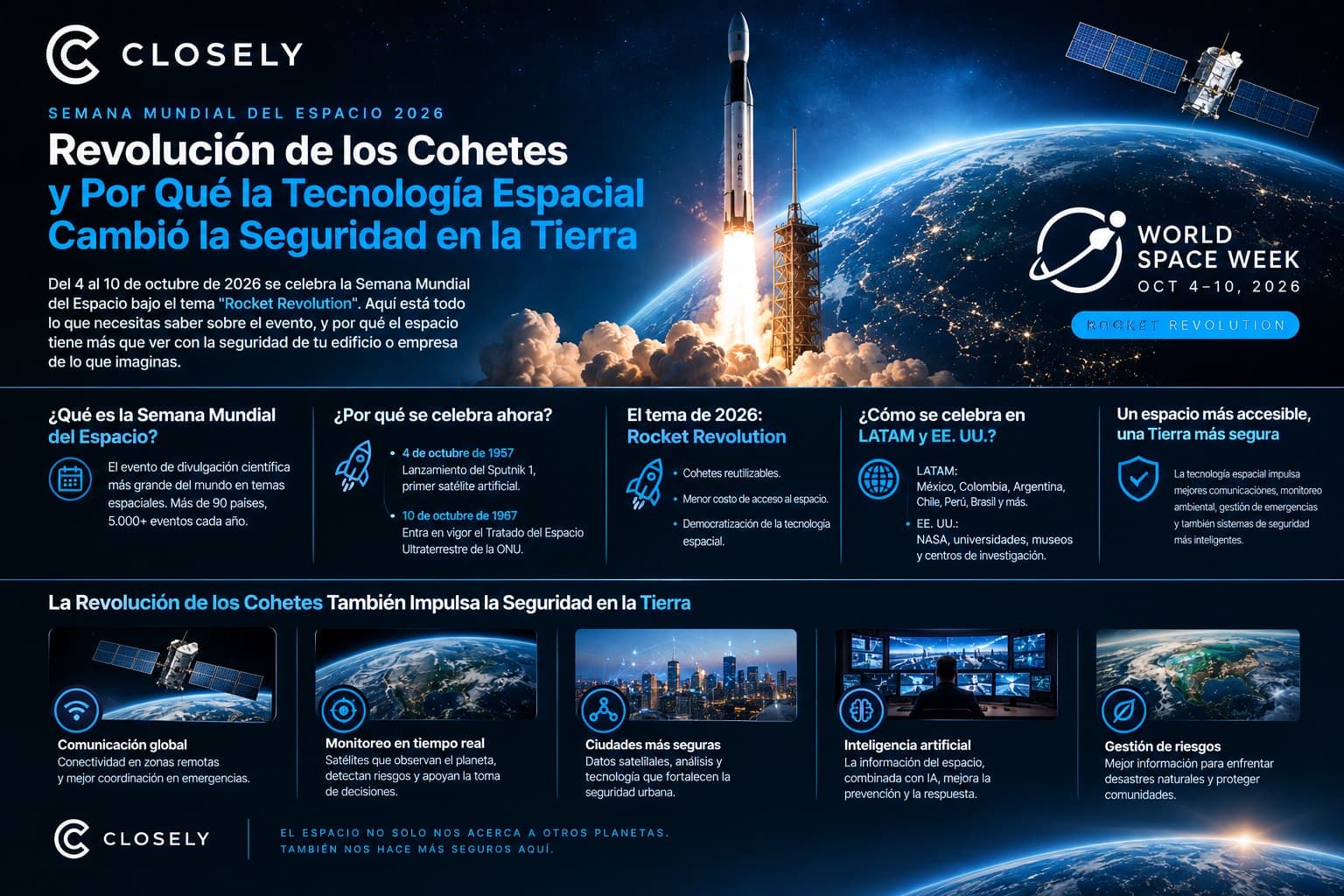
From October 4 to 10, 2026, the world celebrates World Space Week under the theme "Rocket Revolution." Here's everything you need to know about the event, and why space has more to do with the security of your building or company than you might imagine.
What World Space Week Is and Why It's Celebrated Now
Every year, from October 4 to 10, more than 90 countries celebrate World Space Week, the largest public science outreach event in the world on space science and technology. It's organized by the World Space Week Association in coordination with the United Nations Office for Outer Space Affairs.
The dates aren't arbitrary. On October 4, 1957, the Soviet Union launched Sputnik 1, the first artificial satellite in history. When Sputnik began orbiting Earth emitting its famous radio beep, it forever changed humanity's relationship with space and kicked off the space age. And on October 10, 1967, the Treaty on Principles Governing the Activities of States in the Exploration and Use of Outer Space entered into force, the first international legal framework for the use of space.
In 1999, the UN General Assembly declared that week World Space Week on a permanent basis. Since then, thousands of events take place simultaneously around the planet every year.
The 2026 Theme: Rocket Revolution
For World Space Week 2026, the official theme is "Rocket Revolution." The theme reflects the radical transformation the space industry is going through: the rise of reusable rockets, the dramatic drop in the cost of launching cargo into space, and the democratization of access to orbit, which used to be reserved for the major powers.
By 2026, private companies such as SpaceX, Rocket Lab, Blue Origin, and dozens of space startups around the world have turned what used to cost hundreds of millions of dollars into something within reach of small governments, universities, and private companies. World Space Week 2026 celebrates that transition and examines what it means for the future of humanity.
How World Space Week Is Celebrated in Latin America and the United States
In Latin America
World Space Week in Mexico is one of the most active on the continent. UNAM's Universum Science Museum in Mexico City hosts workshops, talks, and demonstrations throughout the week, with activities for the general public, students, and the scientific community.
In Colombia, World Space Week brings together universities, research centers, and scientific organizations in a format that mixes conferences with more interactive activities such as SpaceUP, an unconference where participants propose and lead the conversation topics. Fundación Universitaria Los Libertadores has been one of the host organizations in previous editions.
In Argentina, Chile, Peru, and Brazil, the week also features events across major cities, with an emphasis on science education for young people and outreach about each country's space program. Brazil, with the Alcântara Launch Center and its own space program ambitions, is particularly active.
In the United States
The United States is naturally one of the countries with the highest density of World Space Week events. As part of World Space Week 2026, NASA and its regional centers (Kennedy Space Center in Florida, Johnson Space Center in Houston, the Jet Propulsion Laboratory in California) host events open to the public, live broadcasts, and educational programs.
Universities with aerospace engineering programs, science museums, and planetariums across the country also take part with their own programming. With "Rocket Revolution" as the theme, the emphasis is on the new ecosystem of private space companies and what it means for the economy, technology, and global geopolitics.
The Rocket Revolution and What Really Changed
The World Space Week 2026 theme isn't just about propulsion. It's about a change of model with implications for the technology we use on Earth.
The Cost of Reaching Space Plummeted
In the 1990s, launching one kilogram of cargo into space cost around $54,000. With SpaceX's reusable rockets, that cost dropped to under $3,000 per kilogram on some launches, and it keeps falling. That cost reduction isn't just a technical achievement: it's what made possible the deployment of low-cost satellite constellations that now provide high-speed internet in remote areas, real-time Earth observation data, and communication capabilities that used to require massive ground infrastructure.
The Satellites That Changed Security on Earth
This is where the connection between space and physical security becomes very concrete.
GPS, which most people take for granted as a navigation technology, is a system of 31 satellites in medium Earth orbit that is also the foundation of the fleet tracking, vehicle monitoring, and security staff coordination systems used today by tens of thousands of companies in Latin America and the United States.
Earth observation satellites, whose resolution has improved dramatically in recent years, provide up-to-date imagery of critical facilities, borders, conflict zones, and high-risk areas that many countries' national security systems integrate into their threat assessments.
Satellite communications ensure that security systems in remote areas, industrial facilities without cellular coverage, and emergency response teams in difficult terrain stay connected when ground infrastructure fails.
The AI That Went to Space Before It Reached Security Cameras
This is the part that's rarely told: many of the artificial intelligence technologies applied today in security cameras, video analysis, and anomaly detection have roots in space research.
Computer vision, the foundation of event detection systems in video surveillance, developed and matured partly thanks to satellite image processing programs. Space agencies needed to process millions of images of Earth's surface to identify relevant patterns, and the algorithms developed for that are the direct ancestors of the detection models that today analyze what happens in the hallway of a corporate building.
Sensor fusion, time-series anomaly detection, and machine learning for object classification in images are technologies that NASA and European space agencies developed decades before video surveillance systems adopted them.
Rocket Revolution: What's Next in Space and Its Effects on Security
The "Rocket Revolution" celebrated during World Space Week 2026 isn't over. What comes next has direct implications for physical security on Earth.
More low-orbit satellites mean greater coverage and lower latency for satellite communications, improving connectivity for security systems in remote areas and providing redundancy for critical facilities that can't rely on ground infrastructure alone.
Better satellite imagery at lower cost means Earth observation becomes democratized, not just for governments but for infrastructure operators who want to monitor facilities spread over large areas.
More reusable rockets mean more access to space for more players, including Latin American countries developing their own space programs that will eventually have independent observation capabilities.
Space Technology in the Day-to-Day of Physical Security
At Closely AI we work with technology that, although it operates on Earth, shares the same technological lineage that World Space Week celebrates. Our artificial intelligence models for video analysis have roots in the same kind of research that spent decades interpreting images from space.
The computer vision that Closely's Watcher applies to detect anomalous behavior on security cameras, tell a genuine event from a false alarm, and identify threats in real time before they escalate uses the same mathematical principles that satellite image processing systems apply to analyze Earth's surface from orbit.
The difference is scale and application. What satellites do with hundreds of kilometers of Earth's surface, Watcher does with the square meters of a building, a shopping center, or an industrial facility. Anomaly detection logic, object classification, pattern learning, and noise reduction are the thread connecting both disciplines.
In the week the world celebrates space and its impact on humanity, it's worth remembering that the most transformative technologies always find unexpected applications. GPS was designed for military navigation and today coordinates the delivery of your food order. Space computer vision was designed to interpret satellite imagery and today cuts up to 88% of false alarms in security monitoring centers.
If you want to see how that technology works in your security operation, Closely offers a free two-week demo on the cameras you already have installed.
10 Frequently Asked Questions About World Space Week 2026
1. When is World Space Week 2026?
World Space Week 2026 takes place from October 4 to 10. These dates are fixed every year and were chosen by the UN to commemorate two historic milestones: the launch of Sputnik 1 on October 4, 1957, humanity's first artificial satellite, and the entry into force of the Outer Space Treaty on October 10, 1967.
2. What is the theme of World Space Week 2026?
The official theme of World Space Week 2026 is "Rocket Revolution." The theme celebrates the transformation of the space industry driven by reusable rockets and the dramatic drop in the cost of accessing space, which has allowed private companies, universities, and smaller countries to take an active part in space exploration.
3. Who organizes World Space Week?
World Space Week is organized by the World Space Week Association in coordination with the United Nations Office for Outer Space Affairs. It was declared by the UN General Assembly in December 1999. In each country, local organizations such as science museums, universities, research centers, and space enthusiast groups host their own events under the same global theme.
4. Where is World Space Week celebrated in Mexico?
World Space Week in Mexico is centered at UNAM's Universum Science Museum in Mexico City, which hosts workshops, talks, demonstrations, and interactive activities throughout the week. It isn't limited to the capital: universities and science museums in Guadalajara, Monterrey, and other cities also take part with their own programming.
5. How does space technology impact physical security on Earth?
Space technology has several direct impacts on physical security. Satellite-based GPS is the foundation of fleet tracking and security staff coordination systems. Satellite communications ensure connectivity for security systems in areas without ground coverage. And computer vision technologies originally developed for satellite image processing are the direct predecessors of the artificial intelligence systems that analyze security camera video in real time today.
6. Which Latin American countries participate most actively in World Space Week?
Mexico, Brazil, Colombia, Argentina, Chile, and Peru are the Latin American countries with the highest participation in World Space Week. Brazil is especially active given its own space program and the Alcântara Launch Center. Mexico has events in multiple cities through universities and science museums. Colombia has hosted events with international participation from NASA scientists and other agencies.
7. What is the Rocket Revolution and why is it the World Space Week 2026 theme?
The Rocket Revolution refers to the transformation of the space industry driven mainly by the development of reusable rockets. While traditional rockets were used only once, companies like SpaceX developed rockets that land and are reused, cutting the cost of launching cargo into space from more than $50,000 per kilogram to under $3,000 in some cases. That cost reduction democratized access to space and is the context World Space Week 2026 celebrates and examines.
8. What does artificial intelligence have to do with space exploration?
The connection runs deeper than it seems. AI is essential for processing the enormous amounts of data generated by telescopes, observation satellites, and space probes. The computer vision algorithms that identify galaxies in James Webb Space Telescope images are cousins of the ones that analyze security camera video on Earth. The anomaly detection techniques that spot unusual signals in astronomical data are the same ones that detect suspicious behavior at physical facilities. World Space Week 2026 is a good moment to reflect on how much space technology we use without realizing it in everyday applications.
9. How does security camera technology relate to space?
Modern security cameras and the artificial intelligence systems that power them share a technological lineage with space research. Modern computer vision developed partly out of the need to process satellite imagery at scale. Object detection and behavior classification models have roots in the systems space agencies built to interpret images of Earth's surface from orbit. Platforms like Closely apply that same detection logic to conventional security camera feeds to identify threats in real time.
10. Where can I watch World Space Week 2026 events online?
The World Space Week Association maintains an event directory on its official site (worldspaceweek.org), where you can search activities by country and city. NASA streams many of its events live on its YouTube channel and website. Participating science museums and universities in Mexico, Colombia, Argentina, and other Latin American countries also usually stream their main activities on their official YouTube channels and social media during World Space Week 2026.