License Plate Recognition Technology: How LPR Is Changing Vehicle Security in 2026
How license plate recognition works, where it adds real value, and what you need to know before deploying it — from parking access to law enforcement.
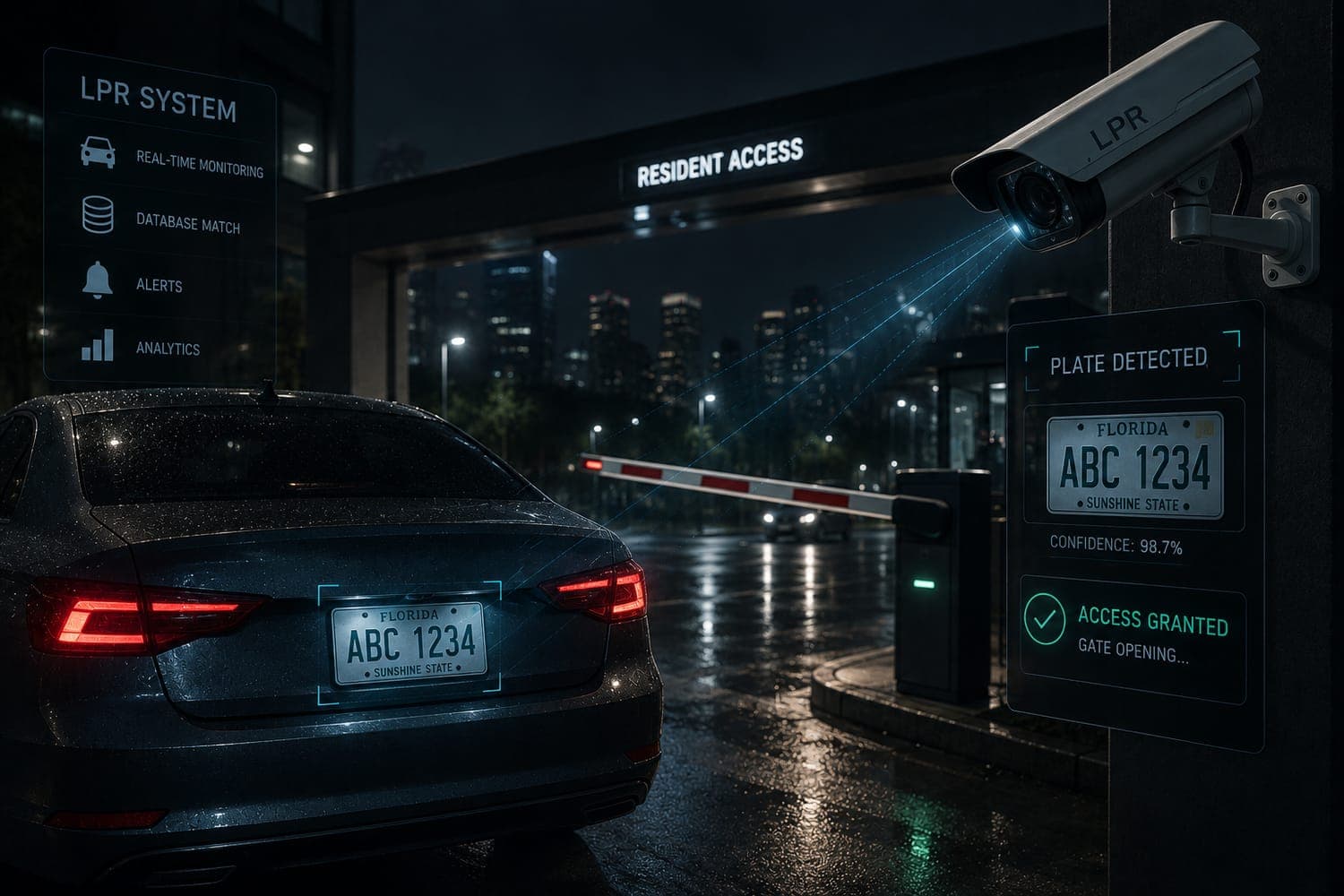
License plate recognition (LPR, also ALPR or ANPR) uses cameras and AI to read vehicle plates, convert them to text, and match them against databases — in under two seconds. What changed recently is accuracy and cost: modern AI-powered systems read plates at highway speed, at night, and at angles, on affordable cameras. Here's how it works, where it's used across the US and LATAM, and what to know before deploying it.
From parking garages to border crossings, license plate recognition is everywhere. Here's how it actually works, where it adds real value, and what you need to know before deploying it.
What license plate recognition technology actually does
Let's start with the basics, because there's a lot of confusion about what license plate recognition technology is and isn't.
At its core, license plate recognition — also called LPR, ALPR (Automated License Plate Recognition), or ANPR (Automatic Number Plate Recognition) — is a computer vision technology that uses cameras to capture images of vehicle license plates and then uses optical character recognition (OCR) software to convert those images into readable text that can be stored, searched, and matched against databases.
The output is simple: a camera sees a plate, reads it, logs it with a timestamp and location, and either triggers an action (open a gate, send an alert, flag a database match) or stores the record for later search.
What's changed dramatically in recent years is the accuracy, speed, and cost of doing this. Early LPR systems required expensive specialized cameras, perfect lighting conditions, and slow speeds. Modern license plate recognition systems powered by AI can read plates accurately at highway speeds, in rain, at night, at acute angles, and on cameras that cost a fraction of what dedicated LPR hardware used to cost. That shift has opened up the technology to applications that would have been impractical a decade ago.
How LPR technology works — without the technical jargon
The three steps behind every plate read
Every license plate recognition read happens in three stages, whether it takes a fraction of a second or a few seconds depending on the system:
1. Detection — The system identifies that there's a vehicle in the frame and locates the region of the image that contains the license plate. This is a computer vision task: the model has been trained on millions of images of vehicles and plates across different countries, lighting conditions, and angles. Modern detection models can locate a plate even when it's partially obscured, dirty, or at an angle up to about 45 degrees off-axis.
2. Segmentation and normalization — The system isolates the plate from the rest of the image, corrects for perspective distortion, and normalizes the image (adjusting brightness, contrast, and size) to give the OCR step the cleanest possible input.
3. Character recognition — The system reads each character on the plate individually and assembles them into a string. This is where AI has made the biggest gains: deep learning OCR models trained on regional plate formats — US state plates, Mexican plates, Colombian plates, Brazilian plates — are dramatically more accurate than the rule-based systems that dominated early LPR.
Once the plate string is read, it gets compared against one or more databases: an access control whitelist, a stolen vehicle registry, a watchlist of flagged plates, or simply stored in a log for historical search. The whole process — from vehicle entering frame to alert or gate action — typically takes under two seconds in modern license plate recognition systems.
Where license plate recognition is being used in 2026
Parking and access control
This is the most widespread application of license plate recognition systems in both the US and Latin America. Parking facilities, residential buildings, corporate campuses, and industrial sites use LPR to automate vehicle access: registered plates get in automatically, unregistered plates trigger a barrier to stay closed or alert a guard.
The operational benefit over traditional access control (magnetic cards, tags, remote controls) is significant. Plates can't be forgotten at home. They don't require the driver to roll down a window or fumble with a card. They're harder to share than a physical token — you'd have to share the vehicle, not just the credential. And the log created by every entry and exit event is automatically tied to a specific vehicle, not a generic credential that multiple people might use.
For residential buildings and gated communities — a model common across Latin America in countries like Colombia, Mexico, and Peru, and increasingly in US suburban markets — automated license plate recognition at the entrance gate replaces or complements a human porter and creates a searchable entry log that property managers can actually use.
Law enforcement and urban security
Law enforcement agencies across the US and Latin America deploy mobile and fixed license plate recognition systems to identify stolen vehicles, locate wanted persons, and detect vehicles of interest at checkpoints and on highways.
In the US, state and local police departments use LPR extensively — mounted on patrol cars, on fixed gantries at key intersections, and at highway toll points. The reads are compared in real time against the National Crime Information Center (NCIC) database. A match triggers an immediate alert to the officer. The volume of plates these systems process is staggering: a single patrol car LPR unit can read thousands of plates per shift, a task that would be impossible manually.
In Latin America, the adoption curve is steeper. Colombia's National Police, Mexico's federal highway authority, and several municipal governments have deployed fixed LPR infrastructure on major corridors. Security companies managing urban surveillance networks increasingly include automated license plate recognition as part of their monitoring capability — both for real-time alerting and for retrospective investigation of incident-related vehicles.
Logistics, fleets, and supply chain security
Logistics operators and port authorities use LPR technology to manage truck and vehicle flow at loading docks, warehouses, and border crossings. Every vehicle that enters or exits a controlled zone is logged automatically — no manual check-in, no paper manifests, no human bottleneck at the gate.
For last-mile delivery operations in urban environments — a sector that's grown enormously across both the US and LATAM — LPR technology at distribution centers creates clean vehicle logs that help operations managers track delivery vehicle utilization, identify unauthorized vehicles at secure facilities, and investigate theft or damage incidents tied to specific vehicle movements.
Retail and commercial real estate
Retail parking lots and commercial real estate operators use license plate recognition to understand how long customers stay, identify repeat visitors, detect vehicles associated with past incidents, and enforce parking time limits in mixed-use developments.
This application sits at the intersection of security and business intelligence: the same system that flags a vehicle on a watchlist also tells a property manager that average dwell time has increased by 20% since they opened the new tenant, or that a vehicle has been in the lot for nine hours and probably needs to be investigated.
Toll systems and traffic management
Highway toll systems across the US and Latin America are the largest-scale deployment of automated license plate recognition in existence. In the US, systems like E-ZPass in the northeast and TxTag in Texas rely on LPR to capture plates of vehicles without transponders for billing. Across LATAM, electronic tolling on major highways uses similar infrastructure.
Traffic management centers use LPR data to monitor vehicle flows, detect incidents (a vehicle stopped on a highway is detectable by the absence of a plate read that should have occurred), and manage congestion response in real time.
The AI layer that makes modern LPR work
Traditional license plate recognition systems were rule-based: they looked for a specific rectangle in a specific part of the frame, applied a fixed OCR routine, and failed whenever conditions deviated from the expected pattern.
Modern AI-powered license plate recognition works entirely differently. The detection model learns from millions of examples — plates partially covered by snow, mud, or shadow; vehicles at speed; cameras positioned at challenging angles; plates from dozens of different regional formats. The recognition model learns the character sets and format rules for each jurisdiction: the specific font used on California plates is different from Colombian plates is different from Mexican plates, and a properly trained model knows all of them.
The accuracy difference is substantial. Leading AI-powered license plate recognition systems achieve read accuracy above 95% in real-world conditions — meaning less than 5 characters missed per 100 plates read. For high-value applications like law enforcement hotlist matching or access control, this accuracy level is what makes the technology operationally viable.
The other dimension where AI changes things is cross-camera intelligence. A standalone LPR camera reads one plate at one point. An AI platform that aggregates reads from multiple cameras across a site — or across multiple sites — can track a vehicle's movement: where it entered, which zones it passed through, how long it spent in each area, where it exited. That vehicle trajectory data, correlated with incident timing, is one of the most powerful investigative tools in modern physical security.
What to know about LPR regulations in the US and LATAM
License plate recognition technology sits at an interesting legal intersection: license plates are public information (they're designed to be read by anyone), but the aggregated database of where a specific vehicle has been, over time, starts to look a lot like location surveillance of an individual.
In the United States, LPR regulation varies significantly by state. At the federal level, there's no comprehensive LPR law — but states like California, New Hampshire, and Utah have specific laws governing how long LPR data can be retained, who can access it, and what it can be used for. For commercial applications (parking, retail, access control), the regulatory landscape is relatively permissive, but retention limits and use restrictions are worth understanding before deploying. For law enforcement applications, department policies and state laws apply.
In Latin America, data protection frameworks like Colombia's Ley 1581, Mexico's LFPDPPP, and Brazil's LGPD govern how personal data — including vehicle tracking data — can be collected, retained, and used. The general principle across these frameworks is that data collection must be proportionate to the legitimate purpose, retention should be limited to what's necessary, and subjects have rights to access and deletion. For security companies deploying LPR technology in these markets, building retention policies and access controls into the system design from the start is significantly easier than retrofitting them later.
The practical advice for any license plate recognition deployment in either market: define your retention period upfront (30-90 days is common for access control; law enforcement has different standards), limit database access to authorized personnel, and document your legitimate purpose clearly.
How Closely brings license plate recognition into your security operation
Here's a gap that most LPR deployments have: the plate read happens, a log gets created, maybe an alert fires — but that event exists in isolation. It doesn't connect to what the cameras saw at the same moment. It doesn't correlate with other events happening elsewhere on site. It doesn't feed into the broader incident intelligence picture that a security operator needs to make fast, confident decisions.
Closely solves this at the platform level. Closely's license plate recognition module — currently in active development — is built directly into the same AI monitoring layer that handles perimeter detection, loitering alerts, crowd formation, and access control events. Rather than adding LPR as a separate system that generates a separate log, Closely makes automated license plate recognition a native detection capability within a unified SOC interface.
Here's what that looks like in practice:
A vehicle with a flagged plate pulls into the parking area of a client site. Closely's LPR technology reads the plate in real time, cross-references it against the operator's watchlist — vehicles associated with past incidents, unauthorized vendors, flagged individuals — and within seconds surfaces a prioritized alert to the SOC operator. The alert includes the plate read, the confidence score, a still from the camera at the moment of detection, and the live feed from every camera covering that zone. If that same plate triggered an event at a different client site managed by the same operator last week, that history is part of the alert context.
No separate LPR platform to log into. No manual cross-referencing between systems. No waiting until the end of shift to review what happened.
The same infrastructure that runs AI-powered license plate recognition also tracks every other event on that site — so when a flagged vehicle enters and someone simultaneously props open a service door on the other side of the building, those two events are correlated automatically and escalated as a combined alert. That's the difference between a data record and actual security intelligence.
For security operators in the US and Latin America managing fleets of client sites, Closely's integrated license plate recognition means vehicle monitoring becomes part of the standard monitoring package — not a separate product that requires a separate deployment, separate configuration, and separate training for operators.
Every plate read generates structured incident data: plate string, timestamp, camera location, watchlist match status, operator response, and outcome. That data accumulates across the entire client portfolio, creating a vehicle intelligence layer that has operational value today and institutional value over time — for client reporting, forensic investigation, insurance underwriting, and logistics risk management.
If you want to see how Closely's LPR technology integrates with your existing camera infrastructure and SOC workflow — including your current NVR or DVR setup — the team is available to walk through it.
Frequently Asked Questions
What is license plate recognition technology and how does it work?
License plate recognition technology (also called LPR, ALPR, or ANPR) uses cameras and AI-powered software to automatically read vehicle license plates, convert them to text, and match that text against databases or log it for future reference. Modern systems work in three stages: detecting the plate in the image, isolating and normalizing it, and reading the characters using deep learning OCR models trained on regional plate formats. The entire process typically takes under two seconds.
How accurate are modern AI-powered license plate recognition systems?
Leading AI-powered license plate recognition systems achieve read accuracy above 95% in real-world conditions — meaning they correctly read more than 95 out of every 100 plates they encounter, even in challenging conditions like rain, nighttime, partial occlusion, or angles up to 45 degrees. Accuracy varies by system quality, camera placement, and lighting. Specialized LPR cameras with IR illumination in controlled conditions (like a parking barrier) can achieve accuracy above 99%. Mobile or general-purpose CCTV cameras running LPR software in variable conditions will typically perform at 90-96%.
What's the difference between LPR, ALPR, and ANPR — are they the same thing?
Yes, all three terms refer to the same technology. LPR (License Plate Recognition) and ALPR (Automated License Plate Recognition) are used most commonly in North America, particularly in the US. ANPR (Automatic Number Plate Recognition) is the standard term in the UK and parts of Latin America influenced by European standards. The underlying technology is identical — the terminology difference is regional.
Can license plate recognition systems work with cameras I already have installed?
It depends on the camera. License plate recognition works best with cameras positioned to capture the plate directly — typically within a 30-45 degree horizontal angle, at a height that aligns with plate level for the vehicle type you're monitoring. If your existing cameras are positioned correctly for plate capture and deliver 1080p or higher resolution, many AI analytics platforms can run LPR on those feeds without additional hardware. Specialized LPR cameras with dedicated IR illumination give better results at higher vehicle speeds or in lower-light conditions, but aren't always necessary for access control at controlled entry points.
How is license plate recognition used for parking and access control at residential buildings?
For residential buildings and gated communities, license plate recognition systems replace or complement traditional access control methods like remote controls, RFID cards, or intercom calls. Registered resident vehicles are added to a whitelist — when their plate is read at the gate, access is granted automatically without the driver needing to do anything. Unregistered plates trigger the barrier to stay closed and alert a security operator or resident. Every entry and exit is automatically logged with a timestamp, creating a searchable vehicle movement record that property managers can use for security investigations or visitor verification.
Is license plate recognition legal for private businesses in the United States and Latin America?
In the US, license plate recognition is legal for private commercial use in most states, since license plates are publicly visible information. However, data retention rules, access restrictions, and use limitations vary by state — California, New Hampshire, and Utah have specific LPR laws worth reviewing before deployment. In Latin America, data protection frameworks like Colombia's Ley 1581, Mexico's LFPDPPP, and Brazil's LGPD apply to vehicle tracking data. The general principle across both markets is that collection must be proportionate to a legitimate purpose, retention should be limited, and access should be restricted to authorized personnel.
What is the difference between a fixed LPR system and a mobile LPR system?
A fixed LPR system uses cameras mounted at specific locations — building entrances, highway gantries, parking barriers, toll points — to capture every vehicle that passes that point. A mobile LPR system uses cameras mounted on a vehicle (typically a police patrol car or parking enforcement vehicle) that continuously reads plates as the vehicle drives through an area. Fixed systems give you deep, consistent coverage of a specific point; mobile systems give you broader but less continuous coverage across a wider geographic area. Law enforcement uses both; commercial applications almost exclusively use fixed systems.
How does AI improve license plate recognition compared to older systems?
Older license plate recognition systems were rule-based: they looked for a plate-shaped rectangle in a fixed image region, applied a rigid OCR algorithm, and failed when conditions deviated from the expected setup. AI-powered systems learn from millions of real-world examples and handle variability — different plate formats, challenging lighting, partial occlusion, high vehicle speeds, and acute camera angles — that would defeat rule-based approaches. They also handle multi-country plate formats in the same system, which matters for border areas and international logistics operations.
How long should a license plate recognition system retain vehicle data?
Best practice — and in many jurisdictions, legal requirement — is to retain LPR data only as long as necessary for the stated purpose. For parking and access control, 30-90 days is typical and covers most incident investigation timelines. Law enforcement agencies may retain data longer under specific legal frameworks. For commercial deployments in Latin America subject to local data protection law, a 30-day default retention with an explicit legal basis documented for any longer retention period is a reasonable starting point. Always define your retention policy before deploying, not after.
Does Closely have built-in license plate recognition, or do I need a separate LPR system?
Closely is building license plate recognition as a native feature within its AI monitoring platform — meaning LPR is not a bolt-on integration but a detection capability that runs inside the same unified SOC layer as loitering detection, perimeter alerts, and access control events. When a flagged plate is detected, the alert surfaces in the operator's queue with the camera feed, watchlist match context, and any correlated events from the same site — all in one place. For security operators who want automated license plate recognition without managing a separate LPR system on top of their existing monitoring stack, Closely is the platform to evaluate.