Intelligent Video Analytics: From Recording to Real-Time Intelligence
Most cameras record everything and understand nothing. Intelligent video analytics changes that by converting footage into real-time detection, operational patterns, and institutional business intelligence.
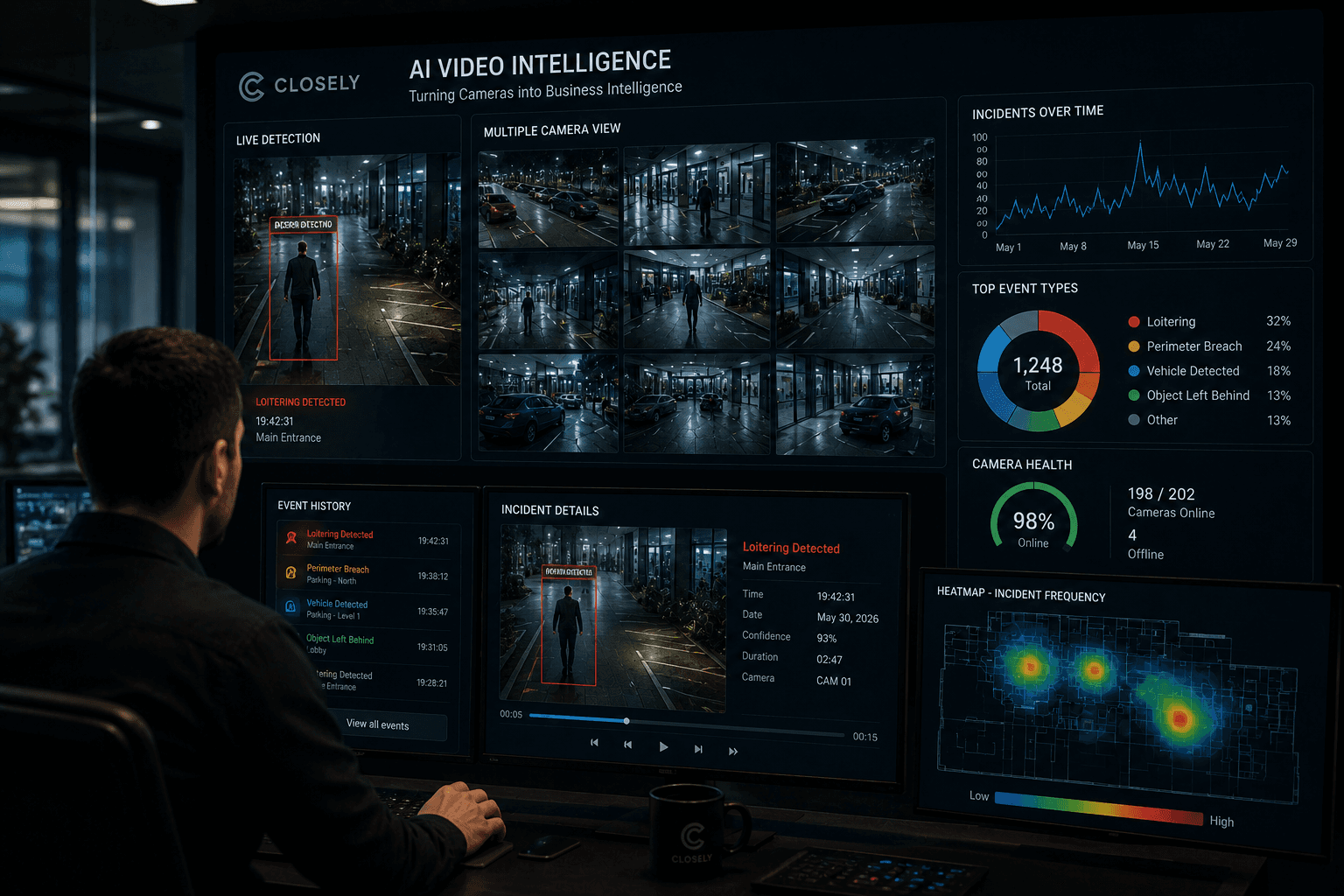
Most security cameras watch everything and understand nothing. Intelligent video analytics changes that. Here is what actually happens when you add real intelligence to a camera network.
The Difference Between Recording and Understanding
Security cameras have been around for decades. The technology has evolved significantly, resolution has improved, storage has gotten cheaper, and remote access has become standard. But the fundamental model stayed the same for a long time: cameras record, humans watch, incidents get documented after the fact.
Intelligent video analytics breaks that model. Not by making cameras smarter in a marketing sense, but by adding a layer of software above the camera infrastructure that actively processes what the cameras see, extracts meaning from it, and generates structured output that operators can act on in real time.
The distinction sounds simple but the operational implications are enormous. A system that records tells you what happened after you review the footage. A video intelligence platform tells you what is happening while there is still time to respond to it. A system that generates structured incident data tells you what has been happening across your entire camera network over weeks and months, in a format that reveals patterns, informs decisions, and has value beyond the immediate security response.
That third layer, where video footage becomes structured intelligence, is where the real value lives. And it is what separates genuine intelligent video surveillance from security theater dressed up in AI branding.
According to the 2026 World Security Report, which surveyed 2,352 chief security officers across 31 countries, AI-powered video surveillance and analytics is the single most cited cutting-edge technology that security leaders consider crucial for the next two years, at 45% globally and 46% in both Latin America and the United States. That demand signal reflects organizations recognizing that video infrastructure they have already paid for is generating almost none of its potential value, and that a video intelligence platform is what closes that gap.
What Intelligent Video Analytics Actually Does
Layer One: Real-Time Event Detection
The most visible function of intelligent video analytics is real-time detection. Computer vision models analyze every camera feed simultaneously, identifying specific events and behavioral patterns as they occur.
The detection types that mature platforms handle include loitering (a person stationary in a zone beyond expected time), perimeter breaches (crossing a defined virtual boundary), tailgating (an unauthorized person following through a controlled access point), crowd formation, abandoned objects, vehicle intrusion, weapon detection, smoke and vape, and shoplifting behavior detection. Each of these is configurable per camera and per site, so the system learns what normal looks like in each specific environment and flags deviations from that baseline.
What reaches the human operator of a video intelligence platform is not a raw alert stream. It is a pre-validated, pre-classified event with the camera location, timestamp, confidence score, and video evidence already assembled. The operator receives the information needed to make a decision, not a notification that forces them to go find the relevant feed and orient themselves before they can assess the situation.
The reduction in false positive volume is what makes this operationally meaningful. A typical motion-triggered system generates hundreds of alerts per shift, the vast majority of which turn out to be irrelevant. Smart video analytics that uses a cascaded detection pipeline, with motion filtering at the first layer, object classification at the second, and behavioral reasoning at the third, delivers a fraction of that alert volume with dramatically higher relevance. Operators who were drowning in noise start spending their time on actual security decisions.
Layer Two: Operational Intelligence
Beyond real-time detection, intelligent video surveillance generates a second category of value that most basic security systems cannot produce: operational intelligence derived from aggregated incident data.
Every validated event is a structured data point. Timestamp, camera location, event type, confidence score, visual evidence, operator response, resolution time. Individually, each record is useful for incident documentation. Aggregated over weeks and months across a camera network, those records reveal patterns that change how security operations are managed.
Which camera zones generate the highest incident volume? Which time windows are consistently highest risk? Which detection types are overrepresented at specific client sites? Which sites have improving or worsening incident frequency over time? These questions are impossible to answer from a recording system that generates unstructured footage. They become straightforward to answer when the recording system is also an AI video intelligence system generating structured data from every event.
Security operators who have access to this pattern intelligence make deployment decisions based on evidence rather than intuition. Guards are assigned to locations where incident data shows the highest need. Camera coverage is adjusted based on actual incident patterns rather than guesses about where coverage might be needed. Client SLA commitments are backed by documented performance data rather than estimates.
Layer Three: Institutional Intelligence
This is the layer that most security technology discussions skip over entirely, but it is where the long-term strategic value of intelligent video analytics networks actually lives.
A single site generating structured incident data is operationally useful. A network of hundreds of sites generating standardized incident data across a city or region is something qualitatively different: a real-time risk intelligence layer that has commercial value well beyond the security operations it supports.
Insurers price risk using data that is delayed, aggregated, and geographically coarse. A network of validated, real-time incident data from across a city, structured to micro-zone level, gives insurers the granular risk inputs they have never had access to before. Logistics companies routing last-mile deliveries need to know which neighborhoods and time windows carry elevated theft and assault risk for their drivers. Governments allocating patrol resources want to know where incidents are actually occurring, not where they were reported hours or days later.
Intelligent video analytics at scale is what makes this institutional data layer possible. Every validated incident in the operator network becomes a structured data point in an intelligence layer that compounds in value as the network grows.
The Architecture That Makes It Work
Why Three Tiers Matter
The reason that most early attempts at video analytics failed operationally was computational cost and false positive volume. Running a sophisticated AI model on every pixel of every frame of every camera continuously is either too expensive, too slow, or both. The solution that works at scale is a cascaded detection architecture.
Tier one handles motion and scene change detection using basic computer vision. This is fast and cheap and eliminates the vast majority of footage from further analysis. If nothing has changed in the frame, nothing needs AI analysis.
Tier two applies object detection and classification to the frames that passed tier one. Is the detected motion caused by a relevant object, a person or vehicle, or by something irrelevant like a lighting change, a shadow, or a moving branch? This step eliminates the majority of false positives before any expensive reasoning is applied.
Tier three applies behavioral reasoning to the events that passed tiers one and two. Given what this camera has learned about its location, given the time of day, given the behavior of the detected object over time, is this event anomalous enough to surface to a human operator?
Only events that pass all three tiers generate an alert. The result is that tier-three reasoning, which is the most computationally expensive component, processes a tiny fraction of the total footage. Detection quality is high, inference costs are manageable, and false positive volume is low enough to sustain genuine operator engagement with the alert stream.
This architecture is what makes smart video analytics viable at scale across large camera fleets. Platforms that skip the cascaded approach and run everything through high-cost models continuously either charge prohibitive prices or produce alert volumes that operators quickly learn to ignore.
The Data Model Behind the Intelligence
The structured output that intelligent video surveillance generates is only as valuable as the data model behind it. Events need to be categorized consistently across different sites and different operators for the aggregated data to be useful for pattern analysis or institutional applications.
A mature AI video intelligence platform defines a standard incident schema: event type and subtype, location (site, zone within site, camera), timestamp, severity, detection confidence, visual evidence reference, operator response, resolution outcome, and whether the event was validated or dismissed. That schema is what allows incident data from a warehouse in Houston and an apartment complex in Bogotá to be compared, aggregated, and analyzed as part of the same intelligence layer.
Without a consistent data model, aggregated incident data is just a pile of records. With it, the data becomes something that can support trend analysis, risk scoring, institutional reporting, and the kind of cross-site pattern recognition that reveals organized criminal activity operating across multiple locations.
How Intelligent Video Analytics Works Across Different Industries
Security Operations Centers
The most direct beneficiary of intelligent video analytics is the security operations center. A mid-sized SOC managing 500 cameras across 20 client sites processes enormous volumes of potential events daily. Without intelligent filtering and prioritization, operators either ignore the alert stream out of fatigue or are overwhelmed to the point where genuine incidents slip through.
Smart video analytics transforms the SOC from a reactive monitoring function into a proactive security intelligence function. Operators receive a curated stream of validated events with context already assembled. Response quality improves because attention is directed where it is actually needed. Coverage scales without proportional headcount growth because the filtering and prioritization work is done by the system rather than by the operator.
Commercial Real Estate and Property Management
Building managers and real estate operators have camera networks that were originally installed for reactive documentation and now sit largely idle between incidents. Intelligent video surveillance converts that passive infrastructure into an active monitoring system without hardware replacement, since most IP cameras already in place support the RTSP and ONVIF protocols that analytics platforms use to connect.
For property managers overseeing multiple buildings, intelligent analytics provides visibility across the entire portfolio from a single interface, along with the incident pattern data that supports evidence-based decisions about where security resources should be concentrated.
Retail
Retail is one of the strongest use cases for AI video intelligence because the financial stakes of both detection and pattern intelligence are clear and measurable. Real-time shoplifting detection that allows staff intervention while theft is in progress recovers merchandise that a recording-only system would simply document as lost. Pattern intelligence that identifies which store zones, product categories, and time windows carry highest risk allows targeted staff deployment and merchandise placement adjustments that reduce shrinkage structurally over time.
Logistics and Industrial Facilities
Warehouses, distribution centers, and manufacturing plants have security environments that are complex and variable. Perimeter monitoring across large areas, access control at multiple entry points, tracking of vehicles and personnel in operational zones, and after-hours detection all require continuous coverage that human staffing cannot provide cost-effectively.
Intelligent video analytics running on existing camera infrastructure provides that continuous coverage, surfaces events that require human attention, and generates the operational data that facility managers use to optimize security deployment and demonstrate compliance with safety and insurance requirements.
How Closely Delivers Intelligent Video Analytics
Closely is built around the thesis that video infrastructure already in place across security operations in the US and Latin America is dramatically underutilized, and that the intelligence layer is what closes that gap.
The platform connects to any IP camera, NVR, or DVR with RTSP and ONVIF support. No hardware replacement. No changes to existing recording infrastructure. Closely ingests the video streams and runs its three-tier detection pipeline continuously, surfacing validated events to SOC operators with full context assembled.
The detection layer covers the full range of smart video analytics use cases: loitering, perimeter breach, tailgating, crowd formation, weapon detection, smoke and vape detection, shoplifting behavior, abandoned objects, open door alerts, and delivery identification. Each detection type is configurable per camera, with thresholds tuned to the specific environment and risk profile of each client site.
Every validated event generates a structured incident record that feeds into the operational intelligence layer. For security operators managing multiple client sites, that intelligence layer provides the portfolio-level visibility and pattern data that transforms security from a cost center into a capability with measurable, demonstrable value.
The longer-term value is the institutional intelligence layer that scales with the network. As Closely's operator network grows across the US and Latin America, the aggregated, validated incident data that the platform generates becomes a risk intelligence asset with applications for insurance underwriting, logistics risk management, and public safety planning that extend well beyond the individual security operations it supports.
For security operators in both markets looking to scale their monitoring capability through a video intelligence platform without proportionally scaling headcount, and for those building toward the institutional data opportunity, Closely is the platform worth evaluating.
10 Frequently Asked Questions About Intelligent Video Analytics
1. What is intelligent video analytics and how is it different from regular video surveillance? Regular video surveillance records footage. Intelligent video analytics actively analyzes that footage in real time, identifies specific events and behavioral patterns, generates structured alerts with evidence attached, and accumulates incident data into an intelligence layer that has value beyond the immediate security response. The practical difference is between a system that documents what happened after the fact and a system that detects what is happening in time for someone to respond to it.
2. What does AI video intelligence actually detect in a security camera feed? Modern AI video intelligence platforms detect behavioral patterns and event types including loitering, perimeter breaches, tailgating at access points, crowd formation, abandoned objects, vehicle intrusion, weapon detection, smoke and vape, shoplifting behavior, and access control anomalies. Detection types are configurable per camera and per site, with the system learning the baseline for each specific environment and flagging deviations from that baseline rather than applying generic rules.
3. How does intelligent video analytics reduce false positives in security monitoring? The key is a cascaded detection architecture. Basic motion filtering eliminates static frames at the first layer. Object classification at the second layer determines whether the motion involves a relevant object or an irrelevant trigger like a shadow or lighting change. Behavioral reasoning at the third layer evaluates whether the object's behavior is actually anomalous given the context of that location and time. Only events that pass all three layers generate an alert. This approach reduces false positive volume by 50 to 80 percent compared to basic motion-triggered systems, which is what keeps operators genuinely engaged with the alert stream.
4. Can intelligent video analytics work with cameras already installed in my building or facility? In most cases, yes. Closely and similar intelligent video surveillance platforms connect to existing IP cameras via RTSP and ONVIF, which are supported by virtually all current-generation cameras from manufacturers including Hikvision, Dahua, Axis, Hanwha, and Avigilon. The analytics run on top of existing camera streams without hardware replacement. For most facilities with cameras installed after 2015, the hardware already meets the resolution and frame rate requirements for reliable AI detection.
5. What structured data does intelligent video analytics generate and what can you do with it? Every validated event generates a structured record containing the camera location, timestamp, event type, confidence score, visual evidence, operator response, and outcome. Individually, these records support incident documentation and compliance. Aggregated over time, they reveal which zones carry highest incident frequency, which time windows are consistently elevated risk, and which detection types are overrepresented at specific sites. At network scale across multiple sites, the aggregated data becomes an institutional intelligence asset with applications for insurance underwriting, logistics risk scoring, and public safety planning.
6. How many cameras can an intelligent video analytics platform monitor at the same time? Unlike human operators who can realistically monitor 6 to 8 feeds with genuine attention, smart video analytics platforms process every connected feed simultaneously and continuously. The practical limit is computational capacity, not attention. Enterprise platforms are designed to monitor thousands of cameras across multiple client sites from a centralized interface. Adding cameras to the network does not reduce monitoring quality for existing cameras.
7. How long does it take for an intelligent video analytics system to learn what normal looks like at a specific location? Most AI video intelligence platforms require one to four weeks of observation to establish a reliable baseline for a typical camera location. During this period the system observes behavioral patterns without generating full alerts, building the statistical model of normal activity for that environment at different times of day and week. More complex environments with high operational variability may benefit from longer baseline periods. After the baseline is established, anomaly detection operates against that learned context rather than generic thresholds.
8. What is the difference between edge video analytics and cloud-based intelligent video surveillance? Edge analytics runs AI processing directly on the camera hardware, reducing bandwidth requirements and working in connectivity-constrained environments. Cloud or server-based intelligent video analytics processes streams from standard IP cameras on external infrastructure, enabling more sophisticated and frequently updated models without hardware replacement. For most enterprise deployments with reliable network connectivity and existing camera infrastructure, cloud-based analytics on existing cameras is the more practical and cost-effective path to smart video analytics capability.
9. How is intelligent video analytics being adopted in Latin America compared to the US? Adoption is accelerating in both markets, driven by similar underlying pressures: rising labor costs for human monitoring, expanding camera deployments, and demand for operational intelligence rather than passive recording. The 2026 World Security Report found that 46 percent of CSOs in both the US and Latin America cite AI-powered video surveillance and analytics as crucial for the next two years. In LATAM specifically, the combination of higher physical insecurity, large existing camera deployments that lack an intelligence layer, and security operators facing pressure to serve more clients without proportional headcount growth makes the ROI case for intelligent video surveillance particularly compelling.
10. How does Closely approach intelligent video analytics differently from other platforms? Most video analytics platforms focus on detection: surfacing alerts when events occur. Closely treats detection as the first step in a longer workflow that also includes alert prioritization, structured incident documentation, and aggregation of incident data into an operational and institutional intelligence layer. The result is a platform that generates value not just from today's alert but from the pattern intelligence that accumulates as incident records build up across the operator's camera network. For security operators in the US and Latin America building toward both operational efficiency and institutional data monetization, that distinction between a detection tool and an AI video intelligence platform is what matters most when evaluating options.