Closely vs. Omnilert: Which AI Security Platform Does Your Operation Need
Closely vs. Omnilert: what each platform detects, which market it's built for, how they differ, and when to use each one.
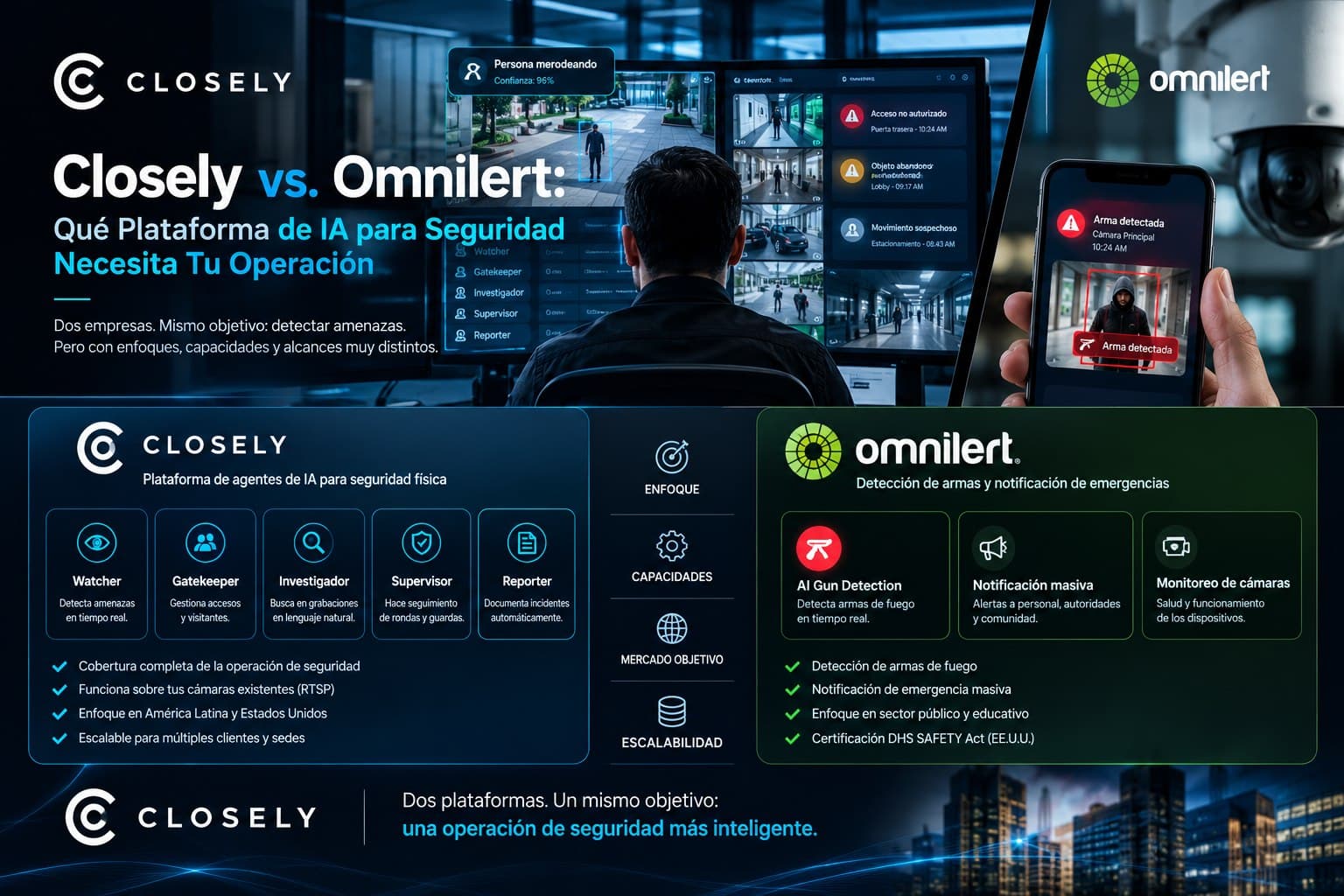
Two companies that use artificial intelligence to detect threats on security cameras, but with very different product philosophies, target markets, and capabilities. This guide compares Closely and Omnilert so you know which one fits your operation.
Why This Comparison Matters Today
The market for artificial intelligence applied to physical security is growing fast, and with that growth comes confusion. Dozens of platforms promise to detect threats, reduce false alarms, and automate responses. But they don't all do the same thing, and choosing wrong means paying for technology that doesn't solve your operation's real problem.
An AI security platform can focus on a very specific problem, such as firearm detection, or it can cover the entire SOC operation. Knowing what you need before evaluating options saves months of pilots in the wrong direction.
Closely vs. Omnilert is a comparison that comes up often because both platforms use AI on existing security cameras to detect threats before they escalate. That's where the similarity ends.
Omnilert is a platform focused mainly on firearm detection, with a mass emergency notification component. It's aimed primarily at the U.S. education, government, and public sector market, where the risk of active shootings is an institutional priority.
Closely is an AI agent platform for physical security operations, designed for security companies, corporate buildings, shopping centers, and industrial sites in Latin America and the United States. It solves the full SOC (Security Operations Center) problem: from detection to documentation, including validation, escalation, and coordination.
Understanding that difference in focus is the starting point for knowing which platform serves which purpose.
What Omnilert Is and What It Does
Omnilert is a U.S. company with a very specific proposition: real-time firearm detection using artificial intelligence on existing security cameras. For anyone looking for an Omnilert alternative that covers a broader range of security operations, understanding what Omnilert does and doesn't do is the starting point.
Its main product, AI Gun Detection, analyzes camera video for the visible presence of firearms. When the system detects a gun, it triggers an alert protocol that can include automatic notifications to security staff, authorities, and, at educational facilities, the entire community.
The platform also includes mass emergency communication tools, camera health monitoring, and automation of critical incident response workflows.
Omnilert holds a SAFETY Act Designation from the U.S. Department of Homeland Security (DHS), which gives it credibility in the North American public sector and education market.
What Omnilert is for:
- Firearm detection at educational facilities, hospitals, and government buildings
- Mass emergency notification when an alert is triggered
- A market primarily in the United States, public sector and education
- Sites where the primary risk is an active shooter
What Omnilert wasn't designed for:
- Private security operations with multiple clients
- Continuous behavior monitoring, not just weapons
- Visitor management, access control, or guard patrols
- The Latin American market and its operational particularities
For those who need an Omnilert alternative with broader operational coverage, the next section explains what Closely offers.
What Closely Is and What It Does
Closely is an AI agent platform for physical security operations. It isn't a single detection product: it's a suite of five specialized agents that automate different parts of a SOC's operation.
The core difference between Closely and Omnilert is the breadth of the proposition. While Omnilert solves a very specific problem (weapon detection and emergency notification), Closely automates the entire security operation.
Closely's five agents are:
Watcher: Closely's visual threat detection system. It analyzes the video feed in real time for anomalous behavior: people loitering, abandoned objects, access to restricted areas, aggressive behavior, weapon detection, and risk situations. It reduces false alarms by up to 88% compared with conventional motion detection.
Gatekeeper (AI Doorman): manages visitor flow autonomously. It identifies who arrives, notifies via WhatsApp and a simultaneous phone call, and manages access without anyone having to sit in front of a monitor constantly. It lets one operator handle up to 100 buildings at once.
Investigator: turns reviewing hours of recordings into a query that takes minutes. The operator describes in natural language what they're looking for ("man in a red shirt who came in through the side door between 3 and 4 pm") and the system finds the relevant clips.
Supervisor: tracks guard patrols and rounds in real time, verifying that checkpoints are hit on time and alerting when there are deviations.
Reporter: automatically documents every incident without the operator filling in anything by hand. It generates structured reports for auditing, follow-up, and continuous improvement.
Closely vs. Omnilert: Head-to-Head
| Criterion | Closely | Omnilert |
|---|---|---|
| Main focus | Full SOC operation | Firearm detection |
| Target market | LATAM + U.S., private security companies, corporate | U.S., education and government |
| Threat detection | Anomalous behavior, weapons, access, zones | Mainly firearms |
| Visitor management | Yes (Gatekeeper / AI Doorman) | No |
| Search in recordings | Yes, natural language (Investigator) | No |
| Guard monitoring | Yes (Supervisor) | No |
| Automatic documentation | Yes (Reporter) | Limited |
| Emergency notification | Escalation via WhatsApp and phone call | Yes, mass notification |
| Camera integration | RTSP, any IP brand | Compatible cameras |
| Availability in LATAM | Yes, built for LATAM | No, focused on the U.S. |
| Pricing model | Per installation | Contact sales |
When Omnilert Makes Sense
Omnilert has a very solid proposition for a very specific problem. If the question is "how do I detect an active shooter on my U.S. university campus and notify the entire community in seconds," Omnilert answers it well.
It's the right platform when:
- The site is an educational campus, hospital, or government building in the U.S.
- The main risk you want to mitigate is an active shooter event
- You need to comply with emergency protocols that include regulated mass notification
- The budget comes from public funds or school safety grants
Its SAFETY Act Designation gives it advantages in U.S. public procurement. That said, for private security operations in LATAM or corporations that need more than weapon detection, Closely is the Omnilert alternative with broader operational coverage.
When Closely Makes Sense
Closely's proposition is broader and more relevant for most private security operations in Latin America and for the corporate and residential market in the United States.
It makes sense when:
- You manage multiple sites from a centralized SOC
- You need to reduce your operators' workload without sacrificing coverage
- You want to add artificial intelligence on top of the cameras you already have without changing the infrastructure
- The problem isn't just weapons: it's behavior, access, visitors, patrols, and documentation
- You operate in Colombia, Mexico, Peru, Chile, Argentina, or the Hispanic market in the United States
- Your end client is a company, a residential building, a shopping center, or an industrial site
Closely and Omnilert solve different layers of the problem. Omnilert is a threat detection system for extremely high-severity events in very specific contexts. Closely is the complete operational infrastructure for everyday physical security.
The Real Question: What Is Your Operation Solving?
When someone searches for Closely vs. Omnilert, they're usually evaluating AI security platforms and want to understand the real difference between them.
The honest answer is that they don't compete in the same space.
Omnilert solves firearm detection and mass emergency communication, mainly in the U.S. education and government sector. It's a threat detection system specialized in the worst possible scenario: an active shooter.
Closely solves the complete daily physical security operation, from intelligent monitoring of multiple sites to visitor management, forensic search in recordings, and automatic incident documentation. It also includes behavioral threat detection that goes far beyond firearms.
If your operation is a private security company with clients in corporate buildings, shopping centers, industrial or residential sites in Latin America, the comparison has a clear answer: Closely is built for that use case, Omnilert isn't.
If you're the security director of a school district in Texas concerned about active shooter protocols, Omnilert is the more specific answer, although Closely can complement the daily operation of that same campus.
Closely offers a free two-week demo on the cameras you already have installed. No infrastructure changes, no commitments. It's the fastest way to see whether the platform solves your operation's real problem.
10 Frequently Asked Questions: Closely vs. Omnilert
1. What is the main difference between Closely and Omnilert?
The core difference is scope and market. Omnilert is a platform specialized in firearm detection and mass emergency notification, aimed mainly at the education and government sector in the United States. Closely is an AI agent platform for the complete physical security operation: behavior detection, visitor management, guard monitoring, search in recordings, and automatic documentation, designed for Latin America and the U.S. corporate market.
2. Does Closely detect firearms like Omnilert?
Yes. Closely's Watcher agent includes weapon detection within its real-time video analysis capabilities, alongside anomalous behavior detection, access to restricted areas, abandoned objects, and other risk situations. The difference is that Closely isn't limited to weapons: it provides broad detection of behavioral and situational threats. Both platforms cover weapon detection, but with different approaches.
3. Does Omnilert work in Latin America?
Omnilert is focused on the U.S. market, especially education, government, and the public sector. It doesn't have an established presence or specific support for the Latin American market. In that context the comparison is asymmetrical: Closely was designed to operate in Colombia, Mexico, Peru, Chile, Argentina, and the Hispanic market in the United States, with Spanish-language support and adaptation to the region's operational particularities.
4. What is the DHS SAFETY Act and why does Omnilert have it?
The SAFETY Act (Support Anti-terrorism by Fostering Effective Technologies Act) is a U.S. Department of Homeland Security program that grants liability protections to security technology companies against claims arising from acts of terrorism, when their technology has been approved by the program. Omnilert obtained SAFETY Act Designation for its gun detection product, which gives it credibility in U.S. public sector and education procurement. This designation is relevant mainly in that specific regulatory context.
5. How much does Omnilert cost compared with Closely?
Neither Omnilert nor Closely publishes prices on its website. Both platforms use custom pricing based on installation size and specific needs. The difference is that Closely can be evaluated free for two weeks on existing cameras, which lets you calculate the real ROI before committing. For Omnilert, you need to contact the sales team directly.
6. Does Closely require replacing existing cameras?
No. Closely connects to existing security cameras that support RTSP, which includes the vast majority of IP cameras on the market: Hikvision, Dahua, Axis, Bosch, Hanwha, Reolink, and dozens more. No investment in new hardware is required to get started: artificial intelligence is added as a software layer on top of the existing infrastructure.
7. What is Closely's Gatekeeper agent, and does Omnilert have it?
Gatekeeper (also called AI Doorman) is the Closely agent that manages visitor flow autonomously: it identifies who arrives, notifies the resident or responsible person via WhatsApp and a simultaneous phone call, and manages access without an operator having to monitor constantly. Omnilert has no equivalent feature: its focus is weapon detection and emergencies, not day-to-day visitor and access management.
8. What kind of company is Closely better for than Omnilert?
Closely is more relevant for private security companies running SOCs with multiple clients, corporate buildings, residential complexes, shopping centers, industrial facilities, and any operation where the daily challenge is monitoring many points with few operators, managing visitors, documenting incidents, and coordinating guards. Omnilert is more specific to high-risk institutional environments in the U.S. with mass emergency protocols.
9. Can Closely send mass notifications like Omnilert?
Closely sends automatic notifications via WhatsApp and a simultaneous phone call when an incident is detected or a visitor arrives. The kind of mass emergency notification Omnilert does (alerting hundreds of people across a campus at once) isn't Closely's core functionality. This point reflects the difference in use case: Omnilert is optimized for responding to large-scale catastrophic events, and Closely for intelligent day-to-day operational management.
10. How can I try Closely before making a decision?
Closely offers a free two-week demo on the cameras you already have installed. The process includes connecting to the existing cameras, configuring the agents relevant to your operation, and monitoring real results at your site. It's the most direct way to compare Closely and Omnilert with real data from your own environment before any purchase decision.