Closely vs. Coram AI: Comparing Artificial Intelligence Platforms for Physical Security
Closely vs. Coram AI: deployment models, features, markets, pricing, and when to use each AI security platform.
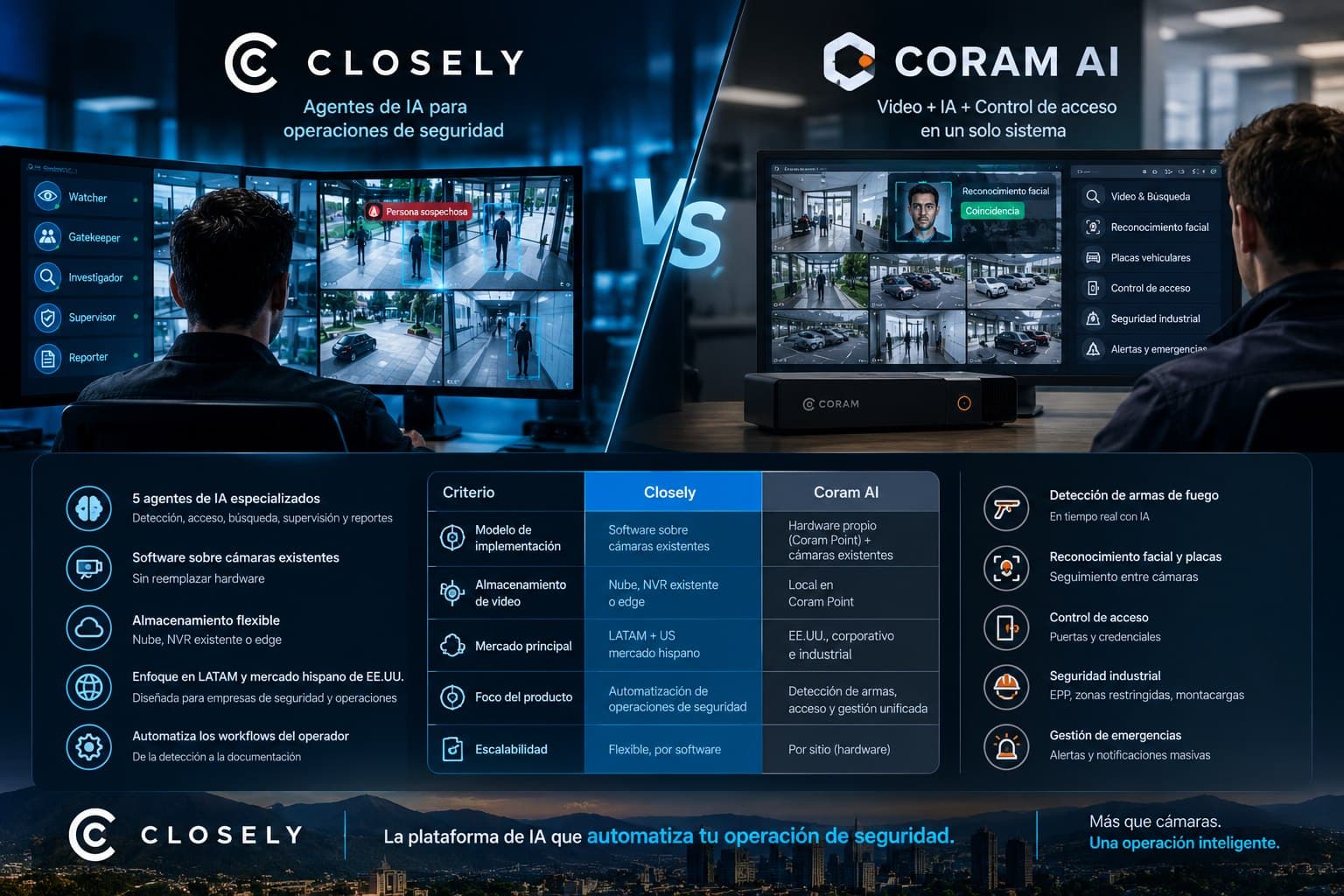
Two platforms that use AI on existing security cameras to automate operations. One designed for the U.S. corporate and industrial market. The other designed to operate in Latin America and the Hispanic market in the U.S. This guide compares Closely and Coram AI so you know which one fits your operation.
Why It Makes Sense to Compare Closely and Coram AI
When someone searches for Closely vs. Coram AI, they're usually evaluating artificial intelligence platforms for physical security that integrate with existing cameras, reduce the operational workload, and help detect incidents before they escalate.
Both are AI security systems that connect to IP cameras compatible with RTSP or ONVIF and add an AI layer on top of the existing infrastructure. Neither requires replacing current cameras to work.
But that's where the most obvious similarities end. The comparison reveals important differences in how they're built, the markets they serve, the deployment models they require, and the problems they solve best.
What Coram AI Is and What It Was Designed For
Coram AI is an AI video surveillance platform developed in the United States that combines video management with artificial intelligence, access control, visitor management, and industrial safety in a single system.
Its product includes the Coram Point, a proprietary hardware appliance installed at each site that processes artificial intelligence at the edge and stores video locally. That means each installation requires an additional physical device on top of the existing cameras.
Coram AI's main features include:
- Live and recorded video with natural language search
- Facial recognition and cross-camera person tracking
- License plate recognition
- Tailgating detection at controlled access points
- Access control with door and credential management
- Emergency response and facility lockdown tools
- Industrial safety detection: PPE, restricted zones, forklifts, falls
Its target market is security, operations, and industrial safety teams at large corporate and industrial organizations, mainly in the United States. As an AI video surveillance platform, Coram AI aims to consolidate multiple security tools into a single system.
What Closely Is and What It Solves
Closely is also an AI video surveillance platform, designed specifically for security companies, corporate buildings, shopping centers, and industrial sites in Latin America and the Hispanic market in the United States.
The core conceptual difference is the deployment model and product focus. While Coram AI is built around a consolidated video management system with artificial intelligence as an added layer, Closely is a platform of autonomous agents designed to automate the security operator's workflows, not just add detection.
Closely's five agents are:
Watcher: analyzes the video feed in real time for anomalous behavior, people in restricted zones, abandoned objects, aggressive behavior, and physical threats. It reduces false alarms by up to 88% compared with conventional motion detection, and covers a broad behavioral spectrum instead of being limited to specific events.
Gatekeeper (AI Doorman): manages visitors autonomously. It identifies who arrives, notifies via WhatsApp and a simultaneous phone call, and coordinates access without anyone having to monitor constantly. With this agent active, one operator can handle up to 100 buildings at once.
Investigator: turns reviewing hours of recordings into a query that takes minutes. The operator describes what they're looking for in natural language and the system finds the relevant clips. Coram AI has a similar feature called Deep Investigation, although it's oriented mainly toward correlating video events with access control events.
Supervisor: tracks guard patrols and rounds in real time, verifying that checkpoints are hit within the defined times and alerting when there are deviations. Coram AI has no equivalent guard management feature.
Reporter: automatically documents every incident without the operator filling in forms by hand. It generates structured reports for auditing, follow-up, and continuous operational improvement.
Closely vs. Coram AI: Head-to-Head
| Criterion | Closely | Coram AI |
|---|---|---|
| Deployment model | Software on existing cameras | Proprietary hardware (Coram Point) + existing cameras |
| Video storage | Flexible: cloud, existing NVR, or edge | Local on Coram Point |
| Main market | LATAM + U.S. Hispanic market | U.S., corporate and industrial |
| Spanish-language support | Yes, built natively for LATAM | Not documented |
| Visitor management | Yes, with WhatsApp notification | Yes, check-in and screening |
| Guard monitoring | Yes (Supervisor) | No |
| Facial recognition | Yes, real-time watchlist and allowlist | Yes, profiling and tracking |
| Search in recordings | Yes, natural language (Investigator) | Yes (Deep Investigation) |
| Industrial detection | In development | Yes (PPE, zones, falls) |
| Access control | Integration with existing systems | Native to the platform |
| Incident notification | WhatsApp + simultaneous phone call | Text + email |
| Pricing model | Per installation, no extra hardware | Per camera, appliances, and modules |
The Key Difference: Hardware vs. Software
This is the most practical difference for anyone evaluating options.
Coram AI requires installing a Coram Point at each site. That appliance processes AI locally and stores video. That has real advantages: low latency, video recording that doesn't depend on internet connectivity, and AI processing at the edge without sending the whole stream to the cloud.
But it also has concrete implications:
- Each new site requires an additional device that has to be bought, shipped, and installed
- Maintenance includes the hardware, not just the software
- The upfront cost per site is higher
- In Latin American markets with more complex supply chains, this can slow down expansion
Closely works as software on the cameras that already exist, without requiring additional proprietary hardware. Artificial intelligence runs on the video stream using the existing network infrastructure. That simplifies deployment, lowers the cost of entry, and speeds up expansion to new sites.
For operations with dozens or hundreds of distributed sites, like those run by private security companies in LATAM, the difference in model has a direct operational and economic impact.
When Coram AI Makes Sense
Coram AI has a solid proposition as an AI security system for large organizations in the United States that want to consolidate video, access, and industrial safety in a single platform with edge processing.
It's the most appropriate option when:
- The organization is a large industrial corporation or manufacturer in the U.S.
- Native access control integrated with the same video system is required
- Local video storage is a regulatory or data security requirement
- There's budget for additional hardware per site
- Use cases include PPE detection, forklift zones, and workplace safety
When Closely Makes Sense as a Coram AI Alternative
For those operating in LATAM or the U.S. Hispanic market who are looking for a Coram AI alternative that doesn't require additional hardware per site, Closely is the most suitable option. It's also the right fit for private security companies in the U.S. that manage multiple clients and sites.
It makes sense when:
- The operation is a private security company with multiple clients and sites
- The budget doesn't allow for additional hardware at every site
- Deployment needs to be fast: days, not weeks
- The market is LATAM: Colombia, Mexico, Peru, Chile, Argentina
- The natural notification channel is WhatsApp, not email
- Guard management is needed in addition to event detection
- Automatic incident documentation is an operational priority
In the Latin American context, the comparison has a clear answer: Closely is the natural Coram AI alternative for that market. It was designed to operate in Colombia, Mexico, Peru, Chile, and Argentina with their operational particularities, while Coram AI has no established presence or specific support in the region.
The Underlying Question in This Comparison
Evaluating Closely vs. Coram AI is, at bottom, a question about which AI security system fits your operational reality best and which AI video surveillance platform fits your deployment model.
If you have a dedicated IT team, budget for hardware at each site, and operate mainly in large industrial facilities in the U.S., Coram AI offers a consolidated platform with mature capabilities.
If you run multiple sites with leaner security teams, need fast deployments, work in LATAM, and want artificial intelligence to automate your operators' workflows in addition to detecting events, Closely is the Coram AI alternative designed specifically for that use case.
Closely offers a free two-week demo on the cameras you already have installed. No additional hardware, no infrastructure changes, no commitments. It's the most direct way to compare Closely and Coram AI with real data from your own operation.
10 Frequently Asked Questions: Closely vs. Coram AI
1. What is the main difference between Closely and Coram AI?
The most practical difference is the deployment model. Coram AI requires installing its proprietary hardware (Coram Point) at each site to process AI locally. Closely works as software on existing cameras without requiring additional hardware. In addition, Closely is designed natively for the Latin American market, with Spanish-language support and adaptation to the region's operational particularities, while Coram AI is oriented mainly toward the U.S. corporate and industrial market.
2. Do Closely and Coram AI work with the same cameras?
Yes, both platforms are compatible with IP cameras that support RTSP or ONVIF, which includes the vast majority of the market: Hikvision, Dahua, Axis, Bosch, Hanwha, and dozens more. The difference is that Coram AI processes AI locally on the Coram Point, while Closely processes video analysis on the camera streams without proprietary hardware. Both integrate with existing infrastructure, but with different architectures.
3. Does Coram AI offer Spanish-language support or work in Latin America?
Coram AI is developed and sold mainly for the U.S. market. It has no documented commercial presence or specific Spanish-language support for the Latin American market. In that context, Closely is the Coram AI alternative for operations in Colombia, Mexico, Peru, Chile, Argentina, and the U.S. Hispanic market, where it was designed to operate from the start.
4. What is the Coram Point, and do I need something similar to use Closely?
The Coram Point is Coram AI's proprietary hardware appliance, installed at each site to process artificial intelligence at the edge and store video locally. Closely doesn't require any additional proprietary hardware: it connects directly to existing cameras through their RTSP stream. That difference makes deploying Closely faster and cheaper for operations with many distributed sites, which is especially relevant for security companies with multiple clients.
5. Does Closely offer industrial safety detection like Coram AI?
Coram AI has specific industrial safety features: PPE detection (helmets, vests), restricted zone alerts, forklift zones, and fall detection. Closely detects restricted zones and anomalous behavior through the Watcher agent, with the ability to detect weapons and risk situations. Specific PPE and workplace safety capabilities are on the development roadmap. For industrial use, Coram AI has the edge in that specific segment today.
6. How do incident notifications compare between Closely and Coram AI?
Coram AI sends notifications by text and email when a configured event is detected. Closely sends notifications via WhatsApp and a simultaneous phone call, which in the Latin American context have much higher response rates. Closely's Gatekeeper agent also manages visitors by notifying the responsible people via WhatsApp at the same time, before the visitor enters. For LATAM, this difference in channel has a real operational impact.
7. Does Closely have access control like Coram AI?
Coram AI has native access control built into the same platform: door management, credentials, forced-entry alerts, and facility lockdowns. Closely integrates with existing access control systems instead of replacing them. The Gatekeeper agent manages visitor flow and coordinated access, but credential and access hardware management is handled through the systems the client already has installed. For operations that want to consolidate everything into a single system from scratch, Coram AI goes deeper on access control.
8. How much does Closely cost compared with Coram AI?
Neither Closely nor Coram AI publishes standard prices on its website. Both platforms use custom pricing based on installation size. The structural difference is that Coram AI includes the cost of hardware (Coram Point) at each site, while Closely is a software platform that requires no additional hardware. Closely lets you evaluate the platform with a free two-week demo on existing cameras, and its cost of entry is usually lower per installation.
9. Does Closely have facial recognition like Coram AI?
Yes. Both Closely and Coram AI offer facial recognition. Closely implements real-time watchlists and allowlists and stores vectors, not images, of registered faces, which reduces risk if someone gains unauthorized access to the database. Coram AI also offers facial profiling and cross-camera tracking. In both cases, the use of facial recognition is subject to each country's privacy regulations, which treat face vectors as biometric data: Law 1581 in Colombia, and state laws such as BIPA in Illinois in the U.S. Before enabling it, it's worth reviewing the regulatory framework that applies to each installation.
10. How can I evaluate Closely against Coram AI before deciding?
The most direct way is to run a demo of each platform on your own infrastructure. Closely offers a free two-week demo on the cameras you already have installed, with no additional hardware and no commitments. That lets you compare with real data from your operation: how many false alarms it cuts, how visitor management via WhatsApp works, how quickly Investigator finds footage. The best evaluation is always on real video from your site, not on a vendor's controlled demos.