Closely vs. Ambient AI: The 5 Autonomous Agents That Change the Comparison
Ambient AI: computer vision. Closely: five agents (Watcher, Gatekeeper, Investigador, Supervisor, Reporter). Free 2-week demo.
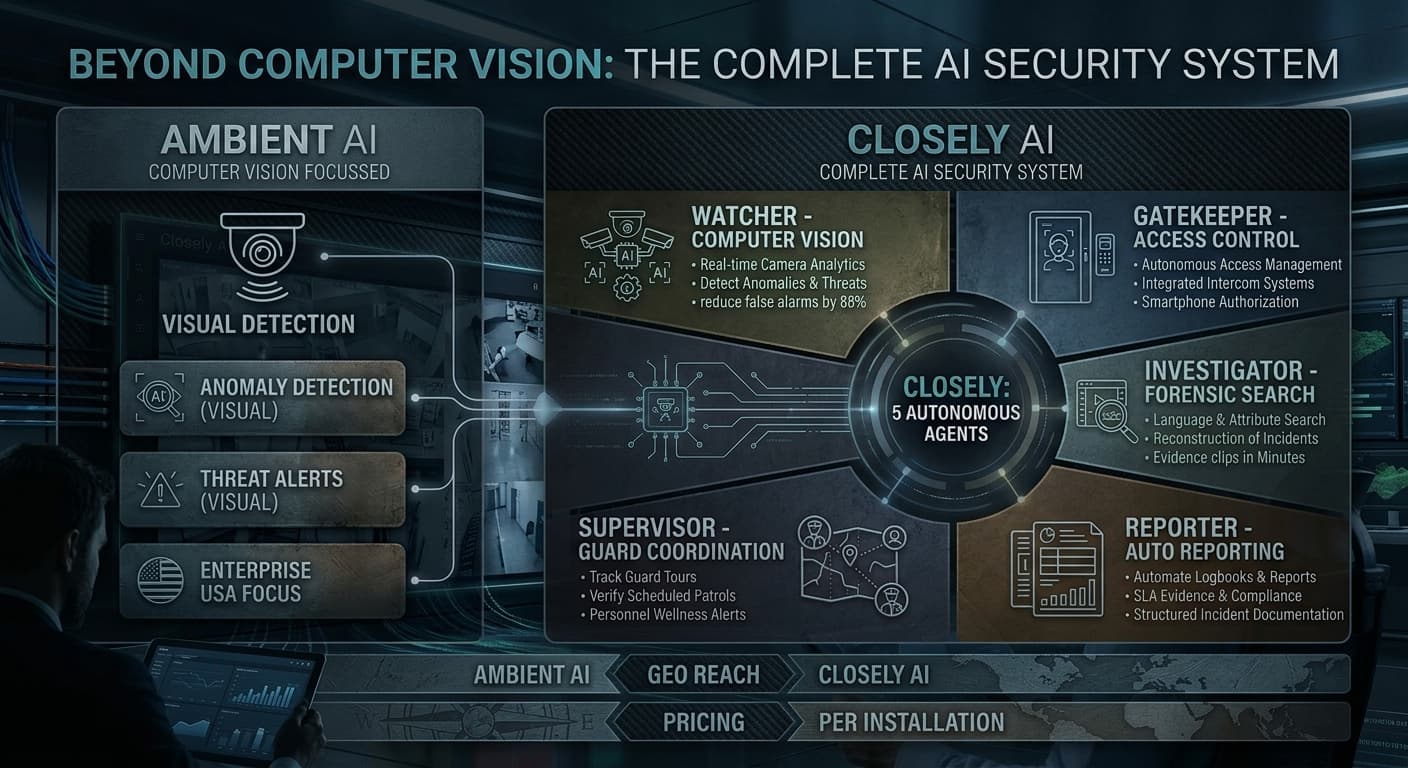
TL;DR: Ambient AI does computer vision. Closely has that plus four additional autonomous agents: Gatekeeper (autonomous access control), Investigator (forensic search), Supervisor (guard coordination), and Reporter (automatic documentation). Closely covers the complete security operations cycle. Operates in the United States and Latin America natively. Priced per installation, not per camera. Free two-week demo with no commitment.
Two AI Platforms, Two Different Philosophies
When someone compares Closely with Ambient AI, they're usually on the right track: evaluating AI platforms for physical security operations and wanting to understand which solves their specific problem better.
Ambient AI is an AI-based security platform based in San Francisco, focused on computer vision detection for enterprise markets in the United States. Its core proposition is solid: use computer vision to detect threats on security cameras. In that sense, it's a well-built AI security platform for its specific use case.
Closely has a different proposition. Not because it's merely a competitor to Ambient AI in computer vision, but because it starts from a different hypothesis about what an AI security platform needs to do for a real security operation to work better. Closely doesn't have one agent. It has five.
That difference—between a visual detection platform and a security operations platform with multiple autonomous agents—structures this entire comparison.
What Ambient AI Does Well
Ambient AI is a respectable platform with a clear focus. Its computer vision models for threat detection are well-developed, and its positioning in the US enterprise market reflects a real bet on large-scale customers.
What Ambient AI solves well is visual detection: identifying anomalous people, behaviors, and objects in camera feeds, and converting those detections into alerts for security operators. For an organization with a single problem to solve—specifically camera-based detection—Ambient AI is a coherent option.
Where the platform has natural limitations is in the breadth of security operations. A real operation isn't just detection: it's verification, response, investigation, coordination of physical personnel, and structured documentation of everything. Those are functions requiring distinct agents, not extensions of the same computer vision model.
The Five Autonomous Agents of Closely
Here's the most relevant difference between Closely and Ambient AI when evaluating for a real security operation: Closely is built around five autonomous agents that cover the complete cycle of security operations, from detection to reporting.
Watcher: The Computer Vision Agent
Watcher is Closely's computer vision agent. It analyzes camera feeds in real time, learns what's normal in each zone at each hour, and detects anomalies with a three-layer pipeline that eliminates up to 88% of false alarms.
Watcher detects loitering, perimeter violation, tailgating, crowding, abandoned objects, weapons, smoke and fire, aggressive behavior, falls, people running, and dozens of additional patterns, all configurable per camera, zone, and industry.
Here, Closely and Ambient AI compete directly. Both platforms do AI for camera surveillance. The difference is what comes after detection.
Gatekeeper: The Access Control Agent
Gatekeeper is Closely's autonomous access control agent. It manages access flows autonomously: when a visitor arrives at a building's intercom, Gatekeeper greets them, collects information, and notifies the resident or facility manager simultaneously via WhatsApp and phone call.
The resident authorizes or denies access from their phone in seconds. Every interaction is automatically recorded with timestamp, visitor identity, and access result. No operator managing the call. No manual log.
This agent has no equivalent in Ambient AI. It's a capability Closely includes as part of its AI security platform.
Investigator: The Forensic Search Agent
Investigator is Closely's forensic investigation agent. When an incident occurs and you need to reconstruct what happened, Investigator allows searching historical recordings using natural language or specific attributes: "show me everyone who entered through the south door between 10pm and 2am on Wednesday," "search for dark-colored vehicles in the parking lot between Monday and Tuesday."
What previously took 20-50 hours of manual video review now takes minutes. Investigator returns relevant clips with timestamp, source camera, and event context, ready for incident reports or delivery to authorities.
Ambient AI has recording search capabilities, but Investigator is specifically designed for security operations needing rapid investigation and structured documentation.
Supervisor: The Guard Deployment Agent
Supervisor is Closely's physical security personnel coordination agent. It tracks guard rounds in real time, verifies that programmed patrols complete on schedule, detects when checkpoints weren't visited in expected time, and generates personnel wellness alerts if a guard stops registering activity for unusual periods.
For security operators with physical field personnel alongside remote monitoring, Supervisor transforms guard supervision from a manual, retrospective task to an automated real-time process. Ambient AI doesn't have this agent.
Reporter: The Automatic Reporting Agent
Reporter is Closely's documentation agent. It automatically generates incident logs, shift reports, and access records without operators filling forms manually. Every event the system processes is documented in structured form with timestamp, visual evidence, event type, and result.
For security companies with SLA commitments to clients, Reporter is the evidence proving service was delivered as agreed. For shopping centers, corporate buildings, or industrial facilities requiring compliance, it's the documentation layer converting security operations into auditable records.
Closely in the United States and Latin America: Why Geographic Reach Matters
Ambient AI is positioned primarily for the US enterprise market. That makes sense given its origins and sales model. But for organizations operating in Latin America, or with simultaneous presence in both markets, that geographic focus creates a practical limitation.
Closely operates in the United States and throughout Latin America. Not as a future expansion, but as part of its current model. Closely's five agents are designed to function in the real operational contexts of physical security in Colombia, Mexico, Peru, Chile, Brazil, Argentina, and parallel markets like Miami, Houston, Los Angeles, or New York.
That means Gatekeeper flows are designed for how intercoms work in Bogotá residential buildings or Lima closed communities. Watcher detection patterns are calibrated for Latin American visual environments. Reporter generates documentation in formats Latin American security companies need for their clients and local authorities.
For a physical security company wanting AI in Colombia and the United States from the same platform, Closely is the option with real operational coverage.
Price Per Installation and Two Weeks Free Demo
Two aspects of Closely's commercial model are worth mentioning explicitly when comparing with Ambient AI.
Price per installation. Closely charges per installation, not per camera or per user. That means costs scale predictably as you add sites, and adding more cameras within the same installation doesn't increase price. For security operators managing multiple client locations, this model is significantly more transparent than common per-camera pricing in the industry.
Two weeks completely free demo. Closely offers two weeks of full platform access on the customer's real camera infrastructure, at no cost and with no commitment. That means before any purchase decision, you can see how all five agents work on your own cameras, in your own environment, with your own real incidents.
If the five agents don't demonstrate value in the free demo, there's no reason to proceed. If the demo demonstrates value, the adoption decision is based on real evidence, not just a sales presentation.
Request the free two-week demo at closely.dev.
The Comparison Table
| Ambient AI | Closely | |
|---|---|---|
| Computer vision (camera detection) | Yes | Yes (Watcher) |
| Autonomous access control | No | Yes (Gatekeeper) |
| Forensic search in recordings | Partial | Yes (Investigator) |
| Physical guard supervision | No | Yes (Supervisor) |
| Automatic structured reporting | Basic | Yes (Reporter) |
| Operation in LATAM | Not native | Yes, active |
| Operation in United States | Yes | Yes |
| Target market | Enterprise USA | Enterprise USA and LATAM |
| Pricing model | Per camera/user | Per installation |
| Free demo | Not published | 2 weeks no cost |
| False alarm reduction | High | Up to 88% |
How Closely Works with Your Existing Infrastructure
One practical detail when evaluating any AI platform for security cameras: do you need to replace the cameras you already have?
Closely connects to any IP camera with RTSP protocol and ONVIF support, which includes virtually all cameras from Hikvision, Dahua, Axis, Hanwha, Avigilon, Bosch, and most market manufacturers. No hardware change. No months-long installation period.
Closely's five agents activate on the infrastructure you already have. That completely changes the adoption calculation: instead of a capital project requiring camera replacement, Closely's AI for camera surveillance is a software decision that can be in production in weeks.
Frequently Asked Questions
What's the main difference between Closely and Ambient AI?
The main difference is platform breadth. Ambient AI is an AI security platform centered on computer vision detection. Closely includes computer vision (Watcher) plus four additional agents: Gatekeeper, Investigator, Supervisor, and Reporter. Closely covers the complete security operations cycle, not just visual detection.
Which markets does Ambient AI operate in and which does Closely?
Ambient AI is positioned primarily in the US enterprise market. Closely operates in the United States and throughout Latin America actively. For organizations in Colombia, Mexico, Peru, Chile, Brazil, or Argentina, Closely has native operational coverage.
What's the Watcher agent and how does it compare with Ambient AI?
Watcher is Closely's surveillance AI agent. It reduces false alarms by up to 88% and detects loitering, perimeter violation, tailgating, crowding, abandoned objects, weapons, smoke and fire, aggressive behavior, and 30+ additional patterns. In pure computer vision, they're comparable platforms. The difference is in the four additional agents.
What does Gatekeeper do that Ambient AI doesn't have?
Gatekeeper manages access autonomously. It greets visitors, collects information, notifies via WhatsApp and phone, and automatically records every interaction. It converts access management from a manual task to an autonomous process. Ambient AI doesn't have this capability.
How does the per-installation pricing model work?
Closely charges per installation, not per camera or user. Adding more cameras within the same installation doesn't increase price. Costs scale predictably when adding sites. This model is more transparent than per-camera pricing.
How does the free two-week demo work?
Closely offers two weeks of full platform access on the customer's real infrastructure, at no cost and with no commitment. The team reviews your camera inventory, confirms compatibility, configures all five agents, and you operate the complete platform with your own cameras and real incidents.
What does Investigator do in a forensic investigation?
Investigator allows searching historical recordings using natural language. Instead of manually reviewing hours of video, an operator queries and the system returns relevant clips in minutes. What previously took 20-50 hours now takes minutes.
How does Supervisor help with guard coordination?
Supervisor tracks guard rounds in real time. It verifies programmed patrols complete on schedule, detects unvisited checkpoints, and generates wellness alerts. It transforms supervision from manual task to automated process.
Does Closely need existing cameras to be replaced?
No. Closely connects to any IP camera with RTSP and ONVIF. All five agents activate on existing infrastructure without changing hardware. Implementation takes weeks.
Which organizations is Closely more suited for?
Closely is better for operators needing complete security operations cycle coverage, with physical guard personnel, requiring autonomous access control, operating in Latin America or both markets, and valuing price transparency and commitment-free demos.
The Conclusion
Ambient AI does one thing very well: computer vision detection. Closely does that and four other things equally well. Closely's five autonomous agents transform how real security operations work: Watcher detects, Gatekeeper controls access, Investigator solves incidents, Supervisor coordinates field personnel, and Reporter documents everything.
For US-only security operations, both platforms are valid options if you only need computer vision. For operations needing the complete cycle, operating in Latin America, or wanting to validate before committing, Closely is the platform with the architecture and coverage that matter.
The free two-week demo is the fastest way to know if the five agents are what your operation needs. Request at closely.dev.