Closely and Dahua Cameras: How to Reduce False Alarms by 88% Without Replacing Hardware
AI on Dahua: 88% fewer false alarms, without replacing cameras, implementation in weeks.
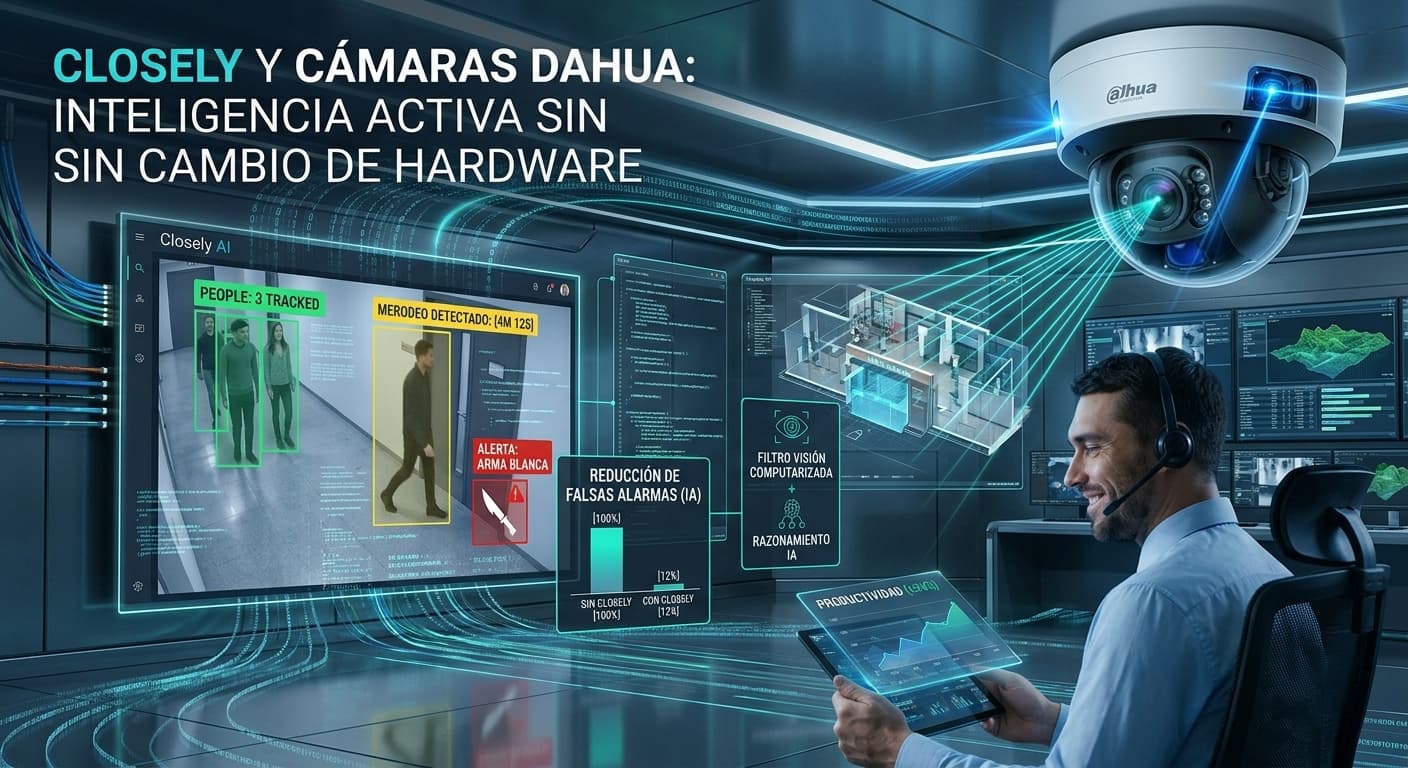
TL;DR: Closely doesn't compete with Dahua cameras, it makes them intelligent. Connects to any IP Dahua camera, runs a three-layer computer vision pipeline on each feed, reduces false alarms by up to 88%. Activates 14+ detection models configurable by industry. Implementation in weeks, no hardware changes. Works in residential, retail, shopping centers, restaurants, construction, and airports.
The Most Common Misconception About Dahua Camera Security
When someone searches "Closely vs. Dahua," they're probably assuming these are alternatives. That you have to choose one or the other. That's exactly the confusion worth clearing up from the start, because it completely changes how you understand the value of each platform.
Dahua cameras are hardware. They're one of the world's largest security camera manufacturers, with massive presence in Latin America, the United States, and virtually every market on the planet. Closely's Dahua AI integration builds on that installed base: their IP cameras, NVRs, and video surveillance systems are already deployed in residential buildings in Bogotá, shopping centers in Mexico City, restaurants in Miami, construction sites in Lima, and airports in Santiago.
Closely is artificial intelligence software. It connects to Dahua cameras already installed and transforms them into an active detection system that understands what it's seeing, instead of just recording it.
The right question isn't "Closely or Dahua?" The right question is "What does Closely do with my Dahua cameras that they can't do alone?" The answer: it converts them into intelligent Dahua cameras that understand what they see, instead of just recording it.
What Dahua Cameras Do Well (And Where They Fall Short)
Dahua security cameras are recognized in the industry for image quality, durability, and competitive pricing. There's good reason they're one of the most deployed brands in the world. Their HD and 4K lines deliver high-resolution video. Their NVRs integrate well with their own cameras. And their price makes them accessible for deployments from small residential buildings to networks of hundreds of locations.
But like any video surveillance system without AI on top, Dahua cameras have a structural limitation no firmware update can fully resolve: they generate enormous numbers of false alarms.
Dahua's native detection system, like practically any conventional security camera, is based on motion detection. When something moves in the frame, the camera fires an alert. That something could be an unauthorized person. Or it could be a branch moving in the wind, a lighting change, an animal, the reflection of a car, or a shadow crossing the sensor.
In practice, monitoring center operators working with conventional Dahua cameras receive hundreds of alerts per shift. Most of those alerts are noise. After a few hours, the operator learns to ignore them. And right when they start ignoring them, the real event occurs that no one saw.
That's not a Dahua-specific problem. It's an architectural problem: the camera records, but doesn't understand.
How Closely Converts Dahua Cameras into Intelligent Cameras: The Integration That Eliminates 88% of False Alarms
Closely connects to Dahua security cameras through industry-standard protocols: RTSP and ONVIF. If your Dahua cameras have IP connectivity and generate a video stream, Closely can connect to them without changing any hardware, modifying existing configuration, or interrupting the recording system already running.
Once connected, Closely runs its three-layer detection pipeline on each camera feed in real time:
The first layer filters basic motion. If nothing relevant changed in the frame, processing stops. This eliminates most noise from the start.
The second layer applies computer vision to classify whether motion involves a relevant object: a person, a vehicle, an object of interest. Wind-moved branches, lighting changes, reflections, and shadows are filtered out here.
The third layer applies AI reasoning: given what this camera has learned about its specific environment, given the time of day, given the context of what's happening in the frame, is this genuinely anomalous behavior requiring human attention?
Only events passing all three layers generate an alert. The measured result: up to 88% reduction in false alarms compared to native detection systems in conventional cameras. An operator who previously received 200 alerts per shift now receives between 20 and 25, all genuinely relevant.
The Computer Vision Models Closely Activates on Dahua
When Closely connects to your Dahua cameras, it activates a complete library of detection models the cameras alone can't run. Each model can be configured per camera, per zone, and per time period, adapting to the specific environment of each installation:
- Loitering detection, identifying people staying in a zone longer than expected
- Perimeter violation detection, with configurable virtual lines that trigger alerts when crossed
- Tailgating detection, identifying when an unauthorized person follows someone through a controlled access
- Crowding detection, with alerts when unusual groups form in specific zones
- Abandoned object detection, identifying bags, packages, or objects left in place
- Firearms and bladed weapon detection through computer vision
- Smoke and fire detection by camera without additional sensors
- Person-on-ground detection, including falls
- Aggressive behavior detection and fights
- PPE validation (helmets, vests, gloves)
- Forensic search by attributes in historical recordings
- Heat maps and people counting in real time
All this converts Dahua cameras into the most complete detection system available for your installation, without changing any hardware.
The Sectors Where Closely Transforms Dahua Cameras
Residential: Buildings and Condominiums
Residential complexes and apartment buildings in Colombia, Mexico, Peru, the United States, and Latin America widely use Dahua cameras in entrances, parking, lobbies, elevators, and common areas. The usual problem: the monitoring center receives so many motion alerts that surveillance becomes reactive, not preventive.
With Closely on the building's Dahua cameras, remote porteria actually works. The system detects tailgating when someone tries to enter behind a vehicle without authorization. Heat maps help identify higher-risk zones in parking. And all alerts are backed by visual evidence.
Retail and Stores
In retail, Closely activates theft behavior detection on existing Dahua cameras: the system learns to distinguish customers examining a product from those concealing one. The alert arrives while the person is still in the store, not after they've left.
For retail chains with multiple locations, all alerts consolidate in a single centralized monitoring interface.
Shopping Centers
A medium shopping center may have 100 to 400 Dahua cameras. With Closely, the same cameras detect crowding, aggressive behavior, people wearing helmets indoors, abandoned objects, floor spills, and excessive queues.
Additionally, they generate traffic heat maps, real-time occupancy and dwell data, converting security infrastructure into actionable commercial intelligence.
Restaurants and Food Service
Closely activates abandoned tray detection on Dahua cameras in restaurants to optimize table rotation, identifies excessive queues, monitors suspicious behavior near registers, and surveils restricted-access zones.
Construction Sites
Construction sites face extreme security challenges. Closely activates nocturnal perimeter intrusion detection on Dahua cameras, PPE validation in work zones, restricted-area vehicle detection, and identification of people outside work hours.
Airports and High-Traffic Facilities
In airports and transit terminals, Closely activates abandoned object detection on Dahua cameras, suspicious behavior in controlled-access areas, real-time people counting for occupancy management, and rapid forensic search.
Why This Combination Works Better Than Replacing All Hardware
Replacing functioning Dahua cameras with cameras from another manufacturer with embedded analytics carries enormous costs: new hardware, installation, rewiring, reconfiguration, and significant implementation time. Many of those cameras offer limited detection sets with little customization capability.
Closely activates on existing Dahua cameras a complete library of computer vision models, configurable per installation, zone, and industry, with 88% fewer false alarms and without touching hardware. Production implementation can happen in weeks.
Frequently Asked Questions
Does Closely replace Dahua cameras or work on top of them?
Closely works on top of existing Dahua cameras, not replacing them. It connects to video feeds through RTSP and ONVIF, runs AI models on those streams in real time. Dahua cameras keep recording exactly as before. Closely adds the intelligent detection layer without changing hardware or interrupting recording.
How does Closely reduce false alarms by up to 88%?
Conventional Dahua cameras use basic motion detection that fires alerts at any change. Closely uses a three-layer pipeline: filters irrelevant motion, classifies whether relevant objects exist (person or vehicle), applies AI reasoning to determine if behavior is anomalous. Only events passing all three layers generate alerts.
What computer vision models can Closely activate on Dahua?
Closely activates 14+ models: loitering, perimeter violation, tailgating, crowding, abandoned objects, weapon detection, smoke and fire, falls, aggressive behavior, PPE validation, heat maps, people counting, and forensic search. Each model configures per camera, zone, and time period.
Which sectors benefit most from this combination?
Residential (buildings), retail, shopping centers, restaurants, construction sites, and airports. In each sector, models configure to specific needs, not generic rules.
Does Closely work with all Dahua camera models?
It works with any Dahua camera with IP connectivity and RTSP stream. This covers virtually Dahua's entire IP camera line from the last ten years. Closely's team conducts compatibility assessment before any implementation.
How does Closely work with Dahua cameras in residential buildings?
It activates tailgating detection on access points, visitor identification in real time, loitering alerts in common areas, fall detection in elevators and hallways, and traffic heat maps. It also integrates with Closely's remote porteria module, where a voice agent handles visitor interactions automatically on the same camera infrastructure.
Can Closely detect theft behavior in stores with Dahua?
Yes. It learns the difference between customers examining products and those concealing them. The alert arrives while the person is still in the store. For retail chains, all alerts consolidate in a centralized interface.
How does it help with PPE validation on construction sites with Dahua?
It identifies whether workers in specific zones wear required PPE: helmets, vests, gloves, safety glasses. When someone enters a work zone without required gear, it generates an immediate alert to the supervisor. This converts safety compliance from periodic manual review to continuous real-time monitoring.
How long does implementation take on existing Dahua installations?
Weeks, not months. No hardware to install or wiring to modify. Closely conducts compatibility assessment, confirms IP connectivity, and configures detection models. The first layer enters production in days.
Why is activating Closely on Dahua better than replacing them?
Replacement means cost of new hardware, installation, and significantly more time. Cameras with proprietary analytics offer limited detections without customization. Closely activates a complete configurable library on existing Dahua with 88% fewer false alarms and zero hardware changes.
The Conclusion
Dahua cameras are already installed in millions of buildings, shopping centers, restaurants, and construction sites worldwide. The problem isn't the camera. It's what happens after it records.
Closely changes that. It connects artificial intelligence to existing Dahua cameras, converts them from systems that record to systems that understand, and reduces false alarms by up to 88%. Without changing any hardware. Without interrupting what already works. In weeks, not months.
For security operators managing fleets with many Dahua cameras, this means modernizing monitoring operations without asking clients to replace infrastructure that's working fine.
Want to know what detections can be activated on your specific Dahua infrastructure? Contact us at closely.dev. Closely's team conducts free compatibility assessment and demonstrations on your own cameras.