Closely AI vs. Softguard: The Difference Between Managing Alarms and Understanding Them
Softguard manages alarms. Closely AI filters them before they reach the operator: up to 88% fewer false alarms and 100 buildings per operator.
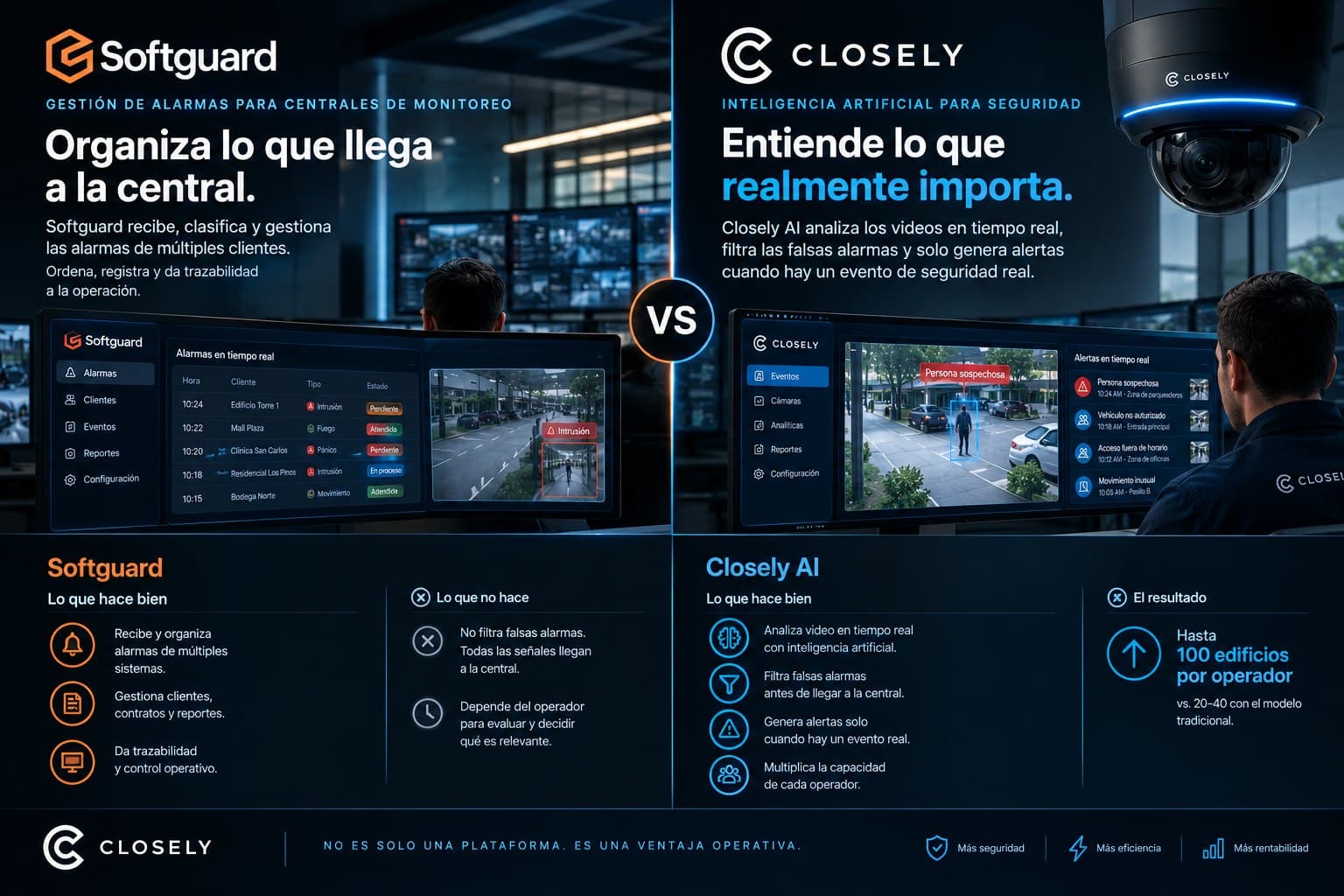
Softguard organizes what reaches the monitoring center. Closely decides what's worth sending there in the first place. That difference completely changes the scale at which a security operator can work.
Why This Comparison Matters in the LATAM Security Market
Private security companies in Latin America face pressure that isn't going away: more clients, more cameras, more events, and a team of operators that can't grow at the same pace as the volume. The question every operations director is answering, one way or another, is the same: how do we scale without losing service quality?
Softguard and Closely AI show up in that conversation from different angles. Softguard is an alarm management platform for monitoring centers that gives security centers the infrastructure to receive, classify, and manage events from multiple clients. Closely AI is an artificial intelligence platform that drastically reduces the volume of events reaching that center, filtering out false alarms before they eat up operator time.
We've competed in some deals where a security operator was evaluating both platforms at the same time. What we learned from those conversations is that the difference is clear enough to be worth explaining properly. Not because Softguard is a bad platform, but because the two do different things for the same problem.
What Softguard Does
Softguard is alarm management software for monitoring centers. Its main function is to receive alarm signals from multiple systems (clients' alarm panels, sensors, detectors) and present them to the center's operator in an organized interface that makes tracking and response easier.
What Softguard does well is the operational management of alarm flow: it lets the operator see which signals are active, which have already been handled, which are pending a response, and keep a record of the interaction with each client. It's essentially a ticketing system and CRM specialized for security centers.
Softguard also handles client communication, service contracts, billing, and service reports. For a security company that wants to organize its alarm management operation and have traceability of what it does with each alarm from each client, Softguard fills that role.
What Softguard doesn't do is filter. When a Hikvision or Dahua camera fires a motion alert, that alert reaches Softguard. So does the next one. And the one after that. Softguard's alarm monitoring system assumes the signals it receives are relevant. It has no native mechanism to tell the difference between a branch moving in the wind and a person entering a restricted area at 2am.
That distinction, trivial for the human eye in context, is exactly the problem that has monitoring center operators in Latin America responding to hundreds of false alarms per shift.
What Closely AI Does
Closely AI is an artificial intelligence security platform designed specifically for security operators in LATAM and the United States. It connects directly to clients' IP cameras, analyzes video feeds in real time, and only generates an alert when it detects something that genuinely requires human attention.
The difference from Softguard's model isn't the interface. It's the architecture. Softguard receives what alarm systems send it. Closely decides, before sending anything, whether what the camera is seeing deserves to become an alert.
That decision is made by a three-layer pipeline:
The first layer filters basic motion. A branch moving in the wind, a lighting change, the shadow of a cloud. None of that generates anything.
The second layer classifies the object. Is it a person? A vehicle? An animal? If it isn't a security-relevant object, it goes no further.
The third layer reasons about context. Given what this camera has learned about its environment, the time of day, and the pattern of what's happening, is this a genuinely anomalous event?
Only what passes all three layers generates an alert. The measured result is a reduction of up to 88% in false alarm volume compared with conventional detection systems. An operator who used to receive 200 alerts per shift now receives between 20 and 25, all with visual evidence and context attached.
The Number That Changes the Conversation: 100 Buildings per Operator
This is the most concrete argument for Closely AI over any platform that only organizes alarms without filtering them.
With Softguard running on conventional alarm systems, a monitoring center operator can manage between 20 and 40 sites with real attention, depending on event density. Beyond that, the operator starts responding mechanically, with no real capacity to evaluate each event.
With Closely AI filtering event volume before it reaches the operator, that same operator can supervise 100 buildings at once without sacrificing attention quality on any of them. AI doesn't replace the operator. It multiplies what each operator can effectively cover.
For a security company that wants to grow its client portfolio without proportionally growing its operator team, that difference is a direct profitability argument. More clients, the same staff structure, the same service quality.
Complementary, Not Identical
It's important to be precise here, because it's the difference between a useful comparison and a confusing one.
Softguard and Closely AI don't compete for exactly the same function. Softguard is the center's operational platform: it manages workflow, client communication, contracts, and reports. It's the security company's operating system.
Closely AI is the intelligence layer that filters what reaches that center. It doesn't manage contracts or billing. What it does is make sure that when an event reaches the operator, it's a real event.
In practice, many security companies in Latin America that use Softguard can also deploy Closely AI on top of their camera installations. Closely AI reduces the noise reaching the center, and Softguard manages the events that do arrive. They're different layers with different functions.
Where they do compete is in the budget and priority conversation. When a security company has to choose where to invest to scale its operation, the question is whether the priority is managing the event flow better or having fewer events to manage. The honest answer for most of the centers we've met is that the most urgent problem is volume, not how the volume is organized.
The Comparison Table
| Softguard | Closely AI | |
|---|---|---|
| Main function | Alarm management and monitoring | Artificial intelligence on cameras |
| Reduces false alarms | Not natively | Up to 88% |
| Real-time video analysis | No | Yes (Watcher) |
| Monitoring center workflow management | Yes | No |
| Autonomous access control | No | Yes (Gatekeeper) |
| Forensic search in recordings | No | Yes (Investigator) |
| Physical guard supervision | No | Yes (Supervisor) |
| Automatic reports | Basic | Yes (Reporter) |
| Scale per operator | 20-40 sites | Up to 100 sites |
| Contract and client management | Yes | No |
| Billing and CRM | Yes | No |
| Main market | LATAM monitoring centers | LATAM and United States |
Five Agents, One Platform
What sets Closely AI apart from a conventional video analytics solution is that it doesn't have just one agent. It has five, and each covers a different function in the security operation.
Watcher is the computer vision agent. It analyzes camera feeds, learns each site's patterns, and generates alerts only when it detects something genuinely anomalous. It's what produces the 88% reduction in false alarms.
Gatekeeper is the access control agent. It autonomously handles visitor interactions at intercoms, notifies the responsible person via WhatsApp and a simultaneous phone call, and records every access automatically.
Investigator is the forensic search agent. It lets you search historical recordings by description or visual attributes, cutting what used to require manual video review from hours to minutes.
Supervisor is the security staff management agent. It tracks patrols in real time, verifies that rounds are completed on schedule, and generates alerts if a guard stops logging activity.
Reporter is the documentation agent. It automatically generates logs, shift reports, and audit records without the operator having to fill in anything manually.
None of these agents exist in Softguard. Not because Softguard is an incomplete product, but because Softguard was designed to manage the alarm flow that already exists, not to transform the nature of that flow.
Closely AI in Practice: What Changes in the Monitoring Center
A security company that runs on Softguard and adds Closely AI on top of its camera installations experiences an operational change that's felt from the first week.
The volume of events reaching the center drops significantly. Operators stop mechanically responding to hundreds of motion alerts that mean nothing and start focusing their attention on the events that actually need it, each with a video clip and context ready.
The center's ability to grow without growing the team becomes real. If one operator can manage 100 sites instead of 30, the company can triple its client portfolio with the same operational structure. That fundamentally changes the profitability model.
And clients notice. A client who used to get calls from the center to confirm false alarms three times a week, pulling them out of work or waking them at night, starts getting calls only when something real is happening. That improvement in client experience is the difference between retention and cancellation in the long run.
For security companies in Colombia, Mexico, Peru, Chile, Argentina, and the U.S. market that want to understand how Closely AI would fit into their current operation, including those already using Softguard, the Closely AI team offers a free two-week demo on their own clients' camera infrastructure.
10 Frequently Asked Questions About Closely AI vs. Softguard
1. What is the main difference between Closely AI and Softguard?
Softguard is an alarm management platform for monitoring centers: it receives signals from alarm systems, organizes the event flow, and manages the center's operation. Closely AI is an artificial intelligence security platform that connects to cameras and filters events before they reach any monitoring center, reducing false alarms by up to 88%. Softguard manages what arrives. Closely AI decides what's worth sending.
2. Can Closely AI and Softguard be used at the same time?
Yes. They're different layers. Closely AI runs on the cameras and filters alert volume before it reaches the monitoring center. Softguard manages the center's workflow with the events that do arrive. For a security company using Softguard, deploying Closely AI on its camera installations reduces the noise reaching the center without replacing the workflow management Softguard provides. The Closely AI team can evaluate the integration with each company's specific operation.
3. Does Softguard have artificial intelligence to reduce false alarms?
Not natively. Softguard is an alarm monitoring platform designed to organize and manage the event flow reaching the center. It doesn't have computer vision models that analyze camera feeds in real time to tell a false alarm from a real event. Closely AI does have that mechanism: its three-layer pipeline filters irrelevant motion, classifies objects, and reasons about context before generating any alert.
4. How many buildings can one operator monitor with Closely AI?
With Closely AI filtering event volume before it reaches the operator, one operator can supervise up to 100 sites simultaneously without sacrificing attention quality on any of them. That contrasts with the 20 to 40 sites an operator can manage with real attention using conventional alarm management platforms without AI filtering. That difference in capacity per operator directly changes a security company's profitability model.
5. How does Closely AI reduce false alarms by 88%?
Closely AI uses a three-layer detection pipeline. The first filters irrelevant motion: lighting changes, shadows, wind. The second classifies the detected object: person, vehicle, animal, or other. The third applies context reasoning: given what this camera has learned about its environment and the time of day, is this event genuinely anomalous? Only events that pass all three layers generate an alert. The result is a reduction of up to 88% in false alarm volume compared with conventional detection systems.
6. Does Closely AI replace the need for an alarm management platform like Softguard?
Not completely. Closely AI doesn't manage client contracts, billing, center communications, or a security company's administrative workflow. Softguard covers those functions. Closely AI covers the intelligence layer on cameras: false alarm filtering, anomalous behavior detection, autonomous access control, guard supervision, and automatic documentation. For a monitoring center that wants to scale its operation, the ideal is to have both layers: Softguard to manage the flow and Closely AI to reduce the noise entering that flow.
7. Does Closely AI work with the cameras my clients already have installed?
Yes. Closely AI connects to any IP camera with RTSP and ONVIF, which includes virtually every camera from Hikvision, Dahua, Axis, Hanwha, Bosch, and most manufacturers in Latin America and the United States. No hardware replacement is required. Deployment on clients' existing camera infrastructure can be completed in days, not months. The Closely AI team confirms compatibility before starting the free two-week demo.
8. What happens to clients who receive a lot of false alarms from their security systems?
Clients who get frequent calls from the monitoring center to confirm false alarms, especially at night or during work hours, develop alarm fatigue: they stop taking alerts seriously because most of them are noise. That's dangerous, because when a real event happens the response can be slow or nonexistent. Closely AI solves this problem at the source: the client only gets calls when something real is happening, which improves retention and the perception of the security company's monitoring service.
9. Does Closely AI have the guard supervision function that Softguard lacks?
Yes. Closely AI's Supervisor agent tracks physical security staff patrols in real time. It verifies that scheduled rounds are completed on time, detects checkpoints that weren't visited within the expected window, and generates wellness alerts if a guard stops logging activity. For security companies that deploy physical guards in addition to remote monitoring, this creates automatic accountability that used to require manual supervision.
10. How can a security company that uses Softguard start using Closely AI?
The most direct entry point is Closely AI's free two-week demo. The team reviews the camera inventory of two or three representative client sites, confirms compatibility, configures the agents for those specific environments, and the company runs the full platform for two weeks on its real infrastructure. There's no need to change or pause Softguard during the evaluation. At the end of the two weeks, the company has real data on how much false alarm volume dropped and how the operator workload changed.