PTZ Cameras and Video Surveillance Systems: Complete Guide to Choosing, Installing and Integrating with AI
PTZ cameras: how they work, when to use them instead of fixed cameras, the leading manufacturers, and how to integrate them with AI.
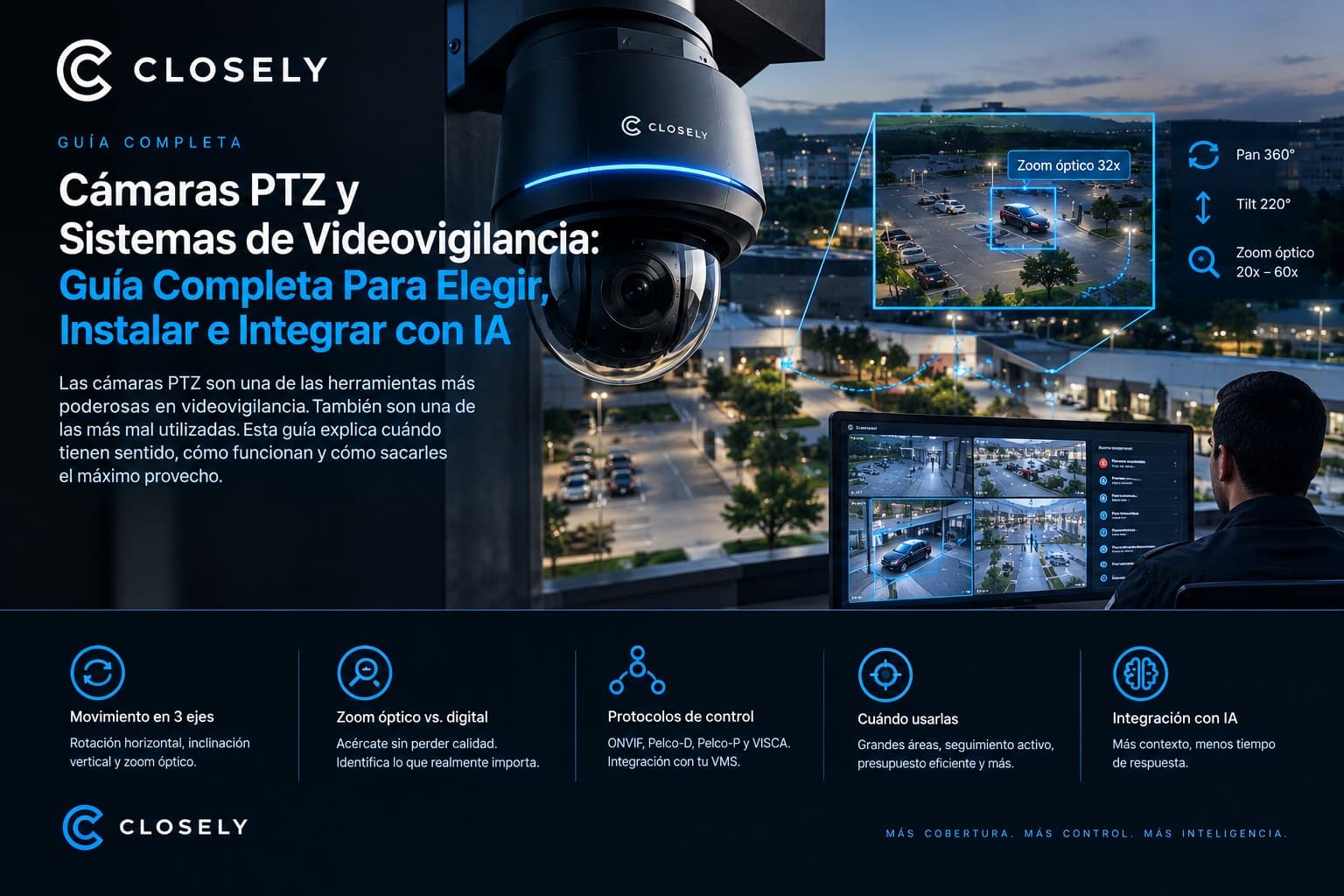
PTZ cameras are one of the most powerful tools in video surveillance. They are also one of the most misused. This guide explains when they make sense, how they work, and how to get the most out of them.
What PTZ Cameras Are and Why They Aren't Right for Every Case
PTZ stands for Pan, Tilt, Zoom: horizontal rotation, vertical tilt, and optical zoom. A PTZ camera is a motorized security camera that can move in those three dimensions remotely, covering a significantly wider observation area than any fixed camera in the same location. A well-implemented PTZ security camera can be the difference between detecting an incident in time and discovering it in the recordings the next day.
Unlike a fixed camera permanently pointed at a specific area, a PTZ surveillance camera can rotate 360 degrees horizontally, tilt up or down as needed, and use its optical zoom to close in on a point of interest without losing image quality. That makes it especially useful in open spaces, long perimeters, large parking lots, public plazas, and any environment where a single fixed camera doesn't have a wide enough field of view to cover the area.
However, the PTZ surveillance camera has an operational cost that isn't always mentioned on spec sheets: a PTZ camera in manual mode depends on someone controlling it. If nobody moves the camera toward where the incident happened, the fact that it can move is useless. That's why the relevant question is not just "what can a PTZ camera do?" but "how will it be controlled, and in what operational context will it be used?"
How a PTZ Camera Works Inside
The Movement Mechanisms
The core of a PTZ camera is its motor system. In modern PTZ video surveillance systems, most cameras use stepper motors for horizontal and vertical movement, which allow precise and repeatable positioning. This is what makes presets possible: predefined positions the camera can automatically return to with millimeter precision.
Movement speed varies significantly between models. High-end PTZ cameras can rotate 360 degrees in under a second, which makes them useful for tracking moving objects. Mid-range models are slower but sufficient for most security applications, where the goal is not real-time tracking but covering multiple zones with a single camera.
Optical Zoom vs. Digital Zoom
One feature that separates quality PTZ cameras from the rest is optical zoom. Optical zoom physically moves the lenses to magnify the image without losing resolution, just like binoculars. Digital zoom, on the other hand, simply crops and enlarges the digital image, losing quality in the process.
In PTZ video surveillance systems, optical zoom matters for a practical reason: when you need to identify a license plate, a person's face, or a specific detail 50 meters away, only optical zoom can do it without the image becoming unusable. PTZ security camera models aimed at serious applications generally offer between 20x and 40x optical zoom. Some high-end models reach 60x.
Control Protocols
PTZ cameras are controlled through specific protocols. The most common on the market are:
ONVIF is the interoperability standard that allows PTZ cameras from different manufacturers to be controlled by the same video management software. Most modern PTZ cameras are ONVIF-compatible, which makes integration with NVRs, VMS, and third-party platforms easier.
Pelco-D and Pelco-P are older serial protocols that still appear in existing installations, especially systems with analog cameras or installations more than ten years old.
VISCA is a Sony protocol widely used in PTZ cameras for video production and broadcast, which also appears in some high-end security cameras.
When to Use PTZ Cameras and When to Use Fixed Cameras
This is the question most often skipped before an installation and most often the cause of problems afterward.
Cases Where a PTZ Makes Sense
Large open spaces such as parking lots, industrial yards, facility perimeters, or public plazas, where the area needing coverage is too large for a single fixed camera, but installing ten fixed cameras would be costly or impractical.
Active tracking points where an operator needs to keep an eye on a specific moving target: a suspicious vehicle in a parking lot, a person following an anomalous pattern in a mall, an incident developing in a public plaza. In these cases, the PTZ's ability to follow the target while keeping a useful image thanks to optical zoom is irreplaceable.
Installations with a limited budget for wide coverage, where a well-placed PTZ can replace multiple fixed cameras for covering alternating zones. This applies especially to installations with periods of high and low activity, where the camera can be scheduled to cover different zones at different times.
As a complement to a network of fixed cameras, to follow up on events detected by the fixed cameras. This is perhaps the most valuable use case in modern AI-enabled installations: the fixed cameras detect an event, and the PTZ is automatically directed to that point for detailed tracking.
Cases Where a Fixed Camera Is Better
Controlled access points such as doors, turnstiles, vehicle entrances, and pedestrian gates. At these points, the specific and constant coverage of a well-placed fixed camera is more reliable than the flexible but intermittent coverage of a PTZ.
Installations without an active operator, where nobody will control the PTZ camera in real time. A PTZ without active control or well-configured presets can end up pointing at the ceiling while an incident happens at the other end of its range of motion.
Forensic recording of specific points, where you need evidence that a specific point was always covered. A fixed camera continuously recording an access point provides stronger evidence than a PTZ that may have been pointing elsewhere at the moment of the incident.
Leading PTZ Camera Manufacturers
Hikvision
Hikvision is the most widely installed PTZ camera manufacturer in Latin America and one of the largest in the world. Its PTZ camera system line ranges from mid-range models for parking lots and commercial spaces to high-speed cameras for traffic and real-time tracking.
Its ColorVu and AcuSense series include PTZ cameras with full-color night imaging, basic built-in intelligent detection, and up to 32x optical zoom. Competitive pricing and availability through local distributors in virtually every Latin American country make Hikvision the most common choice for mid-budget installations.
Dahua
Dahua is the other giant of the PTZ video surveillance market in Latin America. Its SD line includes PTZ cameras with capabilities similar to Hikvision, up to 40x optical zoom on its most advanced models, and basic intelligent detection capabilities that are significantly enhanced when integrated with external AI platforms.
Like Hikvision, Dahua is restricted from use in U.S. federal government installations under the NDAA, which is a factor to consider in that specific market.
Axis Communications
Axis is the reference manufacturer for high-security installations and enterprise projects in Europe and North America. Its Q and P line PTZ surveillance cameras are recognized in the industry for image quality, durability, and level of technical support. They are also significantly more expensive than Hikvision or Dahua.
Its PTZ cameras include native support for ONVIF and VAPIX (its proprietary API), which makes integration with third-party AI platforms easier. In enterprise installations in the United States, Axis is frequently the baseline specification for high-security PTZ cameras.
Hanwha Vision (Samsung)
Hanwha Vision, formerly Samsung Techwin, has a PTZ camera line with a strong presence in the North American market and a growing presence in Latin America. Its cameras are NDAA-compliant for U.S. federal installations, making them a natural alternative to Hikvision and Dahua in that context. Its optical zoom reaches up to 42x on its most advanced models.
Bosch
Bosch occupies the premium segment of the market with its high-end PTZ surveillance cameras, especially in industrial facilities, airports, critical infrastructure, and smart city projects. Its AUTODOME series PTZ cameras include advanced image stabilization, very high movement speeds, and more sophisticated built-in analytics than Asian manufacturers.
How to Integrate PTZ Cameras with Artificial Intelligence
The most effective combination in modern PTZ camera systems is not choosing between fixed or PTZ cameras, but using both in a complementary way with an AI layer that connects them intelligently.
The model that works best in shopping centers, large-scale parking lots, industrial facilities, and university campuses is the following:
Fixed cameras cover access points and the highest-priority zones with constant coverage. AI analyzes those fixed cameras in real time, detects events of interest (a person beginning to behave anomalously, a vehicle stopping where it shouldn't, a group forming unusually), and automatically directs the PTZ camera to that point for detailed tracking with optical zoom.
This maximizes the value of the PTZ security camera: instead of statically watching some generic preset or being manually controlled by an operator, the PTZ becomes the tracking and detail tool that the AI activates when it detects something worth examining up close.
How Closely Integrates with PTZ Cameras
Closely connects to PTZ cameras from any manufacturer that supports RTSP and ONVIF, including the PTZ lines from Hikvision, Dahua, Axis, Hanwha, and Bosch, among others.
Closely's agents analyze PTZ camera feeds exactly as they analyze fixed camera feeds: Watcher detects anomalous behavior, Gatekeeper manages access, Investigator enables forensic search in historical recordings, Supervisor tracks guards, and Reporter documents every event in a structured way.
In installations where PTZ cameras are integrated alongside fixed cameras, Closely provides a unified view of every feed from a single interface, with prioritized alerts that tell the operator exactly which camera to look at and what is happening, regardless of whether that camera is fixed or PTZ.
The advantage of adding AI to a PTZ video surveillance system is especially visible in installations where PTZ cameras run in automatic patrol mode between presets. When the AI system detects an event at one of the patrol positions, it can alert the operator with the event clip even if the camera has already moved on to another preset.
For installations in the United States and Latin America that have PTZ camera systems in place and want to add artificial intelligence on top of that infrastructure without replacing any hardware, Closely offers a free two-week demo to show how the five agents work on their specific camera configuration.
10 Frequently Asked Questions About PTZ Cameras and Video Surveillance Systems
1. What does PTZ mean in security cameras?
PTZ stands for Pan (horizontal rotation), Tilt (vertical tilt), and Zoom (optical magnification). A PTZ security camera is a motorized camera that can move in those three dimensions remotely, allowing it to cover a much wider observation area than a fixed camera from the same location. Its most valuable feature in security applications is optical zoom, which lets it close in on a distant point of interest without losing image quality.
2. When does it make sense to install PTZ cameras instead of fixed cameras?
PTZ cameras make sense when the area to be covered is too wide for a fixed camera, when there are operators who will actively control them in real time, or when they will be used as a complement to fixed cameras in an AI system that directs them automatically toward detected events. They don't make sense at specific access points that need constant coverage, in installations without active operators, or when the goal is permanent forensic recording of a specific point.
3. How much optical zoom does a PTZ camera need for video surveillance?
It depends on the distance at which you need to identify details. To identify license plates or recognize people at 30-50 meters, you generally need 20x to 30x optical zoom. For longer distances, such as industrial facility perimeters or highways, you need 30x to 60x. For indoor spaces or normal-sized parking lots, a PTZ security camera with 20x is usually enough. Avoid models that combine low optical zoom with high digital zoom to inflate the total number, since digital zoom adds no real image quality.
4. Are Hikvision and Dahua PTZ cameras NDAA compliant for installations in the United States?
No. Hikvision and Dahua PTZ cameras, like the rest of their products, are restricted from use in U.S. federal government installations under Section 889 of the NDAA. For federal or federal contractor installations in the United States, NDAA-compliant alternatives include Axis, Hanwha Vision, Avigilon, and Bosch. For private commercial installations in the United States, Hikvision and Dahua can be used without legal restriction.
5. What is the difference between a PTZ camera with presets and one in automatic patrol mode?
Presets are predefined positions the PTZ camera can automatically return to with precision. A camera in automatic patrol mode (auto-patrol) rotates between those presets continuously on a schedule, without needing permanent manual control. This makes it useful for covering multiple zones without an active operator. The limitation is that when the camera is pointing at preset A, it isn't covering preset B. An AI system can detect events in any zone and alert the operator even if the camera has already moved on to another preset.
6. How does a PTZ camera connect to an NVR or video management system?
Most modern PTZ cameras connect to NVRs and VMS systems over Ethernet, using the ONVIF protocol for standard control and video communication. Some manufacturers also offer proprietary APIs (such as Axis's VAPIX or Hikvision's SDK) that allow deeper integrations with their own management systems. Older serial protocols such as Pelco-D appear in existing installations with older hardware or with analog cameras connected to IP encoders.
7. Can a PTZ camera automatically follow a moving person or vehicle?
Yes, although the quality of automatic tracking varies significantly between models. High-end PTZ cameras include automatic tracking through video analytics built into the camera itself, which can keep an object centered in the frame as it moves. Mid-range models generally require an external AI platform for tracking, which analyzes the video and sends movement commands to the camera via ONVIF. The second option is more flexible because the external AI engine can be more sophisticated than the analytics embedded in the camera.
8. How much storage does a PTZ camera consume compared with a fixed camera?
A PTZ camera in active motion generates more data than a fixed camera pointed at a static scene, because constant movement reduces video compression efficiency. However, in automatic patrol mode with fixed presets and little activity, consumption can be similar to a fixed camera. The rule of thumb is to calculate a PTZ's storage as if it were a fixed camera of the same resolution and frame rate in a medium-activity scene, and add a 20-30% margin for periods of active movement.
9. Can Closely control a PTZ camera's movement, or does it only analyze the video?
Closely analyzes PTZ camera video and can integrate with systems that allow movement commands to be sent via ONVIF. In installations where the PTZ is configured to respond to external commands, Closely's agents can potentially direct the camera toward a point where an event was detected. The specific functionality depends on the camera model and installation configuration, so Closely's team reviews compatibility during the initial assessment before the free demo.
10. Is it worth adding artificial intelligence to PTZ cameras that are already installed?
Yes, and it's one of the most effective use cases for AI in video surveillance. PTZ cameras have the potential to cover large areas, but that potential is only fully realized when someone is controlling them or when an AI system directs them automatically toward relevant events. Adding AI to existing PTZ camera systems, such as Closely's five agents, turns infrastructure that often just records with nobody watching into a system that actively detects, alerts, documents, and investigates. Without changing a single camera.