Fisheye Lenses and Wide-Angle Cameras: Complete Guide for Video Surveillance in 2026
Fisheye cameras: how they work, what dewarping is, when to use them instead of fixed cameras, and how to integrate them with AI.
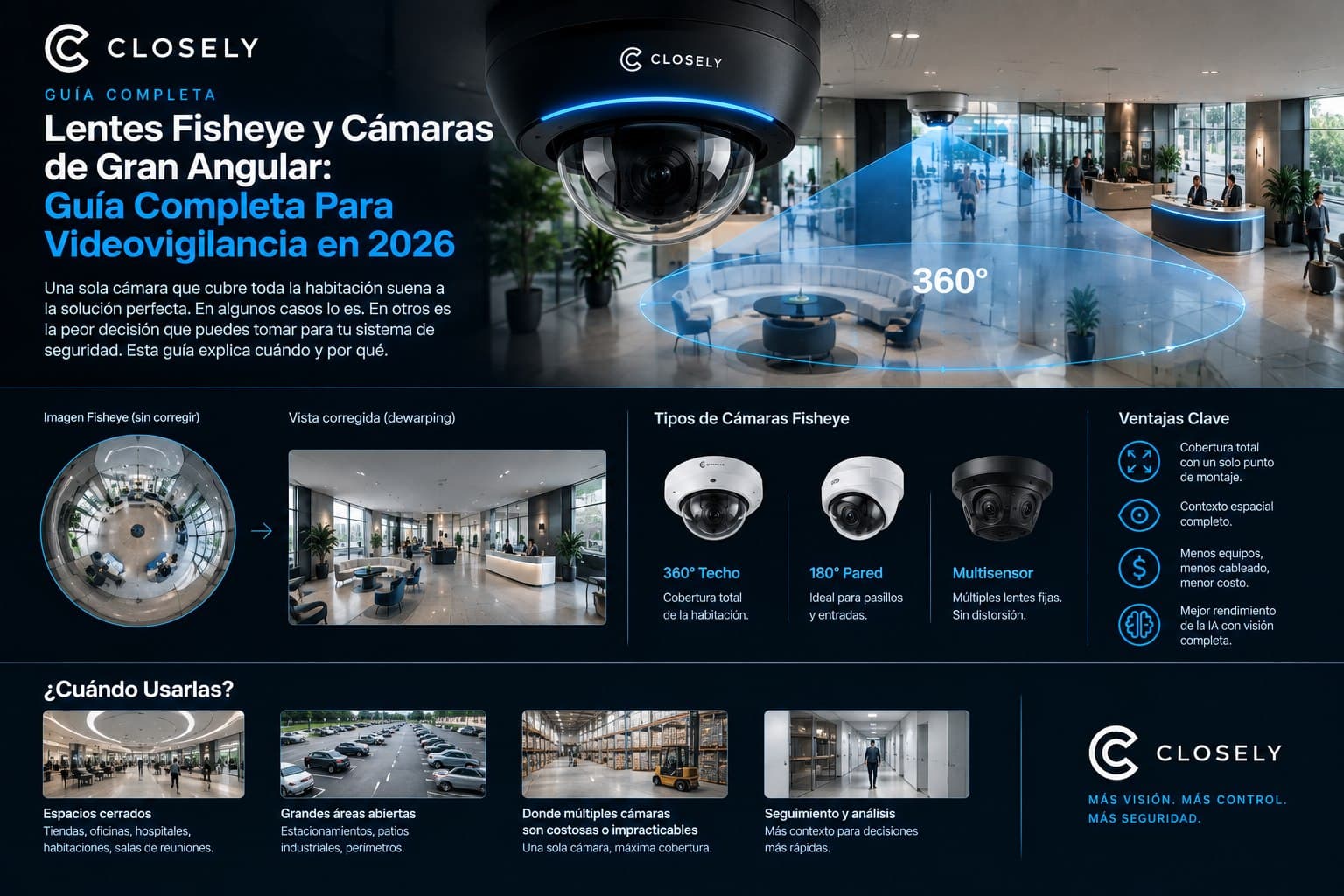
A single camera that covers the whole room sounds like the perfect solution. In some cases it is. In others it's the worst decision you can make for your security system. This guide explains when and why.
What a Fisheye Lens Is and Why It Exists in Security
The term "fisheye" describes a category of ultra-wide-angle lenses that capture extremely wide fields of view, from 180 degrees up to a full 360 degrees in specialized cameras. The name comes from the analogy with how a fish sees underwater: a hemispherical perspective that takes in practically everything around it.
In video surveillance, fisheye cameras are devices designed to capture a 360-degree panoramic view from a single mounting point. Installed on a room's ceiling, a fisheye surveillance camera can see every wall, every corner, and the entire floor at the same time, without needing multiple cameras at different angles.
That ability to cover everything from a single point is what makes them attractive for certain security use cases. But it's also what makes them unsuitable for others. Understanding the difference is what separates a security system that works from one that gives a false sense of coverage.
How Fisheye Cameras Work Technically
Distortion and How It's Corrected
The optical principle behind a fisheye lens for security cameras is equidistant or equal-area projection: the lens bends light extremely to compress a very wide field of view onto a relatively small image sensor. The result is a circular or semicircular image with characteristic barrel distortion: straight lines at the edges of the image appear curved.
That distortion is not a manufacturing defect. It's an unavoidable consequence of compressing 360 degrees into a flat image. What separates quality fisheye cameras from the rest is the image correction software they include, known as dewarping.
Fisheye dewarping is the mathematical transformation that converts the distorted circular image into corrected, usable rectangular views. Good dewarping software can generate multiple simultaneous views from a single fisheye image: a 180-degree corridor panorama, quad views that split the space into four independent zones, and "double panorama" views where the image unfolds as a horizontal strip showing the room's entire perimeter.
Dewarping can happen in the camera itself (onboard) or on the server or NVR that receives the stream. Cameras that dewarp onboard transmit already-corrected streams that any system can handle. Those that rely on the server for dewarping require the NVR or VMS to specifically support that camera model, which can create compatibility problems in mixed installations.
Types of Fisheye Cameras on the Market
Not all fisheye surveillance cameras are the same. The differences that matter most for a security installation are:
360-degree ceiling-mount fisheye is the most common type. It's installed facing down from the ceiling and captures the entire room at once. Ideal for rooms, lobbies, meeting rooms, stores, and enclosed spaces where full floor coverage is the priority.
180-degree wall-mount fisheye captures a hemisphere instead of the full circle. It's useful for hallways where a wall-to-wall 180-degree view is enough, or for entrances where you need to see inside and outside the access point at the same time.
Multisensor with multiple fixed lenses is a variation that combines several normal-angle cameras in the same housing to simulate 360-degree coverage without fisheye distortion. Each sensor covers a segment, and the software stitches the images together. These cameras offer better image quality in each zone but are more expensive and more processing-intensive.
The Real Advantages of Fisheye Cameras in Video Surveillance
Full Coverage from a Single Mounting Point
The main advantage of wide-angle security cameras is fewer blind spots in enclosed spaces. In a 50-square-meter store, a single ceiling-mounted fisheye camera can cover practically the entire space. Achieving the same distortion-free coverage with standard fixed cameras would take three to five cameras at different angles.
That reduces hardware cost, cabling complexity, the number of channel licenses on the NVR, and installation time. In spaces where installing multiple cameras is costly or impractical for infrastructure or aesthetic reasons, fisheye cameras can be the most pragmatic solution.
Full Spatial Context
A conventional fixed camera shows you what happens in its field of view. A fisheye security camera shows you what happens across the entire room at once. That difference in context can matter in forensic investigations: instead of reviewing multiple feeds from different cameras trying to reconstruct what happened and in what order, a single fisheye recording shows the whole event with full spatial context.
In high-traffic areas, such as a shopping center food court, a hotel lobby, or a warehouse floor, that complete view has operational value beyond security: real-time occupancy, traffic flows, and how people are distributed across the space.
Less Maintenance
Fewer cameras mean fewer points of failure, fewer cables to manage, fewer camera configurations to maintain, and less chance of an angle going uncovered because a camera is misaligned or poorly adjusted. In installations with small maintenance teams or where physical access to mounting points is difficult, that's no small factor.
The Limitations Nobody Mentions When Selling Fisheye Cameras
Resolution per Zone Is Limited
This is the most important limitation and the one most often underestimated when evaluating fisheye cameras for security. A 12-megapixel fisheye camera covering 360 degrees is spreading those 12 megapixels across every angle of the room at once. When the dewarping software enlarges a specific zone to view it in detail, it is cropping and scaling a portion of those 12 megapixels, not generating additional resolution.
In practice, in large spaces, people or vehicles at the edge of the fisheye image can appear too small for reliable identification. A 2-megapixel fixed camera pointed directly at an entrance can capture a face or license plate in far more detail than a 12-megapixel fisheye looking at that same entrance from the ceiling.
For applications where identifying people at a distance matters, the fisheye surveillance camera has clear limitations, and this is a deciding factor to weigh before choosing fisheye over fixed cameras.
Long Distances Are a Problem
Fisheye lenses for security cameras are optimized for wide coverage in relatively contained spaces. In large open areas, such as big parking lots, industrial perimeters, or wide outdoor areas, a fisheye camera's ability to capture detail at a distance is insufficient for most security applications.
For those environments, a combination of long-range fixed cameras or PTZ cameras with optical zoom delivers better performance than a fisheye camera, no matter how many megapixels the fisheye has.
Dewarping Consumes Resources
The processing needed to convert the circular fisheye image into multiple usable rectangular views is computationally intensive. In installations with many fisheye cameras, the server or NVR doing the dewarping needs significantly more processing capacity than an equivalent installation with fixed cameras. If the hardware isn't sized for it, the result is video delays, dropped frames, or system instability.
Leading Fisheye Camera Manufacturers
Hikvision
Hikvision has one of the most complete fisheye camera lines in the Latin American and U.S. markets. Its PanoVu series models offer up to 12 megapixels with onboard dewarping, multiple configurable viewing modes, and competitive pricing for mid-budget installations.
The availability of its fisheye cameras through local distributors across virtually the entire continent makes them the default choice for many installations in Colombia, Mexico, Peru, Chile, and the rest of Latin America. The NDAA restriction applies to U.S. federal government installations.
Dahua
Dahua has an equally extensive fisheye line, with its Fisheye and WizMind series including basic video analytics built into the camera. Its high-end models include camera-level person and vehicle detection, which reduces the processing load on the server.
Like Hikvision, Dahua has broad distribution in Latin America and NDAA restrictions for U.S. federal installations.
Axis Communications
Axis has a more selective fisheye offering, with its P3717 and Q3517 models aimed at the enterprise segment. What sets them apart is not only image quality but integration with its AXIS Camera Application Platform analytics ecosystem, which allows artificial intelligence applications to run directly on the camera.
For installations in the United States where NDAA compliance is required, Axis is the strongest enterprise alternative.
Hanwha Vision and Vivotek
Hanwha has NDAA-compliant fisheye models with a solid presence in the North American market. Vivotek, a Taiwanese manufacturer, has a well-regarded fisheye line in Latin America's mid-market segment, with reasonably accessible technical support in the region.
When to Choose Fisheye and When Not To
The decision to use wide-angle security cameras instead of fixed or PTZ cameras should be based on the answers to these four questions:
- Is the space enclosed and of contained size? If so, fisheye can work well.
- Do you need to identify people or vehicles at distances greater than 10 meters with reliable detail? If yes, you probably need fixed or PTZ cameras.
- Can the storage and processing budget absorb the higher consumption of high-resolution fisheye cameras?
- Does the video management software you'll use natively support the specific fisheye model you've chosen?
If the answers are favorable, fisheye cameras can significantly simplify the installation and reduce costs. If any answer raises doubts, the prudent move is to combine them with fixed cameras at critical points.
How Closely Integrates with Fisheye Cameras
Closely connects to fisheye cameras from any manufacturer that supports RTSP and ONVIF, including the fisheye lines from Hikvision, Dahua, Axis, Hanwha, and most manufacturers on the market.
Closely's agents process fisheye camera feeds exactly as they process fixed or PTZ camera feeds. Watcher analyzes the stream in real time for anomalous behavior, Gatekeeper manages access, Investigator enables forensic search in historical recordings, Supervisor tracks guards, and Reporter documents every event in a structured way.
A practical consideration for fisheye installations: when the camera dewarps onboard and transmits multiple virtual streams, Closely can connect to each of those streams and apply independent detection to each virtual zone. This is especially useful in large spaces where different zones of the fisheye view have different risk profiles and require different detection rules.
For installations in the United States and Latin America with fisheye cameras already installed or under evaluation, Closely offers a free two-week demo to show how the five agents work on the customer's specific infrastructure.
10 Frequently Asked Questions About Fisheye Cameras and Wide-Angle Equipment
1. What is a fisheye camera and what is it used for in video surveillance?
A fisheye security camera is a camera equipped with an ultra-wide-angle lens that captures fields of view of 180 to 360 degrees from a single mounting point. In video surveillance it's used to cover entire enclosed spaces with a single camera, eliminating blind spots that would otherwise require multiple conventional cameras. They're especially useful in stores, lobbies, meeting rooms, food courts, and any enclosed space where full coverage from a central point is the priority.
2. What is fisheye dewarping and why does it matter?
Fisheye dewarping is the digital correction process that converts the distorted circular image produced by the wide-angle lens into usable rectangular views. Good dewarping software can generate multiple simultaneous views from a single fisheye image: panoramic, quad, and double panorama. Dewarping can happen in the camera itself (onboard) or on the server receiving the stream. Cameras with onboard dewarping are more compatible with different recording systems because they already transmit the corrected image.
3. How many megapixels does a fisheye camera need for video surveillance?
For small to medium spaces, between 50 and 150 square meters, a 6 to 8 megapixel fisheye security camera is usually enough. For larger spaces or where more detail is needed in specific zones, 12 megapixels or more gives better per-zone resolution when dewarping. Keep in mind that those megapixels are spread across every angle of the space at once, so more megapixels in a fisheye is always preferable if the budget allows.
4. When is a fisheye camera better than multiple fixed cameras?
A wide-angle security camera makes sense when the space is enclosed and contained, the budget limits how many cameras can be installed, cabling infrastructure is limited, or the main goal is full spatial context rather than detailed identification at a distance. It doesn't make sense when you need to identify people or vehicles beyond 10 meters with reliable detail, when the space is very large or open, or when the video management software doesn't properly support the chosen fisheye model.
5. Are Hikvision fisheye cameras good for installations in Latin America?
Hikvision fisheye cameras, especially the PanoVu series, are among the most installed options in Latin America thanks to their combination of price, availability through local distributors, and image quality for the price range. For installations in Colombia, Mexico, Peru, Chile, and other regional markets, they're a solid mid-budget option. For U.S. federal government installations, NDAA restrictions prohibit the use of Hikvision hardware.
6. Can a fisheye camera identify faces or vehicle license plates?
Generally, with significant limitations. A fisheye surveillance camera spreads its resolution across the entire 360-degree field of view. To identify a face or license plate more than 5 meters away, the resolution available per zone is usually insufficient compared with a fixed camera pointed directly at that spot. For applications where biometric or license plate identification is critical, fisheye cameras should be complemented by dedicated fixed cameras at the access points where that identification is needed.
7. What is the difference between a fisheye camera and a 360 multisensor camera?
A fisheye camera uses a single sensor and a single ultra-wide-angle lens that produces a distorted circular image corrected by software. A 360 multisensor camera uses several normal image sensors pointed in different directions, which the software stitches into a panoramic view. The multisensor camera offers better image quality per zone because each sensor has a narrower field of view and more relative resolution, but it's more expensive and more processing-intensive. The fisheye is cheaper and simpler to install.
8. What software or NVR do I need to view a fisheye camera correctly?
To view fisheye camera video correctly, the video management software or NVR must support dewarping for that specific camera model, unless the camera dewarps onboard and transmits already-corrected streams. Major VMS platforms such as Milestone XProtect, Genetec Security Center, and Hikvision's and Dahua's own NVRs support their respective fisheye cameras. For cameras from other manufacturers, it's important to verify specific compatibility before purchasing.
9. How does a fisheye camera affect storage compared with conventional cameras?
High-resolution wide-angle security cameras (8 to 12 megapixels) consume more storage than a 2-megapixel fixed camera, but potentially less than the three or four fixed cameras they would replace for the same coverage. Exact consumption depends on the configured resolution, frame rate, codec (HEVC significantly reduces storage compared with H.264), and the level of activity in the space. In spaces with a lot of continuous motion, video compression is less efficient and storage consumption increases.
10. Can Closely process fisheye camera video for event detection?
Yes. Closely connects to fisheye cameras from any manufacturer with RTSP and ONVIF and processes their feeds with the platform's five agents. Watcher detects anomalous behavior in the fisheye security camera feed, Gatekeeper manages access, Investigator enables forensic search, and Reporter documents events automatically. On cameras that transmit multiple virtual streams after onboard dewarping, Closely can connect to each stream independently and apply different detection rules per zone. The free two-week demo lets you verify compatibility with your specific camera model before any commitment.