AI Video Surveillance and Analytics: Turning Security Cameras Into Business Intelligence in 2026
AI video analytics doesn't just detect threats — it turns every camera feed into structured intelligence. Here's how it's changing security operations.
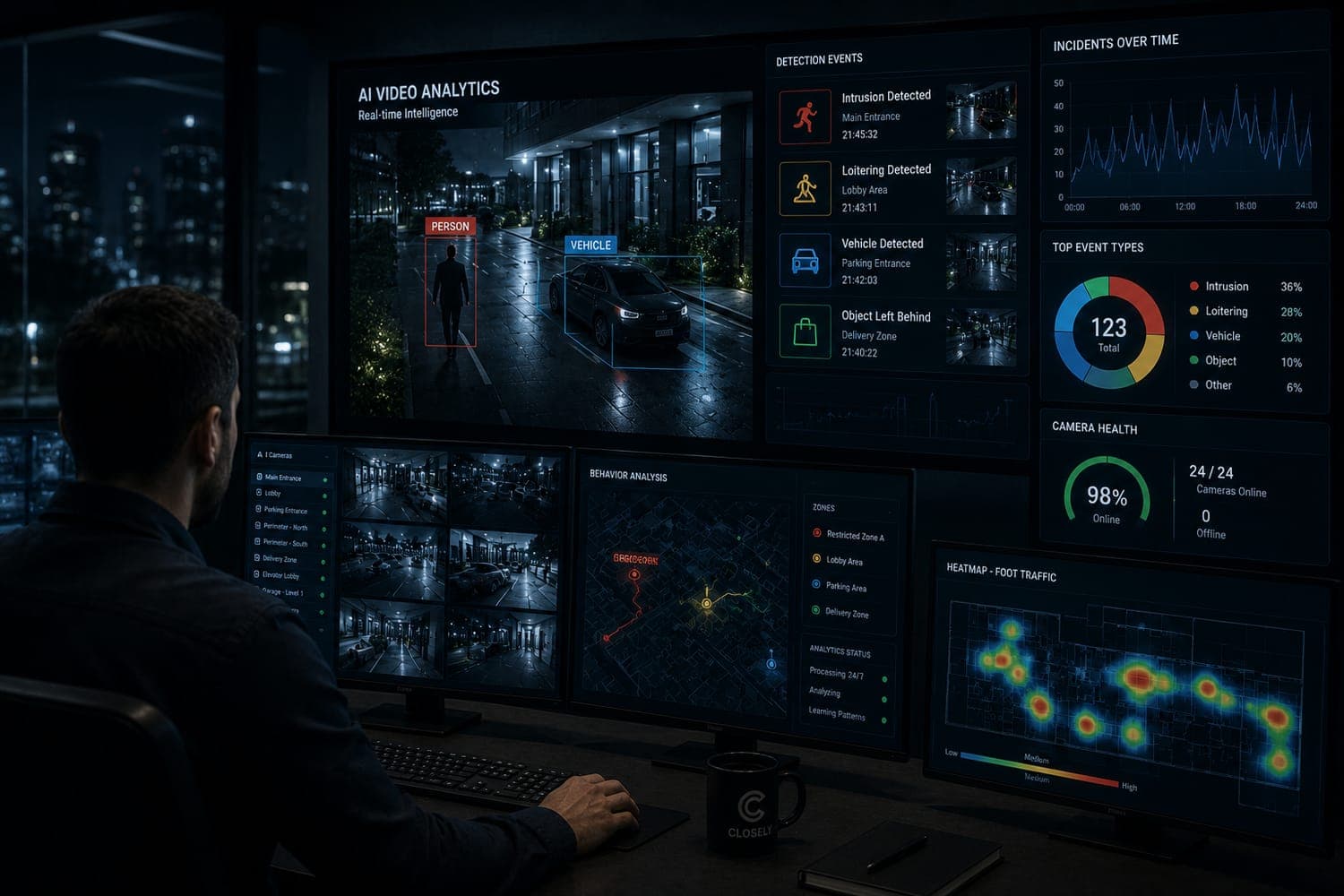
Most cameras record everything and understand nothing — only 5-15% of what a mid-sized operation's cameras see is understood in real time. AI video analytics closes that gap: it converts raw pixels into structured intelligence through object detection, classification, behavioral analysis, and event correlation. The output isn't just an alert — it's a documented, structured incident record that becomes a business intelligence asset over time. Here's how it works and why it's the top-cited security technology for 2026.
Most cameras record everything and understand nothing. AI video analytics changes that — and the business case is clearer than most people realize.
The gap between seeing and understanding
Here's something worth sitting with for a moment. The average mid-sized security operation in the United States or Latin America has somewhere between 50 and 500 cameras running 24 hours a day. Every one of those cameras is seeing something, all the time. But what percentage of what they see is actually understood by anyone in real time?
The honest answer, for most operations, is somewhere between 5% and 15%. The rest gets recorded to a hard drive and reviewed only when something has already gone wrong.
That gap — between what cameras see and what gets acted on — is the problem that AI video surveillance analytics is built to solve. Not by adding more cameras. Not by hiring more operators. But by making the infrastructure you already have actually work. AI-powered video surveillance is how organizations get more out of what they've already deployed — without a hardware refresh or a headcount increase.
According to the 2026 World Security Report, which surveyed 2,352 chief security officers across 31 countries, AI-powered video surveillance and analytics is the single most cited cutting-edge technology that security leaders consider crucial for the next two years — cited by 45% of CSOs globally, and 46% in Latin America. In the United States, 46% of security leaders say the same, with adoption highest in pharmaceuticals (56%) and real estate (56%).
This isn't a technology trend being pushed by vendors. It's a demand signal coming from the people who manage security budgets and understand the operational gaps firsthand.
What AI video analytics actually does with the footage
From pixels to patterns: how behavioral analysis works
The term AI video analytics gets used broadly, so it's worth being specific about what it actually means at the operational level.
A traditional surveillance camera records a continuous video stream. That stream is a sequence of frames — images — that contain an enormous amount of visual information: people, vehicles, objects, lighting changes, movement, stillness. None of that information is structured. It's just pixels.
AI video analytics is the process of converting that raw pixel data into structured intelligence. It does this through a sequence of increasingly sophisticated analysis steps:
Object detection identifies what's in the frame — people, vehicles, packages, animals — and tracks their position across frames. This is the foundation. Without reliable object detection, everything built on top of it breaks down.
Classification assigns meaning to detected objects based on their characteristics: is this a person or a shadow? Is this vehicle a delivery truck or a passenger car? Is this object a bag that someone is carrying or a bag that's been left behind?
Behavioral analysis is where AI video surveillance analytics moves from identifying objects to understanding what they're doing over time. A person walking through a lobby is detected and classified. A person who has been standing near the same entrance for 40 minutes, pacing in a small area, and looking repeatedly at the building entrance — that's a behavioral pattern. Behavioral analysis is what converts observation into anomaly detection.
Event correlation takes behavioral analysis to a network level: not just what's happening on one camera, but how events across multiple cameras at a single site (or across multiple sites) relate to each other. A vehicle that was detected near the perimeter 20 minutes ago is now showing up near a secondary entrance — that correlation, across two different camera feeds, is what good video surveillance analytics surfaces automatically.
Structured incident data is the output: not a raw alert, but a documented event with timestamp, location, event type, confidence score, visual evidence, and context. This is what turns AI video surveillance from a detection tool into an intelligence layer.
The three-tier detection pipeline that actually works
One of the most important architectural decisions in AI video analytics systems is how to balance detection accuracy against computational cost and false positive volume. The naive approach — running every pixel through a sophisticated AI model continuously — is either prohibitively expensive, too slow for real-time operation, or both.
The architecture that works in production uses a cascaded detection pipeline:
Tier 1: Motion filtering — basic computer vision that identifies frames where something has changed versus the static background. This immediately eliminates the vast majority of frames from further analysis — if nothing moved, nothing happened.
Tier 2: Object detection and classification — a computer vision model (like YOLOv8 or similar) that analyzes the motion-flagged frames and determines whether the motion involves a relevant object. Is this a person? A vehicle? An object of interest? Or is it a branch in the wind, a lighting change, or a sensor artifact? This step eliminates the majority of false positives before any sophisticated reasoning occurs.
Tier 3: AI behavioral reasoning — a higher-order model that applies context to the classified objects: Is this behavior anomalous? Does this pattern match a threat signature? Given the time of day, the location, and the historical baseline for this site, is this worth surfacing to a human operator?
Only events that pass all three tiers reach a human as an alert. The result is that operators receive a small number of genuinely relevant events — typically 10-20 per shift instead of 200+ — each with enough context to make a fast, informed decision.
This pipeline architecture is also what makes AI video surveillance economically viable at scale. Running the expensive tier-3 reasoning only on events that passed tiers 1 and 2 keeps inference costs manageable — which is why platforms built this way can operate across large camera fleets without prohibitive cloud compute bills.
What gets detected: the analytics use cases that matter most
Behavioral anomaly detection
The most operationally valuable AI video surveillance analytics capability is behavioral anomaly detection — identifying when something is happening that deviates from the established normal pattern for a given location at a given time.
What constitutes "normal" is learned over time from the camera's historical footage baseline. A busy parking lot at noon looks very different from the same parking lot at 3am. A lobby with 50 people passing through per hour on a Tuesday morning is normal; the same lobby with 50 people at midnight is not. Good behavioral video analytics systems learn these contextual baselines and flag deviations — not all motion, not all presence, but genuine behavioral outliers.
Specific detection types that operate on this principle include:
Loitering detection — a person or vehicle present in a zone beyond the time threshold that's normal for that location. Highly effective at identifying potential threats before they act.
Perimeter breach detection — crossing of a virtual line or entry into a virtual zone that's been defined as restricted. Unlike physical barriers, virtual perimeters can be defined with precision and changed instantly without hardware.
Crowd formation detection — unusual aggregation of people in areas that don't typically see groups. Relevant both for security incidents and for health and safety compliance in commercial environments.
Abandoned object detection — an object present in a frame without a corresponding person nearby, or with a person who left and didn't return. Relevant in transportation hubs, government buildings, and commercial spaces. This is a classic behavioral video analytics use case where temporal analysis — tracking not just what's there but how long it's been there — is what makes the detection meaningful.
Tailgating detection — a second person entering through a controlled access point following an authorized user, without presenting their own credential. One of the most common physical security vulnerabilities and one of the hardest to catch without computer vision.
The analytics that drive operational intelligence
Beyond real-time detection, AI video analytics generates a second category of value: retrospective intelligence derived from aggregated incident data over time.
Every detected event — every loitering alert, every perimeter breach, every access anomaly — is a structured data point. Individually, each is an operational event. Aggregated across weeks, months, and multiple sites, they become an intelligence layer:
Which locations have the highest incident frequency? Which time windows are consistently highest risk? Which detection types are overrepresented at specific sites? Are certain client sites showing patterns that suggest underlying vulnerabilities in their physical layout or access design?
This is where behavioral video analytics transitions from a security tool into a business intelligence asset. The patterns aren't just useful for the next incident — they're the input for strategic security decisions that reduce incident frequency over time.
This pattern intelligence is what allows security operators to shift from reactive (responding to incidents as they happen) to proactive (anticipating where incidents are likely based on evidence). It's also the foundation for the kind of institutional data products — insurance underwriting inputs, logistics risk scoring, government safety intelligence — that represent the long-term commercial value of AI video surveillance networks.
The data layer: why AI video analytics is more than a security tool
One of the most significant shifts in how sophisticated organizations think about AI video surveillance in 2026 is the recognition that the value isn't only in the real-time detection — it's in the structured data generated as a byproduct.
A security camera without analytics generates footage. A security camera with AI video analytics generates structured incident records: timestamped events with location, type, severity, visual evidence, confidence score, and response data. That structure is what makes the data useful beyond the immediate security context.
The 2026 World Security Report found that 93% of security decision-makers plan to use technology to improve incident response — and 38% plan to fully automate the function of containing security incidents. The underlying assumption in both cases is that the technology generates reliable, structured event data. You can't automate containment of events you don't have structured data about.
For security companies operating in Latin America and the United States, this data layer is increasingly a commercial asset in its own right:
For insurance underwriters, structured incident data from a network of monitored sites provides the granular, micro-zone risk intelligence that actuarial models need but currently lack — particularly in LATAM markets where crime data is delayed, aggregated, and unreliable.
For logistics operators, real-time incident data from delivery zones, warehouses, and urban corridors enables route safety scoring and dynamic operational adjustments that reduce theft, driver attrition, and incident-related losses.
For governments and municipalities, validated security incident data from private monitoring networks fills the intelligence gap that public safety agencies increasingly struggle with — particularly for proactive resource allocation and measuring the impact of safety interventions.
The organizations building this data layer today, through AI video surveillance networks with proper incident structuring, are building a strategic asset that compounds over time.
How Closely turns every camera feed into structured intelligence
Closely is built around a specific thesis: that the real value of AI in security isn't the alert — it's the structured data the alert generates, and what you can do with that data at scale.
The platform operates as an intelligence layer above existing camera infrastructure — Hikvision, Dahua, Axis, Hanwha, Avigilon, or any manufacturer with RTSP and ONVIF support. It connects to NVRs and DVRs across multiple client sites, ingests the video streams, and runs them through its three-tier detection pipeline continuously.
What reaches SOC operators is pre-validated, pre-classified, and pre-contextualized. Instead of reviewing raw motion alerts, operators see structured events: what happened, where, at what time, with what confidence score, with visual evidence attached, and correlated with any related events from the same site or same time window.
Closely's detection capabilities include the full range of behavioral video analytics use cases: loitering, perimeter breach, tailgating, crowd formation, open door alerts, bicycle theft, delivery identification, and more. Each detection type is configurable per client site — the system learns what normal looks like at each location and flags deviations from that baseline.
But the part that differentiates Closely from platforms focused purely on detection is what happens after the alert. Every validated incident generates a structured data record that feeds into the operator's incident intelligence layer — usable for client reporting, SLA documentation, trend analysis, and eventually for institutional data products that security operators can monetize with insurers, logistics companies, and government agencies.
AI-powered video surveillance and the structured data it generates is what allows security operators to grow their client base without a linear increase in monitoring staff. For security companies in the US and Latin America looking to scale their camera monitoring operations without scaling headcount proportionally, and for those interested in the longer-term value of the intelligence layer they're building, get in touch with the Closely team.
Frequently Asked Questions
What is AI video surveillance analytics and how is it different from regular video surveillance?
Regular video surveillance records footage — the cameras see everything but understand nothing. AI video surveillance analytics adds a layer of software that actively analyzes the footage in real time, identifies objects and behaviors, classifies events, and surfaces anomalies to human operators as structured alerts. The practical difference is between a system that stores evidence after something happens and a system that detects threats while they're developing, giving operators time to respond before an incident escalates.
How does AI video analytics reduce false positives in security monitoring?
The key is cascaded detection — running events through multiple analysis stages before generating an alert. First, basic motion filtering eliminates static frames. Then computer vision classifies whether the motion involves a relevant object (person, vehicle) or an irrelevant trigger (wind, lighting change). Then behavioral reasoning evaluates whether the object's behavior is actually anomalous given the context. Only events that pass all stages generate an alert. This approach reduces false positive volume by 50-80% compared to simple motion-triggered systems — which is what makes AI video surveillance operationally viable at scale.
What types of behaviors can AI video surveillance analytics detect?
Modern AI video analytics platforms can detect a wide range of behavioral patterns: loitering (person stationary in a zone beyond a time threshold), perimeter breaches (crossing a defined virtual boundary), tailgating (unauthorized person following through a controlled access point), crowd formation, abandoned objects, vehicle intrusion, open door alerts, bicycle theft, and delivery identification, among others. The specific detections available depend on the platform — mature systems allow detection types to be configured per camera and per site to match the specific risk profile of each location.
How many cameras can an AI video surveillance system monitor simultaneously?
Unlike human operators — who can realistically maintain effective attention on 6-8 feeds — AI video surveillance systems monitor every connected feed simultaneously, continuously, without fatigue. The practical limit is computational capacity, not attention. Enterprise-grade platforms like Closely are designed to handle thousands of cameras across multiple client sites from a centralized monitoring interface. The AI processes all feeds in parallel; human operators only engage when the AI has already identified and validated an event worth their attention.
What structured data does AI video analytics generate from security footage?
Each validated incident from an AI video analytics system generates a structured data record containing: timestamp, camera location, event type and subtype, confidence score, visual evidence (still image or clip), operator response, resolution time, and outcome. Aggregated across a camera fleet over time, this data reveals incident patterns by location, time of day, event type, and severity — enabling evidence-based security deployment decisions and, at scale, valuable institutional intelligence products for insurance underwriting, logistics risk scoring, and government safety planning.
How does AI video surveillance handle edge cases and ambiguous situations?
Ambiguous situations — an object that's hard to classify, a behavior that's borderline anomalous — are exactly what the tier-3 AI reasoning layer is designed for. Rather than generating an alert for everything uncertain (which creates noise) or ignoring everything uncertain (which creates gaps), a good AI video analytics pipeline assigns a confidence score. Events below a certain confidence threshold are either queued for lower-priority human review or logged without alerting. Events above the threshold generate a prioritized alert. This probabilistic approach is what gives mature AI video surveillance systems their operational reliability.
Can AI video analytics be added to existing camera infrastructure without replacing hardware?
Yes — and this is one of the most important practical points for organizations evaluating AI video surveillance. Modern analytics platforms connect to existing cameras, NVRs, and DVRs via standard protocols (RTSP and ONVIF), which are supported by virtually all IP cameras from major manufacturers. The AI layer processes the video streams without interrupting existing recording workflows. No hardware replacement is needed. For most organizations, adding AI video analytics is a software decision, not a capital equipment project — and the analytics start generating value from the cameras already installed.
What is the ROI of AI video surveillance analytics for a security company managing multiple sites?
The ROI comes from three sources. First, operational leverage: AI-assisted operators can effectively cover 3-5× more cameras than manual monitoring, reducing labor cost per camera significantly. Second, incident cost reduction: faster detection means smaller incident impact — a breach caught in 30 seconds has a different outcome than one caught 8 minutes later. Third, data monetization: the structured incident data generated by AI video analytics at scale has commercial value for insurance underwriting, logistics risk management, and government safety contracts. For security companies managing hundreds to thousands of cameras, the combination of these factors typically delivers strong ROI within the first few months of deployment.
How is AI video surveillance analytics being adopted across different industries in the US and Latin America?
Adoption patterns differ by sector. In the US, pharmaceuticals and real estate lead at 56% of CSOs citing AI-powered video surveillance as crucial (versus 46% US average), per the 2026 World Security Report. In Latin America, where physical insecurity is structurally higher and security labor costs are rising, adoption is driven by monitoring centers managing large residential and commercial portfolios. Across both markets, logistics, retail, and industrial operators are accelerating adoption driven by theft reduction and operational efficiency. The sectors with the slowest adoption — education and energy in the US — still show 40%+ of CSOs citing AI video analytics as crucial within two years.
What should I look for when evaluating an AI video surveillance analytics platform?
Five criteria matter most: detection accuracy and false positive rate in real-world conditions (not lab benchmarks); compatibility with your existing camera infrastructure without hardware replacement; scalability across multiple sites from a centralized interface; quality of structured incident data output (not just alerts, but usable data records); and the vendor's ability to configure detection types to your specific site risk profiles rather than offering one-size-fits-all analytics. Platforms like Closely are worth evaluating specifically because they're built around the operational reality of security companies managing heterogeneous camera fleets across multiple client sites — not single-site installations.