Vape and Smoke Detection: How AI Cameras Are Catching What Traditional Detectors Miss in 2026
Traditional smoke alarms react to fire. AI camera-based smoke and vape detection catches the problem before it becomes one — with timestamped visual evidence.
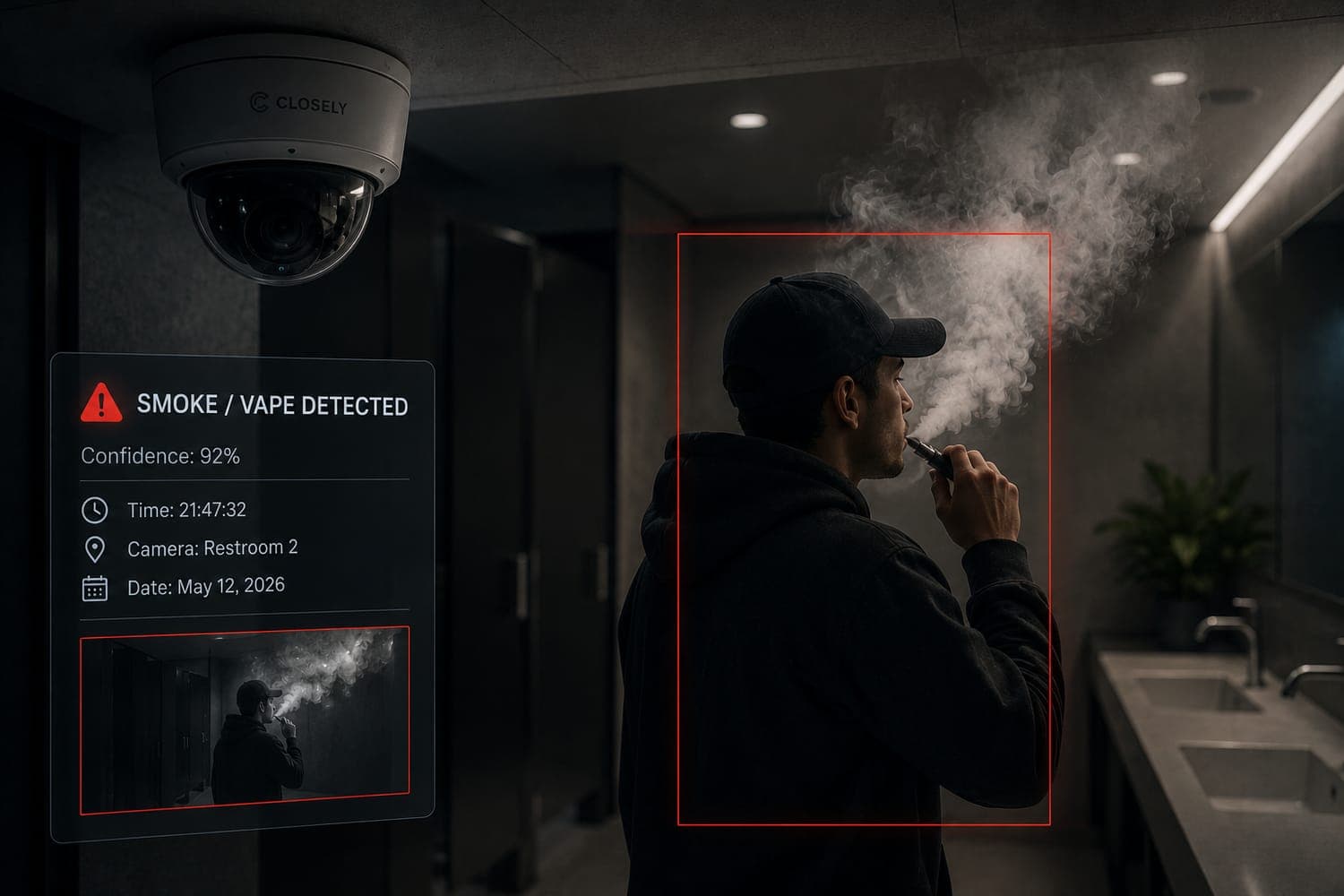
Traditional smoke alarms react to fire. AI camera-based smoke and vape detection catches the problem before it becomes one — and tells you exactly where, when, and who. Instead of adding sensor hardware, it uses the cameras already installed to detect smoke and vapor visually, in real time, with the full visual context and timestamped evidence that turns enforcement from "he said, she said" into a documented record.
Why traditional smoke and vape detectors aren't enough anymore
Anyone who manages a property — a school, an apartment building, a commercial office, a short-term rental — knows this problem well. You have smoke detectors installed. You're technically compliant. And you still find out that someone was vaping in the bathroom, smoking in a non-smoking unit, or using prohibited substances in a restricted area only after the fact — from a smell complaint, a damage claim, or a conversation with a neighbor.
Traditional smoke detectors are designed for one thing: detecting the combustion particles that indicate an active fire. They're not designed to detect the vapor cloud from an e-cigarette, the light smoke from someone briefly lighting up on a balcony, or the repeated pattern of a tenant who smokes inside a non-smoking apartment but opens the window and fans the smoke before anything triggers.
Vape detectors — dedicated electronic sensors that detect aerosol particles from e-cigarettes — solve one part of this problem but introduce another: they're single-purpose hardware that needs to be installed, maintained, and managed separately. They tell you something happened in a room, but not what it looked like, who was there, or what the context was.
AI-powered smoke and vape detection using existing security cameras is a different approach entirely. Think of it as vape detector cameras that are already installed — just waiting for the right software to activate them. Instead of adding new sensor hardware, it uses the camera feeds already installed across a property to detect smoke and vapor visually — in real time, with the full visual context of who was present, what they were doing, and exactly when it happened. That visual evidence is what changes the entire enforcement picture.
How AI visual smoke and vape detection actually works
Detection through the camera, not through the air
The core principle behind AI vape detection and AI smoke detection using cameras is computer vision — the same technology that detects a person loitering near a perimeter or a vehicle entering a restricted zone, applied to the visual signature of smoke and vapor in a frame.
Smoke and vapor have recognizable visual characteristics: the diffusion pattern, the density gradient, the movement behavior in air, the way they interact with lighting conditions. A computer vision model trained on thousands of real examples — different types of smoke, different vapor densities, different lighting environments, different camera angles — learns to identify these visual signatures reliably and distinguish them from visually similar but benign phenomena like steam from a cup of coffee, condensation on a window, or dust in a sunbeam.
When Closely's detection model identifies smoke or vapor in a camera frame, it doesn't just log a pixel change — it classifies the event, assigns a confidence score, generates a timestamped alert with a still image and video clip as evidence, and pushes that alert to the monitoring operator or property manager in real time. The response can happen while the person is still there, not hours later when the evidence has dissipated.
The detection runs continuously across every connected camera feed — bathrooms where a fixed smoke detector wouldn't capture vapor from an e-cigarette, stairwells where smoking is prohibited but rarely monitored, common areas where no-smoking rules are enforced inconsistently, and private units in rental properties where traditional detectors give tenants cover as long as they don't create visible combustion.
What makes visual detection different from sensor-based detection
The gap between a sensor alert and a camera-based AI smoke detection alert is significant, and it matters most in enforcement situations.
A sensor tells you: something happened in this room at this time.
A camera-based system tells you: this is what happened, this is what it looked like, this is who was present, this is the exact timestamp, and here is the video evidence.
For property managers dealing with lease violations, for school administrators handling disciplinary situations, for compliance officers responding to policy breaches, the difference between "the sensor fired" and "here is the video" is the difference between an allegation and documented evidence. AI vape detection that generates visual evidence transforms enforcement from a confrontational "he said, she said" situation into a documented record.
Where AI smoke and vape detection is making the biggest difference
Short-term rentals and vacation properties
The short-term rental market in both the United States and Latin America has a smoking problem that's well understood by anyone who manages properties on platforms like Airbnb, VRBO, or local equivalents. Non-smoking properties get smoked in. The damage — odor remediation, linen replacement, cleaning costs — often exceeds the security deposit. And proving it happened during a specific guest's stay, not a previous one, is genuinely difficult without documented evidence.
AI smoke detection in short-term rental properties changes this calculation completely. When a guest smokes or vapes inside a non-smoking property, the event is detected in real time, timestamped, and logged with visual evidence. The property manager is notified immediately — not when the next guest complains, not when the cleaning crew discovers it. The evidence exists the moment the violation occurs, tied to the specific booking period.
For property managers operating at scale — managing dozens or hundreds of units across a city — vape detector cameras running AI analytics are one of the highest-ROI monitoring applications available. The cost of a single remediation after an undocumented smoking incident often exceeds months of platform subscription fees.
Schools and educational institutions
Vaping in schools has become one of the most significant enforcement challenges for administrators across the United States and, increasingly, in Latin American countries where e-cigarette adoption among adolescents is growing rapidly. The problem is structural: traditional smoke detectors don't reliably detect vapor from modern e-cigarettes, bathrooms and stairwells are supervision blind spots, and students are sophisticated enough to know which areas have cameras and which don't.
AI vape detection using cameras addresses this at the architectural level. Cameras in non-private areas — hallways, stairwell entrances, exterior spaces near school buildings, common areas — can be configured to detect vapor in real time and alert school security or administration immediately. The response happens while the student is still in the area, not during a retrospective investigation.
Beyond the disciplinary application, real-time AI smoke and vape detection in schools provides a health and safety function: detecting smoke from prohibited substances or potential fire sources immediately, regardless of whether a traditional smoke alarm would trigger. For schools in both the US and Latin America investing in campus security systems, adding vape and smoke detection to existing camera infrastructure is a natural extension that doesn't require additional hardware.
Residential buildings and apartment complexes
Non-smoking policies in residential buildings are among the most complained-about and least-enforced rules in property management. Tenants smoke in their units. Smoke travels through ventilation systems and shared walls. Neighbors complain. The property manager has no documented evidence against the specific tenant, and the lease dispute becomes a prolonged back-and-forth.
AI smoke detection in common areas — hallways, elevators, stairwells, lobby, parking structures, rooftop terraces — documents smoking violations in shared spaces automatically. Every event is timestamped and logged with visual evidence. Repeated violations by the same individual, identified by camera and time of day, become a documented pattern that supports lease enforcement action.
For residential buildings in Bogotá, Mexico City, Miami, or any city where non-smoking residential policies are standard, this capability transforms the property manager's ability to enforce the rules they've always had on paper.
Commercial offices and corporate campuses
Smoking policies in office buildings are well-established but inconsistently enforced. Designated smoking areas exist, but employees smoke near entrances, in stairwells, on rooftop areas that aren't designated zones, and in parking structures. The enforcement gap is usually a staffing gap — no one is actively monitoring every non-designated area continuously.
AI vape and smoke detection running on existing security camera infrastructure monitors those areas continuously without dedicated staff. When someone smokes in a non-designated zone, the alert goes to the facilities manager or security team immediately, with evidence. For corporate campuses where smoking policy compliance is linked to insurance premiums or health and safety certifications, documented enforcement matters.
Hospitality: hotels, hostels, and event venues
Non-smoking hotel rooms that get smoked in are a recurring operational problem for the hospitality industry in both the US and Latin America. The cleaning and remediation cost is significant, the damage to the guest experience for the next occupant can be severe, and proving the violation after the fact — without real-time detection — is difficult.
AI smoke detection in hotel corridors, near non-smoking room entrances, and in common areas provides real-time alerts when smoking occurs, enabling staff to respond immediately rather than discovering the violation at checkout. For event venues managing large spaces where smoking is prohibited throughout, the same camera infrastructure used for crowd monitoring can be extended to handle AI vape and smoke detection as an additional detection layer.
How Closely handles smoke and vape detection
Closely detects smoke and vapor visually through existing security camera feeds — no additional hardware required.
The detection works as a dedicated Watcher configured for a specific camera or set of cameras. Closely's computer vision model analyzes the video stream continuously, looking for the visual signatures of smoke and vapor — the diffusion pattern, density, movement, and interaction with the ambient lighting in that specific environment. When a detection event occurs, the system classifies it, assigns a confidence score, and generates a real-time alert with the timestamped video clip as evidence.
What reaches the operator or property manager isn't just a notification — it's a documented incident record: which camera, exact timestamp, confidence score, and the visual evidence clip. That record is stored automatically and accessible for later reference, lease enforcement, disciplinary action, insurance claims, or compliance documentation.
Because Closely connects to existing IP camera infrastructure — Hikvision, Dahua, Axis, Hanwha, and any camera with RTSP and ONVIF support — adding AI smoke and vape detection to a property doesn't mean installing new hardware. It means configuring a new Watcher on cameras that are already there. For property managers, school administrators, and facility operators who already have cameras deployed, the activation is a software configuration, not a construction project.
For security operators in the US and Latin America managing multiple client properties, Closely's vape detector cameras capability is part of the same unified platform that handles loitering, perimeter breach, access control events, and all other detection types — consolidated into one SOC interface with one alert stream and one incident data layer.
If you manage a property where smoking or vaping enforcement is a genuine operational problem, get in touch. At Closely we'll show you how AI detection would work on the cameras you already have — no new hardware, no construction project.
Frequently Asked Questions
Can a regular security camera detect vaping or smoking without a special sensor?
Yes — with the right AI software running on top of it. AI vape detection using cameras works by having a computer vision model analyze the video feed for the visual characteristics of smoke and vapor: how they diffuse in air, how they interact with light, and how their movement pattern differs from other visual phenomena like steam or dust. Cameras with 1080p resolution or higher in reasonably well-lit environments can reliably detect smoking and vaping events without any additional sensor hardware, when combined with a platform like Closely that runs visual detection models on the camera feed.
What's the difference between an AI smoke detector using a camera and a traditional smoke alarm?
A traditional smoke alarm detects combustion particles in the air and triggers when concentration exceeds a threshold — it's designed to detect active fires. It doesn't detect vapor from e-cigarettes, light smoke that dissipates quickly, or smoking through an open window. An AI smoke detection system using cameras detects the visual presence of smoke or vapor in the camera frame — it sees the event happening rather than sensing particles in the air. The camera-based approach also generates visual evidence (timestamped video clip), whereas a traditional alarm only tells you that a threshold was crossed at a point in time.
How does AI vape detection help property managers enforce non-smoking policies in rental units?
The enforcement problem with non-smoking rental policies has always been evidence. Smell alone is disputed; verbal complaints from neighbors are he-said-she-said. AI vape detection through cameras in common areas — hallways, stairwells, building entrances — generates timestamped visual evidence of policy violations as they occur. For short-term rentals, the evidence is tied to a specific booking period. For long-term leases, repeated documented violations build a pattern that supports formal enforcement action. Property managers go from suspecting a violation to having documented proof.
Can AI smoke detection cameras work in school bathrooms to detect vaping?
Cameras in school bathrooms raise obvious privacy concerns and are generally not appropriate or legal. The effective approach for schools is to deploy AI vape detection cameras in non-private adjacent areas: hallway entrances to bathroom corridors, stairwell landings, exterior doors near common student gathering areas, and outdoor spaces where vaping often migrates. When vapor is detected in those camera zones, the alert triggers immediately while the person is still likely in the area. This provides meaningful enforcement capability without placing cameras in areas where students have a reasonable expectation of privacy.
What types of smoke and vapor can AI camera-based detection identify?
Modern AI smoke detection models are trained on a broad range of smoke and vapor visual signatures: cigarette smoke, e-cigarette vapor (which has a distinctly different diffusion pattern from cigarette smoke), marijuana smoke, and general combustion smoke from potential fire sources. The training dataset includes different lighting conditions, camera angles, room types, and vapor densities. Detection accuracy varies by environment — well-lit spaces with good camera positioning achieve higher accuracy — but the model is designed to handle the range of conditions found in real commercial and residential deployments.
How quickly does Closely alert a property manager or security operator when smoke or vaping is detected?
Detection and alert generation happens in real time — typically within seconds of the smoke or vapor appearing in the camera frame. The alert reaches the designated recipient (property manager, SOC operator, school administrator) immediately via the Closely platform interface. Because the response happens while the event is still occurring rather than after the fact, it enables intervention — contacting the person on-site, dispatching staff, or initiating the documentation process — while the evidence is fresh and the person is still present.
Does AI vape detection generate false positives from steam, fog, or dust?
Any AI detection system has a false positive rate, and AI vape detection is no exception — steam from a shower room near a camera, fog in an outdoor environment, or certain dust conditions can trigger events. The way Closely manages this is through confidence scoring: events below a confidence threshold are either logged without alerting or queued for lower-priority review, rather than generating an immediate alert. Over time, the system learns the specific visual environment of each camera — what the baseline "background noise" looks like — and calibrates accordingly. False positive rates in typical commercial deployments are low enough to be operationally manageable.
Is AI smoke detection through cameras legal in the US and Latin America?
Camera-based AI smoke detection operates on the same legal basis as the underlying camera installation. In the US, cameras in non-private commercial spaces (hallways, common areas, lobbies, exterior) are generally legal with appropriate notice posted. Audio recording has stricter requirements in some states (two-party consent states like California), but video detection of smoke and vapor is visual — not audio — and follows standard surveillance law. In Latin America, data protection frameworks like Colombia's Ley 1581, Mexico's LFPDPPP, and Brazil's LGPD apply to video surveillance data generally. The key compliance requirements — visible signage, proportionate use, defined retention periods, restricted access — apply to the camera system as a whole, not specifically to what detection types run on the feed.
Can the same camera system used for smoke detection also handle other security monitoring?
Yes — and this is one of the significant advantages of camera-based AI vape and smoke detection over standalone sensor hardware. Closely runs multiple detection types on the same camera feed simultaneously: a camera monitoring a building entrance can handle smoke/vape detection, loitering detection, perimeter breach alerts, and tailgating detection from the same hardware, with the AI layer managing all of them through a unified platform. This means the capital investment in camera infrastructure serves multiple security and compliance functions at once, rather than requiring separate dedicated hardware for each detection type.
How do I add AI smoke and vape detection to my existing security cameras?
If your cameras are IP cameras (from manufacturers like Hikvision, Dahua, Axis, Hanwha, or similar) and have RTSP stream capability — which virtually all modern IP cameras do — adding AI vape detection is a software configuration, not a hardware project. Closely connects to your existing camera feeds and activates the smoke and vape detection Watcher on the cameras where you want coverage. No new hardware, no construction, no changes to your recording setup. The team walks through your specific camera infrastructure to confirm compatibility and configure the detection thresholds appropriate for your environment before going live.