How AI Catches Shoplifters in Retail in Real Time
Retail shrinkage costs the industry over $100 billion a year. AI changes the game from documenting losses to preventing them in real time.
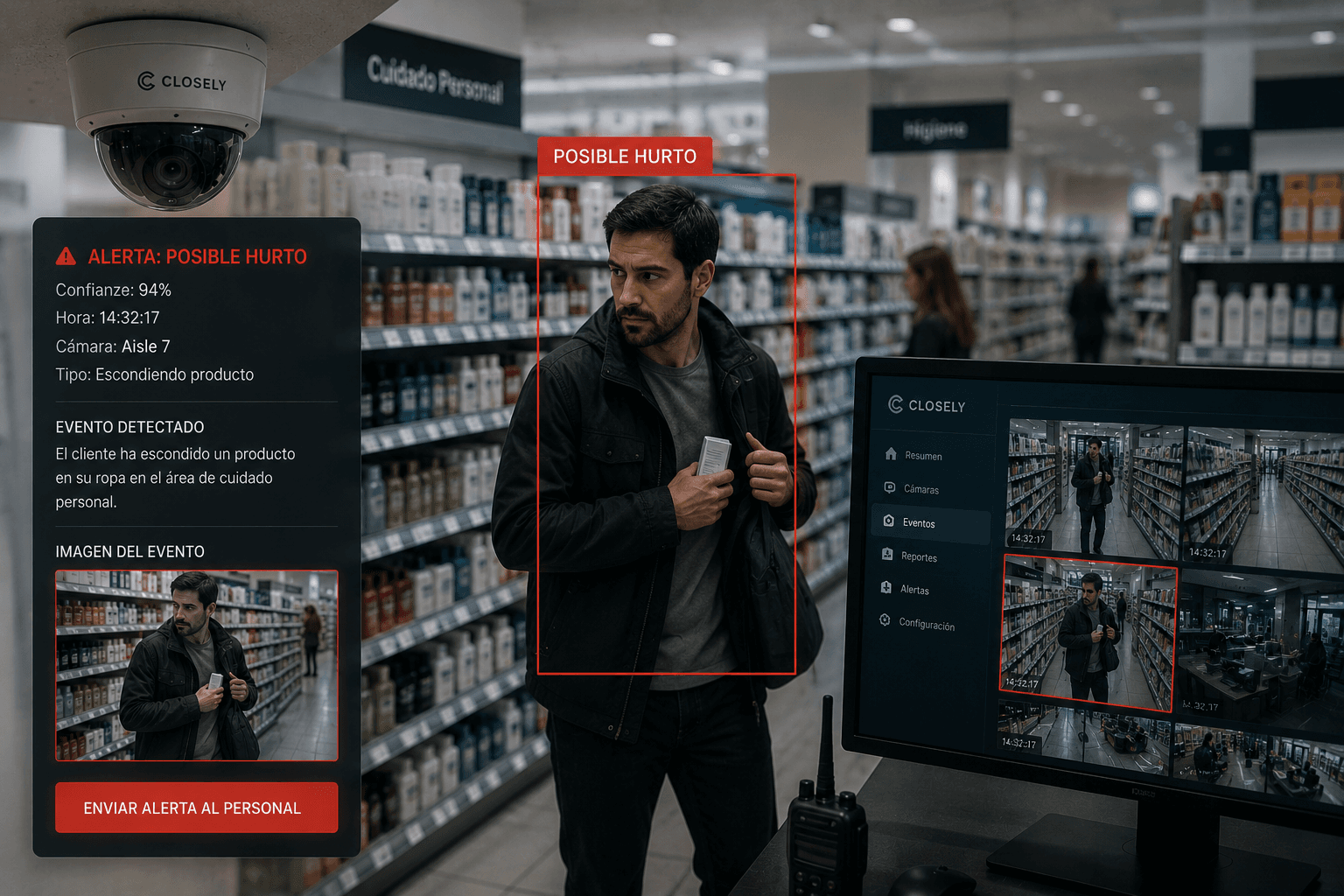
Retail shrinkage costs the industry over $100 billion a year globally. Most of it happens while someone is watching — just not watching the right thing at the right time. AI changes that.
The Retail Theft Problem Is Bigger Than Most Store Owners Admit
Let's start with a number that puts everything in perspective: retail shrinkage (inventory loss from theft, fraud, and operational errors) represents between 1.5% and 2% of total retail revenue on average. That sounds small until you do the math on what it means for a store operating on a 5% or 8% margin. Retail theft alone — external shoplifting and organized crime — typically drives 35-45% of that total. A 2% shrinkage rate doesn't just eat into profit. In many cases, it turns what should be a profitable operation into a marginal one.
And the problem is getting worse. The National Retail Federation's annual reports consistently show that retail theft is accelerating across the United States both in frequency and average incident value. Organized retail theft rings operating across multiple cities account for an increasingly large share of total losses, shifting the problem from opportunistic shoplifting toward coordinated criminal activity, driven by a combination of organized retail crime, opportunistic shoplifting, and employee theft. In Latin America, the picture is similar: retail loss prevention is one of the top operational concerns for supermarkets, pharmacies, electronics stores, and convenience chains across Colombia, Mexico, Peru, Chile, and Brazil.
The traditional response — security guards at the entrance, EAS tags on merchandise, cameras in the corners — has a well-documented problem: it's reactive. The guard sees what's in front of them. The cameras record everything that happens. But by the time anyone reviews the footage, the merchandise is gone, the person is gone, and the evidence is just a record of a loss that already occurred.
AI loss prevention changes this from a documentation function to an intervention function. The system detects theft behavior as it's happening — not after — and alerts store staff in real time while there's still an opportunity to act.
What "Retail Shrinkage" Actually Costs And Where It Comes From
Breaking Down the Numbers
Retail shrinkage isn't just shoplifting. The full picture of inventory loss in a typical retail operation breaks down roughly as follows:
External theft (shoplifting and organized retail crime) — typically 35-45% of total shrinkage. This is the category that AI loss prevention technology addresses most directly. Everything from the opportunistic customer who pockets a small item to organized groups systematically targeting high-value merchandise.
Employee theft and internal fraud — typically 28-35% of shrinkage. Often the most difficult to detect and address because employees understand the store's security procedures and camera coverage. Internal theft tends to involve the POS area, stockroom access, and high-value inventory zones.
Administrative and process errors — roughly 20-25%. Pricing errors, receiving discrepancies, paperwork mistakes. Not malicious, but real losses that compound over time.
Vendor fraud — smaller percentage but significant in food and beverage retail where supplier relationships involve high-volume, hard-to-audit deliveries.
AI retail security technology is most directly applicable to external theft and internal fraud — together representing 60-80% of total retail shrinkage depending on the store type and location.
The Hidden Cost Beyond Inventory
The direct cost of stolen merchandise is only part of the picture. Retail loss prevention failures create cascading costs that don't show up in shrinkage numbers:
Staff time diverted to loss investigation, police reports, and inventory reconciliation instead of customer service or operational tasks. A store that experiences frequent theft events spends disproportionate management bandwidth on documentation rather than operations.
Insurance premiums that increase after repeated loss events, particularly for high-value merchandise categories.
Inventory distortions that affect ordering decisions — phantom inventory (items recorded as in stock but actually stolen) leads to stockouts that frustrate customers and reduce sales.
Employee morale in high-theft environments. Staff who witness theft regularly and feel the company isn't addressing it effectively tend to have lower engagement and higher turnover.
The ROI calculation for AI loss prevention technology needs to account for all of these costs, not just the direct value of recovered merchandise.
How AI Detects Shoplifting in Real Time
Computer Vision That Understands What Stealing Looks Like
The core technology behind Closely's AI retail security solution is computer vision trained specifically on shoplifting behaviors — not just generic motion detection or object classification.
Here's the operational distinction that matters: a standard security camera with basic motion detection sees that someone picked up a product. That's not useful information — picking up products is what customers do. AI loss prevention technology goes further by analyzing what happens next: Does the person move toward a checkout area? Do they conceal the item in a bag, in their clothing, in another product's packaging? Do they remain in the store for an unusual amount of time near high-value merchandise? Do they exhibit scanning behavior — repeatedly looking around to check for staff before picking up an item?
These behavioral patterns are what distinguish a legitimate shopper from someone in the process of stealing. Closely's computer vision models are trained on thousands of real examples of shoplifting events across different store formats, product categories, and environmental conditions — building a behavioral library that the system uses to classify in-progress interactions in real time.
When the confidence threshold is exceeded — when what the camera sees matches the behavioral patterns associated with theft — the system generates an immediate alert. The store owner, manager, or security staff receives a real-time notification with the camera feed, the timestamp, and the location within the store. The response can happen while the person is still in the store, not after they've left.
What Real-Time Actually Means for Intervention
The difference between a real-time alert and a post-incident recording is the difference between prevention and documentation.
With a traditional retail loss prevention setup, the typical workflow is: theft occurs → employee or review process identifies it → footage is pulled → police report is filed → loss is written off. The merchandise is gone, the probability of recovery is low, and the entire process consumes significant staff time for an outcome that doesn't recover the loss.
With AI retail security, the workflow shifts: behavior is detected while it's happening → manager or security receives a real-time alert → staff can approach the customer, position themselves near the exit, or make their presence known → theft is either deterred or interrupted. The detection event creates an intervention window that doesn't exist in a recording-only system.
Even when direct intervention isn't possible — a small store with limited staff, or a situation where approach would be inappropriate — the real-time alert creates a documented, timestamped record with video evidence that supports police cooperation and insurance claims significantly better than footage pulled from a retrospective search.
Where AI Loss Prevention Is Making the Most Impact
Supermarkets and Grocery Retail
Supermarkets face a particular retail shrinkage challenge: high traffic, complex store layouts, dozens of concurrent interactions at any moment, and a product mix that ranges from low-value staples to high-margin perishables and premium categories. The labor cost of stationary loss prevention staff in a large supermarket is significant, and their coverage is inherently limited to what they can observe directly.
AI loss prevention in supermarkets runs on existing camera infrastructure — overhead cameras that already cover the sales floor — and monitors all zones simultaneously. High-risk areas (wine and spirits, premium cuts, electronics accessories, personal care) can be configured for more sensitive detection thresholds. The system generates alerts when behavioral patterns in those zones match shoplifting signatures, allowing floor staff to respond without stationary surveillance labor.
In Latin American supermarket chains operating in cities like Bogotá, Lima, or Guadalajara where organized shoplifting networks operating across multiple store locations are a documented problem — AI retail security that generates structured incident data across the store network creates an intelligence picture that single-store security systems can't.
Pharmacies and Health & Beauty Retail
High-value, small-format merchandise in pharmacy retail — over-the-counter medications, cosmetics, personal care products — is among the most frequently targeted category by organized retail crime in both the US and Latin America. Locking merchandise is one response, but it creates friction for legitimate customers and requires staff to unlock products constantly.
AI loss prevention cameras monitoring open-shelf high-value sections alert staff immediately when behavioral patterns suggest concealment. The response is targeted — going to the specific area where the alert fired — rather than a general increase in staff presence that slows service for everyone.
Electronics and High-Value Specialty Retail
Electronics retail has some of the highest per-incident shrinkage values of any retail category. A single stolen item can represent hundreds or thousands of dollars. The economics of AI retail security for electronics are compelling: even a small number of prevented incidents per month typically cover the platform cost many times over.
AI loss prevention in electronics retail is particularly effective at monitoring display areas where products are handled by customers — identifying when an interaction goes from examination to concealment — and alerting staff while the interaction is still in progress.
Convenience and Small Format Retail
Small convenience stores and neighborhood shops in both the US and Latin America often operate with minimal staff — sometimes a single person managing everything. Traditional retail loss prevention measures are difficult to implement effectively in these environments because there simply isn't the headcount to dedicate to monitoring.
AI retail security changes the math for small-format retail. A single system monitoring all camera feeds simultaneously — alerting the single staff member on duty, or the store owner on their phone — provides coverage that wasn't economically achievable with traditional approaches. For franchise networks and convenience chains managing dozens of small locations, centralized AI monitoring across the entire portfolio provides fleet-level visibility that individual store managers can't generate independently.
How Closely's AI Catches Shoplifters and Reduces Retail Shrinkage
Closely has built computer vision detection specifically for retail loss prevention — a Watcher trained on shoplifting behaviors that runs on existing security cameras without requiring new hardware.
The system monitors camera feeds in real time, analyzing customer interactions in sales floor zones for the behavioral signatures of shoplifting: concealment movements, scanning behavior, unusual dwell time near high-value merchandise, and interaction patterns that deviate from legitimate shopping behavior. When detections exceed the confidence threshold, the store owner or manager receives an immediate real-time alert on their phone, via the Closely platform with the camera location, timestamp, and video clip.
The alert is actionable: it tells you where in the store, what the camera captured, and when it happened. Staff can respond while the person is still on premises. In stores where staff response isn't practical, the alert creates a timestamped documented record with video evidence — significantly stronger than retrospective footage retrieval — for police cooperation and insurance purposes.
Every detection generates a structured incident record that accumulates over time: which zones have the highest incident frequency, which time windows are highest risk, which product areas are targeted most often. That pattern intelligence allows store operators to adjust staff deployment, reconfigure high-value merchandise placement, and make evidence-based decisions about where loss prevention attention is most needed — instead of relying on intuition and manual observation.
For retail chains managing multiple locations across the US or Latin America, Closely's centralized monitoring interface shows incident data across the entire portfolio. A pattern of coordinated theft hitting multiple locations — a signature of organized retail crime — becomes visible at the network level rather than appearing as isolated incidents at each store.
If you operate a retail business and retail shrinkage is eating into your margins, Closely is worth a conversation about what real-time AI detection looks like for your specific store format and camera infrastructure.
10 Frequently Asked Questions About AI Loss Prevention in Retail
1. How does AI detect shoplifting in a retail store in real time? Closely's AI loss prevention technology uses computer vision models trained on shoplifting behaviors — not just motion detection. The system analyzes what customers do after picking up a product: do they move toward checkout, or do they exhibit concealment movements? Do they display scanning behavior before taking an item? Do they remain unusually long in high-value merchandise areas? When behavioral patterns match shoplifting signatures above a confidence threshold, the system generates an immediate alert to store staff or the owner with camera location, timestamp, and video clip while the person is still in the store.
2. What is retail shrinkage and what percentage of it is actually theft? Retail shrinkage is total inventory loss from all causes: external theft (shoplifting and organized retail crime), employee theft, administrative errors, and vendor fraud. In most retail operations, external theft represents 35-45% of total shrinkage and employee theft represents 28-35% — meaning malicious theft accounts for 60-80% of total shrinkage. The remaining 20-25% is operational errors. AI retail security technology addresses the theft component most directly, which is typically the largest and most preventable portion of shrinkage losses.
3. Does AI loss prevention require replacing existing security cameras? No — and this is one of the most important practical points. Closely's AI loss prevention connects to existing IP cameras via standard RTSP and ONVIF protocols, supported by virtually all current-generation cameras from major manufacturers. The computer vision models run on top of existing camera streams without any hardware replacement. For most retail stores with cameras already installed, adding AI shoplifting detection is a software subscription, not a hardware project. The system works with cameras from Hikvision, Dahua, Axis, Hanwha, and most other IP camera manufacturers.
4. How quickly does the AI alert store staff when it detects shoplifting behavior? Detection and alert generation is near real-time — typically within seconds of the behavioral pattern being identified in the camera frame. The alert reaches the store manager or owner immediately via the Closely platform on their phone or monitoring interface. The response happens while the person is still in the store, creating an intervention window that doesn't exist in recording-only security systems. The time from detection to staff awareness is measured in seconds, not minutes.
5. Can AI loss prevention work in small stores with limited staff? Yes — and small-format retail is actually one of the strongest use cases for AI retail security. In stores operating with a single staff member or minimal headcount, traditional loss prevention approaches (stationary security staff, manual monitoring) aren't economically feasible. AI monitoring sends alerts directly to whoever is on duty, or to the store owner's phone — so a single person can receive a real-time notification about suspicious activity in any camera zone rather than having to actively monitor all feeds simultaneously. For convenience chains and small retail networks across the US and Latin America, AI loss prevention provides coverage that manual approaches simply can't match at the economics of small-format retail.
6. What's the difference between AI loss prevention and traditional retail security approaches? Traditional retail loss prevention is fundamentally a documentation and deterrence system: cameras record what happens, security staff observe what's in front of them, EAS tags create friction for unauthorized removal. These approaches deter some theft and document incidents after they occur. AI retail security adds a detection and intervention layer: the system identifies shoplifting behavior in progress and alerts staff in real time, creating an opportunity to intervene before the merchandise leaves the store. The shift is from documenting losses to preventing them.
7. How does AI detect the difference between a normal shopper and someone shoplifting? The key is behavioral analysis, not just object detection. Picking up a product is normal — it's what shoppers do. What distinguishes shoplifting behavior is what happens next: concealment movements (placing an item in a bag, under clothing, inside another product), scanning behavior (repeatedly checking for staff before taking action), prolonged dwell time in high-value areas without moving toward checkout, and interaction patterns that don't match the expected flow of legitimate shopping. Closely's computer vision models are trained on these behavioral patterns — not just on the presence of a person near merchandise — which is what makes the detection meaningful rather than generating false positives for normal shopping activity.
8. Can the AI identify organized retail crime groups targeting multiple store locations? For retail chains using Closely across multiple locations, incident data is aggregated at the network level — which means patterns across stores become visible. A group targeting multiple locations in a city, hitting the same product categories at similar times of day, appears as a correlated pattern in the centralized monitoring view rather than as isolated incidents at each store. That network-level visibility is what allows security managers to identify organized retail crime activity that individual store security systems can't detect independently.
9. Is AI retail security legal to use in the US and Latin America? AI retail security cameras operate within the same legal framework as standard in-store surveillance cameras. In the US, in-store video surveillance in customer-facing areas is legal with appropriate notice (posted signage), which is already standard practice in virtually all retail environments. The AI analytics run on top of standard surveillance footage — they don't collect biometric data or identify individuals by name or identity. In Latin America, data protection frameworks (Colombia's Ley 1581, Mexico's LFPDPPP) apply to the camera system generally — the AI detection layer doesn't create additional legal complexity beyond what applies to in-store cameras. For any specific jurisdiction requirements, retailers should consult local legal counsel.
10. How does AI loss prevention generate data that helps reduce retail shrinkage over time? Every shoplifting detection generates a structured incident record: store location, camera zone, time, behavioral pattern detected, and video evidence. Aggregated over weeks and months, that data reveals patterns that aren't visible from individual incidents: which zones have the highest incident frequency, which time windows are highest risk, which product categories are targeted most often. That intelligence allows retailers to make evidence-based decisions about staff deployment, merchandise placement, and security configuration — reducing retail shrinkage not just through real-time intervention, but through structural adjustments informed by actual incident patterns. Closely makes that data available in a format that's actionable at both the individual store level and across a multi-location retail portfolio.