AI Cameras vs. AI Agents: Which One Actually Prevents Theft?
Most AI cameras just record theft. AI agents on cameras detect shoplifting in real time and alert you while you can still do something about it. Here is what business owners need to know.
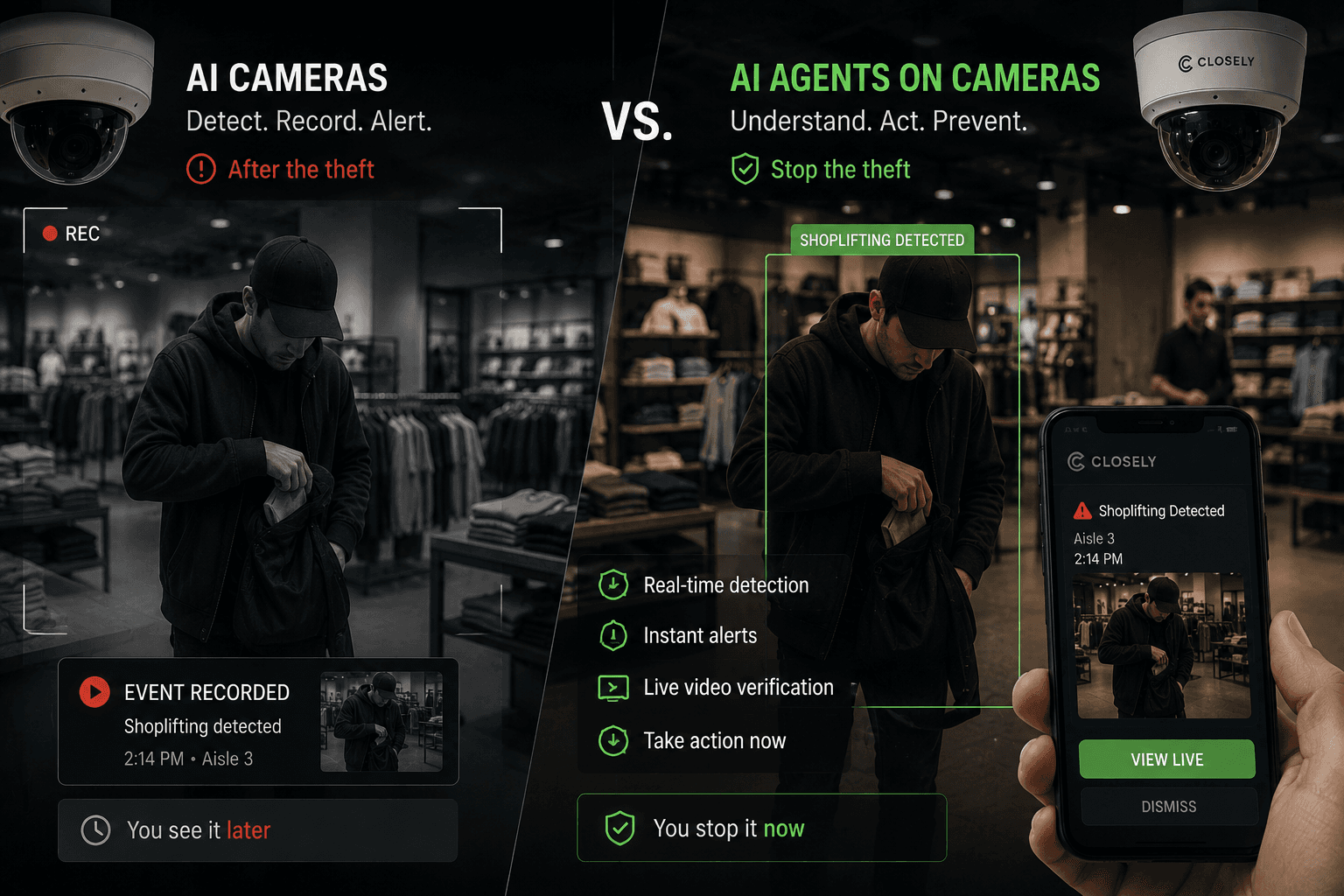
There is a big difference between a camera that records a robbery and one that stops it from happening. Most business owners do not realize which one they have.
What Nobody Tells You When You Buy an "AI Camera"
If you have walked into a security store or talked to a camera vendor recently, you have probably heard some version of this pitch: "These are AI cameras. They detect threats automatically." It sounds exactly like what any business owner would want. And technically, it is not wrong.
But here is what they do not explain: most AI cameras on the market today come with a very limited, fixed set of things they can detect. Line crossing. Someone entering a restricted zone. Basic motion. That is roughly it. The camera cannot tell the difference between a customer examining a product and someone pocketing it. It cannot learn that your store gets its busiest deliveries on Tuesday mornings and that an unfamiliar face in the back at 6am on a Saturday is actually suspicious. It just applies the same generic rules to every situation.
For a retail store owner trying to reduce theft, that gap matters enormously. The difference between AI cameras with fixed rules and AI agents on cameras that actually understand what is happening in your business is the difference between documentation and prevention.
The Real Question: Does It Stop Anything, or Just Record It?
Most security cameras, including a large share of what gets sold as AI cameras, are fundamentally recording devices. They capture everything. They understand almost nothing. When a theft happens, you have footage. But the merchandise is already gone, the person has already left, and you are spending the next hour filing a report instead of running your business.
AI agents on cameras work differently. Instead of waiting for you to review footage, they analyze what is happening in your store in real time and alert you while you still have time to do something about it.
The technology works by learning what your specific store looks like on a normal day. What does the typical customer interaction with a product look like? What does the flow of people through your aisles look like on a busy Saturday afternoon versus a quiet Tuesday morning? Once the system builds that picture of normal, it flags the things that do not fit. And it can do this across every camera in your store simultaneously, something no human can do.
For business owners, the practical result is straightforward: instead of reviewing footage after a loss, you get a notification on your phone while the situation is still happening.
What AI Agents Can Do That Generic AI Cameras Cannot
This is where the practical difference becomes very concrete. Here are the things that matter to a business owner and whether each type of system actually delivers them.
Shoplifting Prevention
Standard AI security cameras with fixed detection rules cannot reliably detect shoplifting. Detecting theft is not about identifying that someone picked up a product. It is about understanding the behavioral pattern of what follows: the quick look around to check for staff, the movement toward a bag or a pocket, the way someone positions their body to block a camera angle. Recognizing that sequence in real time, before the person reaches the exit, is what smart camera detection looks like.
AI agents on cameras are trained on exactly these behavioral patterns. When a detection fires, the store manager gets an alert on their phone with a clip of what the camera captured. They can approach the customer, position themselves near the exit, or simply make their presence known. Most of the time, that is enough to stop the theft before it completes.
Open Door Alerts That Make Sense
A basic AI camera can detect that a door is open. But it has no idea whether that door should be open. Your stock room door being open for ten minutes during a receiving delivery is completely normal. That same door being open at 11pm on a Sunday is not. AI camera analytics that understand the context of your specific operation know the difference and only alert you when it actually matters.
Knowing Who Is in Your Store and Where
AI agents on cameras can generate a live picture of how many people are in your store at any given moment, where they are concentrated, and how that compares to what is normal for that time of day. This is useful for loss prevention because high-traffic moments in low-visibility zones are when most theft happens. It is also useful for operations: knowing where customers spend the most time helps with product placement, staffing decisions, and layout changes.
This kind of analysis, what is sometimes called heatmapping, is not available on standard AI security cameras with fixed detection rules. It requires a system that aggregates what it sees over time and turns it into patterns.
Tailgating Into Restricted Areas
If your business has a stockroom, a cash office, a server room, or any area that only authorized people should access, tailgating is a real risk. Tailgating is when someone follows an authorized person through a controlled door without presenting their own credentials. It is one of the most common ways people get into places they should not be.
Smart camera detection for tailgating does not just flag that two people walked through a door. It understands whether both of them were supposed to be there, and alerts you if the second person was not. That distinction is something fixed AI cameras cannot make.
PPE and Uniform Compliance
For businesses in construction, logistics, food service, or any environment with safety requirements, knowing whether your staff are wearing the right equipment is both a safety and a liability issue. AI camera analytics running on your existing cameras can monitor compliance in real time: are workers in the warehouse wearing their vests? Are kitchen staff wearing gloves and hairnets? Are security personnel in uniform?
When someone enters a compliance zone without the required equipment, the supervisor gets an alert immediately. This capability is not available on standard hardware-based AI security cameras and requires the kind of configurable, context-aware detection that only AI agents on cameras can deliver.
Why the Learning Part Is What Makes It Worth It
One of the things that separates AI agents on cameras from fixed AI cameras most clearly is that the agents get better over time. They learn your business.
When you first connect an AI agent to your cameras, it starts observing. Over the first few weeks, it builds an understanding of what your store looks like on a normal day: the flow of customers, the behavior of staff, the rhythm of deliveries, the times when certain areas are busy and certain areas are quiet. As that baseline develops, the detections become more precise. False alerts decrease because the system learns the difference between something genuinely unusual and something that just looks unfamiliar at first.
Fixed AI cameras do not do this. The detection logic was set at the factory and it does not adapt to your specific business. It applies the same rules on month one and month eighteen regardless of how your operation evolves.
For a business owner, the practical implication is that the value of an AI agent system compounds over time. A retail store that has been running Closely for six months is getting meaningfully better loss prevention than it was getting in week one, without any additional configuration or intervention.
You Probably Do Not Need New Cameras
This is the part that surprises most business owners. AI agents on cameras run on the cameras you already have. If your cameras are IP cameras from brands like Hikvision, Dahua, Axis, Hanwha, or most other common security camera brands, they can support AI agents without any hardware replacement.
The cameras you already paid for can become genuinely intelligent with a software upgrade. That changes the financial calculation significantly. Instead of a hardware project that requires new cameras, new installation, and new cabling, activating AI agents is a software decision that can be up and running in days.
How Closely Works for Business Owners
Closely connects to your existing cameras and activates AI agents configured for your specific type of business. For a retail store, those agents are set up to detect shoplifting behavior, monitor high-value merchandise zones, track traffic patterns, and alert staff in real time when something that looks like a theft is developing. For a restaurant or food business, they can monitor compliance with hygiene and safety requirements. For a business with controlled access areas, they handle tailgating and unauthorized access detection.
Every alert comes with a video clip so you can see exactly what triggered it. The notifications go directly to your phone or to whoever you designate. You do not need to be watching a monitor. You do not need to hire extra security staff. The system watches everything so you can focus on running your business.
Every incident Closely detects is logged automatically with the timestamp, the camera location, and the video evidence. Over time, that log gives you a clear picture of when and where theft and security issues are most likely to occur in your specific operation, so you can make better decisions about where to focus your attention.
If you want to see what this looks like for your store or your locations, the Closely team can walk you through a setup specific to your business.
10 Frequently Asked Questions for Business Owners About AI Cameras and AI Agents
1. Will an AI camera actually stop a shoplifter, or just record what happened? A standard AI camera with fixed detection rules will almost certainly just record it. Reliably detecting shoplifting requires understanding the behavioral pattern of a theft in progress, not just noticing that someone picked up a product. AI agents on cameras detect that behavioral arc in real time and alert store staff while the person is still in the store. The alert includes a video clip so staff can respond appropriately. That is the difference between documentation and prevention.
2. Do I need to replace my existing cameras to get AI detection that actually works? In most cases, no. Closely and similar AI camera analytics platforms connect to cameras you already have installed via standard protocols that virtually all major camera brands support. If your cameras are from Hikvision, Dahua, Axis, Hanwha, or most other common brands, they can support AI agents without hardware replacement. Activating intelligent detection is a software decision, not a construction project.
3. What is the difference between a regular AI camera and AI agents on cameras for a retail business? A regular AI security camera comes with a fixed set of detection rules set by the manufacturer, typically limited to line crossing and zone intrusion. AI agents on cameras have detection capabilities that are configured for your specific business: shoplifting behavior detection, open door alerts with context, people counting, heatmaps of customer movement, and tailgating detection at staff-only areas. The agent also learns what your store looks like on a normal day and gets better at identifying genuine threats over time, something a fixed AI camera does not do.
4. How does the shoplifting detection actually work and what do I get when it fires? The smart camera detection model identifies the behavioral pattern associated with shoplifting: checking for staff nearby, positioning to block a camera angle, concealment movements. When the system detects that pattern above its confidence threshold, it sends an alert to the store manager's phone immediately. The alert includes a short video clip of what triggered the detection. The manager can see what is happening in real time and decide whether to approach the customer, radio staff near the area, or simply move in that direction. The goal is intervention while the person is still in the store.
5. Will the system send me a lot of false alerts that end up being nothing? This is one of the most important practical questions and the honest answer is that it depends on the quality of the system. AI agents on cameras that learn your specific environment over time significantly reduce false alert volume as they build an understanding of what normal looks like in your business. Closely uses a multi-layer detection approach that filters basic motion events and irrelevant triggers before generating an alert, so what reaches you is a genuine anomaly rather than every time someone walks past a camera.
6. Can AI agents monitor whether my staff are following safety or uniform requirements? Yes. This is one of the most useful capabilities for businesses in food service, construction, logistics, and any environment with safety standards. AI camera analytics can monitor whether staff entering specific zones are wearing the required items: uniforms, hard hats, gloves, hairnets, safety vests. When someone enters a compliance zone without the required equipment, an alert goes to the supervisor immediately. This requires a configurable detection system, not a fixed AI security camera, because the specific requirements vary by business and by zone within the same facility.
7. How long does it take for the AI to start working well in my specific store? The first alerts start immediately. The system improves significantly over the first few weeks as it builds a baseline understanding of your specific store: how customers typically behave, when your busy periods are, what staff movement looks like, which areas get high traffic at which times. After three to four weeks, the detection is meaningfully more precise and false alert volume is lower because the AI agents on cameras understand the difference between something genuinely unusual and something that just looked unfamiliar at first. After several months, you have a system that knows your business specifically, not just retail in general.
8. What happens to the footage and the alert records? Can I use them if I need to file a police report? Every alert Closely generates includes a timestamped video clip that is stored automatically as a structured incident record. That record includes the camera location, the time, the type of detection, and the video evidence. If you need to file a police report or an insurance claim, you have documented evidence with a precise timestamp rather than hours of footage to search through. The structured format also means you can pull up all incidents from a specific date, location, or detection type in seconds.
9. Is this affordable for a small or medium-sized retail business, not just large chains? Yes. Because AI camera analytics run on cameras you already have installed, the cost is a software subscription rather than a hardware investment. For a small retail store with existing cameras, the monthly cost of Closely is typically a fraction of what a single shoplifting incident costs in lost merchandise. For multi-location businesses, centralized monitoring across all locations from a single interface means the cost per location is lower than managing each site separately. The ROI calculation for most retail businesses shows a positive return within the first few incidents prevented.
10. How do I know if Closely will work with the cameras I already have in my store? The compatibility check is straightforward. If your cameras are IP cameras from any major brand, including Hikvision, Dahua, Axis, Hanwha, Avigilon, or most other common security camera manufacturers, they almost certainly support the standard protocols that Closely uses to connect. The Closely team can confirm compatibility for your specific camera models before any commitment and walk you through what the setup process looks like for your specific store layout and existing infrastructure.