DVR vs NVR: What's the Difference and How AI Monitoring Works With Both in 2026
What's the difference between a DVR and an NVR, which is better for AI monitoring, and does it matter if you already have both? The complete guide for security operators.
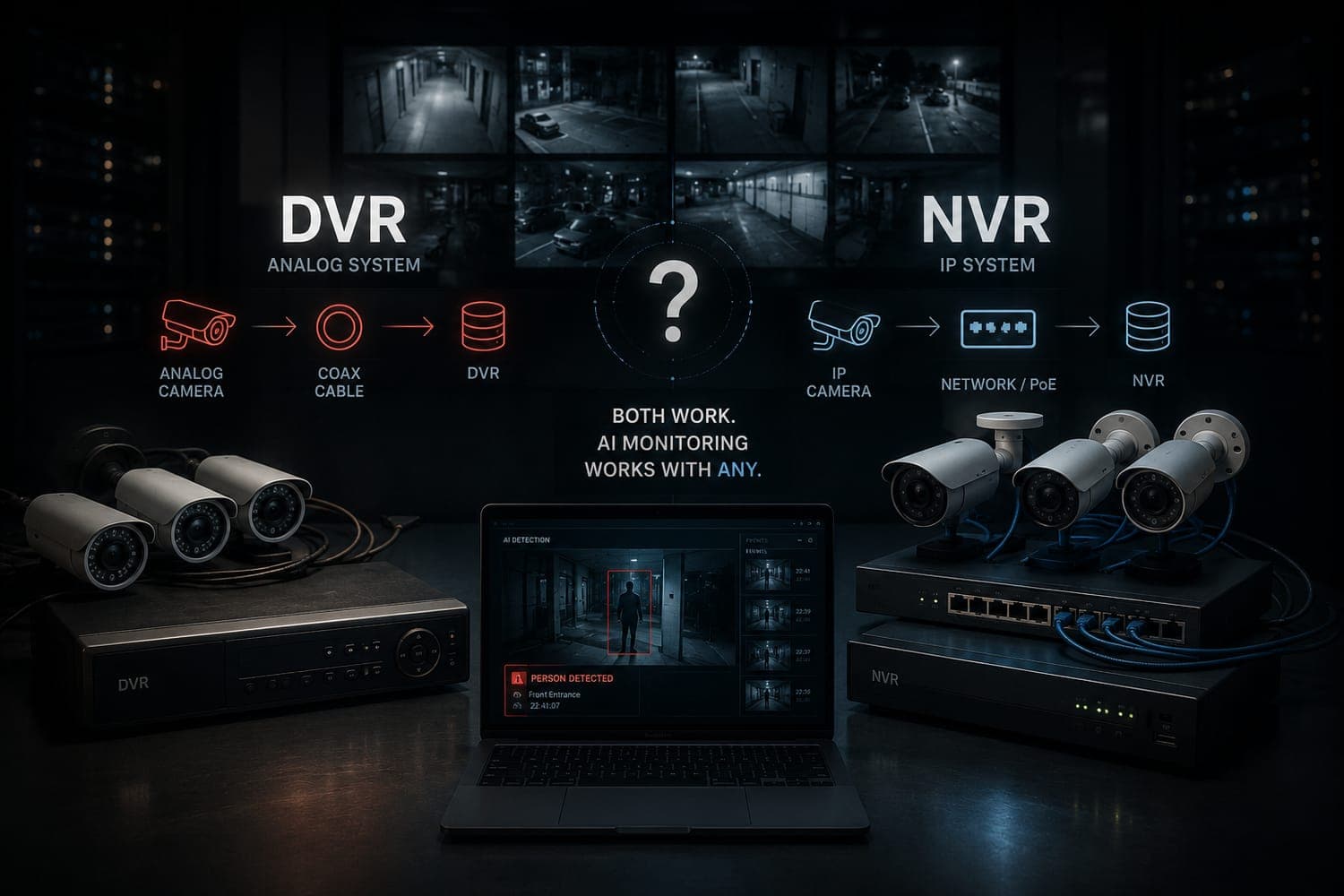
The DVR vs NVR question comes up constantly, but for AI monitoring the answer matters less than you'd think. A DVR digitizes analog camera signals; an NVR stores digital streams from IP cameras. NVRs are better suited to AI (higher resolution, native ONVIF/RTSP), but AI monitoring works with both — what matters is whether there's an IP stream to tap into, not the recorder type. Here's the honest breakdown.
If you manage cameras for a living — or you're thinking about upgrading your security setup — the DVR vs NVR question comes up constantly. Here's the honest breakdown, and why the answer matters less than you'd think when it comes to AI.
Why the DVR vs NVR debate still matters in 2026
Walk into any security operation in the United States or Latin America and you'll find both. Digital Video Recorders in older installations — apartment buildings, warehouses, retail chains that haven't updated their infrastructure in a decade. Network Video Recorders in newer deployments — corporate campuses, mixed-use developments, security companies that have modernized their stack in the last five years.
Neither is going away anytime soon. DVRs represent hundreds of millions of dollars of installed infrastructure across the US and LATAM. And NVRs are the default choice for any new deployment today. So if you're running a monitoring center or managing security across multiple sites, you're almost certainly working with both — often simultaneously.
What's changed is what you can do with either one. Because AI monitoring doesn't care whether your recorder is a DVR or an NVR. It cares about one thing: whether there's an IP connection to tap into. And that changes the conversation entirely.
What is a DVR and how does it work?
The technology behind Digital Video Recorders
A Digital Video Recorder — DVR — is a device that captures video from analog cameras, converts that signal to digital, and stores it locally on a hard drive. That's the core workflow: analog in, digital stored.
The cameras in a DVR setup connect via coaxial cable (typically RG-59 or RG-6) and transmit a raw video signal to the recorder. The DVR does the heavy lifting of digitization, compression (usually H.264 or H.265), and storage. Playback, live viewing, and any remote access are all handled through the DVR's own interface.
DVRs are still relevant for several reasons:
The installed base is enormous. Across the US and Latin America, there are millions of analog camera systems running on DVRs that were installed between 2005 and 2018. Replacing that infrastructure entirely isn't financially realistic for most organizations — a full forklift upgrade means new cameras, new cabling, new recorders, and significant installation labor.
The technology itself is mature and reliable. Analog cameras connected to a DVR work consistently, hold up well in harsh environments, and don't require network configuration or IT expertise to maintain. For a small business owner in Texas or a residential complex manager in Lima, a DVR setup is simple and dependable.
Cost-wise, DVR systems remain cheaper than NVR equivalents at the entry level, which keeps them competitive for budget-sensitive deployments across both markets.
Where DVRs fall short:
Resolution is the biggest limitation. Standard analog cameras top out at relatively low resolution — typically 960H or AHD formats that cap around 1080p even with HD-over-coax upgrades. This matters for AI analytics because object detection accuracy degrades below certain resolution and frame rate thresholds.
Remote access is more limited. DVR-based systems require port forwarding, dynamic DNS configuration, and generally more IT overhead to access reliably from outside the local network. For a centralized monitoring center managing dozens of sites, this adds friction.
Scalability has a hard ceiling. Adding cameras to a DVR setup means adding channels — and DVRs have fixed channel counts. Expansion requires either additional hardware or a full system upgrade.
What is an NVR and how does it work?
The technology behind Network Video Recorders
A Network Video Recorder — NVR — works fundamentally differently. Instead of receiving raw analog signals from cameras, an NVR receives pre-encoded digital video streams from IP cameras over a network. The cameras do their own encoding; the NVR handles storage, management, and access.
In a typical NVR setup, IP cameras connect via ethernet cable (or WiFi), often using PoE (Power over Ethernet) switches that handle both power and data over the same cable run. The NVR receives compressed digital video streams — usually H.264 or H.265 — from each camera and stores them, providing a central interface for live viewing, playback, and remote access.
NVRs have structural advantages that matter operationally:
Resolution and image quality are significantly higher. Modern IP cameras connected to NVRs routinely deliver 4MP, 8MP, and even higher resolution. For AI video analytics — where the system needs to reliably detect, classify, and track objects — this image quality translates directly into detection accuracy.
Network-native architecture makes remote access cleaner. An NVR can be accessed securely via a static IP or cloud relay without the port-forwarding gymnastics that DVR setups require. For a monitoring center managing multiple client sites from a central SOC, this is a major operational difference.
Scalability is more flexible. IP camera systems connected to NVRs can often be expanded by adding cameras to the existing network switch, without replacing the recorder itself — depending on the NVR's channel capacity and storage.
ONVIF compatibility is standard. Most NVRs from major manufacturers — Hikvision, Dahua, Hanwha, Avigilon, Bosch — support the ONVIF interoperability protocol, which means they can communicate with third-party software platforms (like AI monitoring systems) without custom integrations.
Where NVRs add complexity:
Network dependency is the main trade-off. An NVR setup requires a functioning, well-configured local network. Camera connectivity, bandwidth management, IP addressing, and network security all become relevant variables. For organizations without internal IT capability, this adds a layer of complexity that DVR setups don't have.
Initial cost is higher. IP cameras cost more than analog cameras, and the overall system investment for a comparable channel count is typically 20-40% higher than a DVR equivalent at entry level — though the gap narrows as you scale.
DVR vs NVR: side-by-side comparison
| DVR | NVR | |
|---|---|---|
| Camera type | Analog (coaxial cable) | IP (ethernet / WiFi) |
| Encoding | Done at the DVR | Done at the camera |
| Resolution | Up to 1080p (HD-over-coax) | 2MP to 12MP+ |
| Network dependency | Low | High |
| Remote access | Complex (port forwarding) | Clean (IP / cloud) |
| ONVIF support | Rare (hybrid models only) | Standard |
| AI integration | Via IP output or hybrid DVR | Native via RTSP/ONVIF |
| Scalability | Limited by channel count | More flexible |
| Cost (entry level) | Lower | Higher |
| Best for | Existing analog installations | New deployments |
The hybrid DVR: bridging the gap
There's a third option worth knowing about that's become increasingly common in both US and Latin American markets: the hybrid DVR.
A hybrid DVR can accept both analog camera inputs (via coaxial) and IP camera inputs (via ethernet), which means it can manage a mixed camera fleet from a single recorder. More relevantly for AI integration, most hybrid DVRs expose an IP output — typically RTSP streams — that allows external platforms to connect to the video feeds they manage.
This is significant because it means older DVR-based installations don't necessarily need a full hardware replacement to become AI-compatible. A hybrid DVR upgrade — keeping the existing analog cameras, replacing just the recorder — can open up IP connectivity at a fraction of the cost of a complete system overhaul.
In practice, this is one of the most common upgrade paths for security operators in both markets who want to add AI monitoring capabilities to existing analog infrastructure without a full capital investment.
How AI monitoring connects to DVRs and NVRs
Here's the part that matters most for security operators evaluating AI: the DVR vs NVR distinction largely disappears at the integration layer.
For NVRs, the connection is straightforward. NVRs expose RTSP streams for each camera channel and support ONVIF for device communication. An AI monitoring platform connects to the NVR via RTSP — one connection gives access to every camera managed by that recorder. No camera-by-camera configuration, no changes to the existing recording setup.
For DVRs, the path depends on the model. Modern hybrid DVRs expose RTSP streams just like NVRs — same integration approach, same result. Pure analog DVRs require either an IP encoder (a device that converts the analog output to an IP stream) or a hardware upgrade to a hybrid model. In both cases, once there's an IP stream available, the AI layer connects identically.
The critical point: AI monitoring doesn't replace the DVR or NVR. It connects to the existing streams those recorders provide and adds an intelligence layer on top. The recorder keeps recording. The monitoring software keeps monitoring. The AI analyzes every feed in real time and surfaces only the events that need human attention.
For a security company managing 30 sites — some with Hikvision NVRs, some with older Dahua DVRs, some with hybrid setups — the AI layer works across all of them through the same integration approach. The heterogeneity of the hardware stack doesn't block AI adoption; it just means the integration path varies slightly by device type.
What this looks like in the US vs Latin America
In the United States, the installed base skews somewhat more toward newer NVR infrastructure — particularly in commercial real estate, healthcare, education, and enterprise environments. That said, legacy DVR systems remain widespread in small-to-mid-size businesses, multi-family residential, and retail. The trend is clearly toward NVR and IP camera adoption, driven by resolution requirements and the push toward cloud-connected security management.
NDAA compliance is an additional factor in the US market. Hikvision and Dahua NVRs — among the most widely deployed globally — are restricted from federal government procurement under NDAA Section 889. For operators serving US federal clients or working in regulated sectors, this means evaluating NDAA-compliant NVR alternatives from Hanwha, Avigilon, Axis, or Bosch. Importantly, all of these support the same RTSP and ONVIF protocols — AI integration works identically regardless of which compliant brand you choose.
In Latin America, the picture is more mixed. DVR and analog camera installations are significantly more prevalent, particularly in residential security (portería, condominios), small commercial, and any deployment that predates the mid-2010s IP camera adoption curve. Budget constraints mean full infrastructure replacement is rarely an option — which makes hybrid DVR upgrades and AI platforms that can work with existing equipment especially relevant. NVR adoption is growing, driven by new construction and security company modernization programs, but the legacy DVR base is enormous and isn't going anywhere for years.
How Closely works with both DVRs and NVRs
Closely is designed around the infrastructure reality that most security operators actually face: a mixed fleet of equipment, deployed over different time periods, from different manufacturers, across dozens of client sites.
The platform connects to Network Video Recorders via native RTSP and ONVIF — the standard approach for any modern NVR from Hikvision, Dahua, Hanwha, Avigilon, Bosch, or any ONVIF-compliant manufacturer. One NVR connection gives Closely access to every camera channel on that recorder, which it then monitors in real time through a three-tier detection pipeline: motion filtering, computer vision object classification, and AI behavioral reasoning.
For Digital Video Recorders, Closely connects to any DVR that exposes an IP output — which includes all modern hybrid DVRs. For older pure-analog DVRs, the integration path involves adding an IP encoder or upgrading to a hybrid recorder, after which the connection is identical. In most cases, the Closely team can assess your specific DVR models during the compatibility review and identify the lowest-friction path to integration.
What doesn't change regardless of recorder type is how Closely operates once connected. Every camera feed gets monitored simultaneously. Validated alerts reach SOC operators in seconds, pre-classified and with visual context attached. Every incident generates structured data — timestamped, categorized, and stored — that accumulates into an operational intelligence layer across your entire client portfolio.
For security operators in the US managing a mix of NVR installations at commercial clients alongside older DVR setups at legacy accounts, Closely handles both without requiring you to standardize your hardware stack first. For operators in Latin America where DVR infrastructure is widespread and full replacement isn't realistic, this matters a lot.
If you want to understand how Closely integrates with your specific DVR or NVR setup — and what the path to AI monitoring looks like for your current infrastructure — the team is available to walk through it before any commitment.
Frequently Asked Questions
What is the main difference between a DVR and an NVR security system?
A Digital Video Recorder works with analog cameras connected via coaxial cable — the DVR receives the raw video signal and converts it to digital for storage. A Network Video Recorder works with IP cameras that connect over ethernet and send pre-encoded digital streams to the recorder for storage. The practical differences are resolution (NVRs support much higher quality cameras), network architecture, remote access simplicity, and AI integration capability. Both record video; how they receive and process it is fundamentally different.
Can AI monitoring software work with an existing DVR system, or do I need to upgrade to an NVR first?
It depends on the DVR model. Modern hybrid DVRs expose RTSP IP streams and can connect directly to AI monitoring platforms like Closely without any hardware changes. Older pure-analog DVRs require either adding an IP encoder device or upgrading the recorder to a hybrid model — after which the AI integration is identical. In most cases, a hybrid DVR upgrade is significantly cheaper than a full camera and NVR replacement.
Which is better for AI video analytics — a DVR or an NVR?
NVRs are generally better suited for AI video analytics because they work with higher-resolution IP cameras (2MP to 12MP+), have cleaner network connectivity, and natively support ONVIF and RTSP — the protocols AI platforms use to ingest video. That said, AI monitoring can work effectively with DVR systems that have IP output capability. The resolution available from the cameras is usually the limiting factor, not the recorder type itself.
How does an AI monitoring platform connect to an NVR?
AI platforms connect to NVRs via RTSP (Real-Time Streaming Protocol) and ONVIF. The NVR exposes an RTSP URL for each camera channel — the AI platform connects to the NVR once and gets access to every camera feed managed by that recorder. No changes are needed to the NVR's existing recording configuration. Platforms like Closely connect at the stream level, running alongside the existing setup without replacing or disrupting it.
What is a hybrid DVR and why is it relevant for AI monitoring?
A hybrid DVR accepts both analog camera inputs (via coaxial) and IP camera inputs (via ethernet) from a single device. More importantly for AI integration, hybrid DVRs expose IP outputs — RTSP streams — that allow AI monitoring platforms to connect to the camera feeds they manage. This makes hybrid DVRs a cost-effective middle path for organizations that want to add AI monitoring to existing analog installations without replacing their cameras or running new cable.
Are DVR systems still worth investing in for new security installations in 2026?
For brand-new installations, NVR systems are almost always the better choice — higher resolution cameras, cleaner network architecture, native ONVIF support, and better AI integration capability. DVR investment in 2026 makes sense primarily for extending or patching existing analog installations where full replacement isn't practical. If you're starting from scratch, IP cameras and an NVR give you a more capable and future-proof foundation.
How does Closely handle security operations that have a mix of DVRs and NVRs across different client sites?
Closely is built to handle heterogeneous hardware environments — which is the reality for most security operators managing multiple client sites. For NVRs, the platform connects via native RTSP and ONVIF. For hybrid DVRs with IP output, the same approach applies. For legacy analog DVRs, the integration path involves an IP encoder or hardware upgrade, after which Closely operates identically. The AI layer works consistently across different recorder types without requiring hardware standardization first.
Does connecting an NVR or DVR to an AI monitoring platform affect the existing recording or affect video quality?
No on both counts. AI monitoring platforms connect to the RTSP stream as a separate consumer — they don't interrupt the existing recording workflow and don't affect the quality or reliability of the video stored by the recorder. The DVR or NVR continues operating exactly as before. The AI platform processes its own copy of the stream independently. From the recorder's perspective, it's simply serving its video to one additional destination.
What resolution do cameras need to be for AI monitoring to work well on an NVR or DVR?
For reliable object detection and behavioral analysis, 1080p Full HD is the practical minimum — and 2MP or higher is preferable. Most IP cameras connected to NVRs easily meet this threshold. Analog cameras on DVRs vary: older standard-definition cameras (D1, 960H) may produce insufficient resolution for accurate AI detection, while newer HD-over-coax cameras (AHD, TVI, CVI formats) that deliver 1080p or 2MP can work well. Camera positioning and lighting conditions also affect detection quality significantly.
In Latin America, where DVR systems are common, is AI monitoring still a realistic option for security operators?
Yes — and it's one of the most relevant applications given the large installed base of DVR infrastructure in the region. The key is identifying which DVRs in a client portfolio have hybrid or IP output capability, and which require additional hardware. For most mid-sized security operators in Colombia, Mexico, Peru, and other LATAM markets, a significant portion of their existing DVR fleet can connect to AI monitoring with minimal additional investment. Closely works with security operators across Latin America specifically to assess existing infrastructure and identify the most practical integration path for their specific mix of equipment.