AI Access Control Systems: How Intelligent Security Is Redefining Who Gets In
Traditional access control only checks credentials. AI-powered access control checks behavior — and that changes everything for security operations.
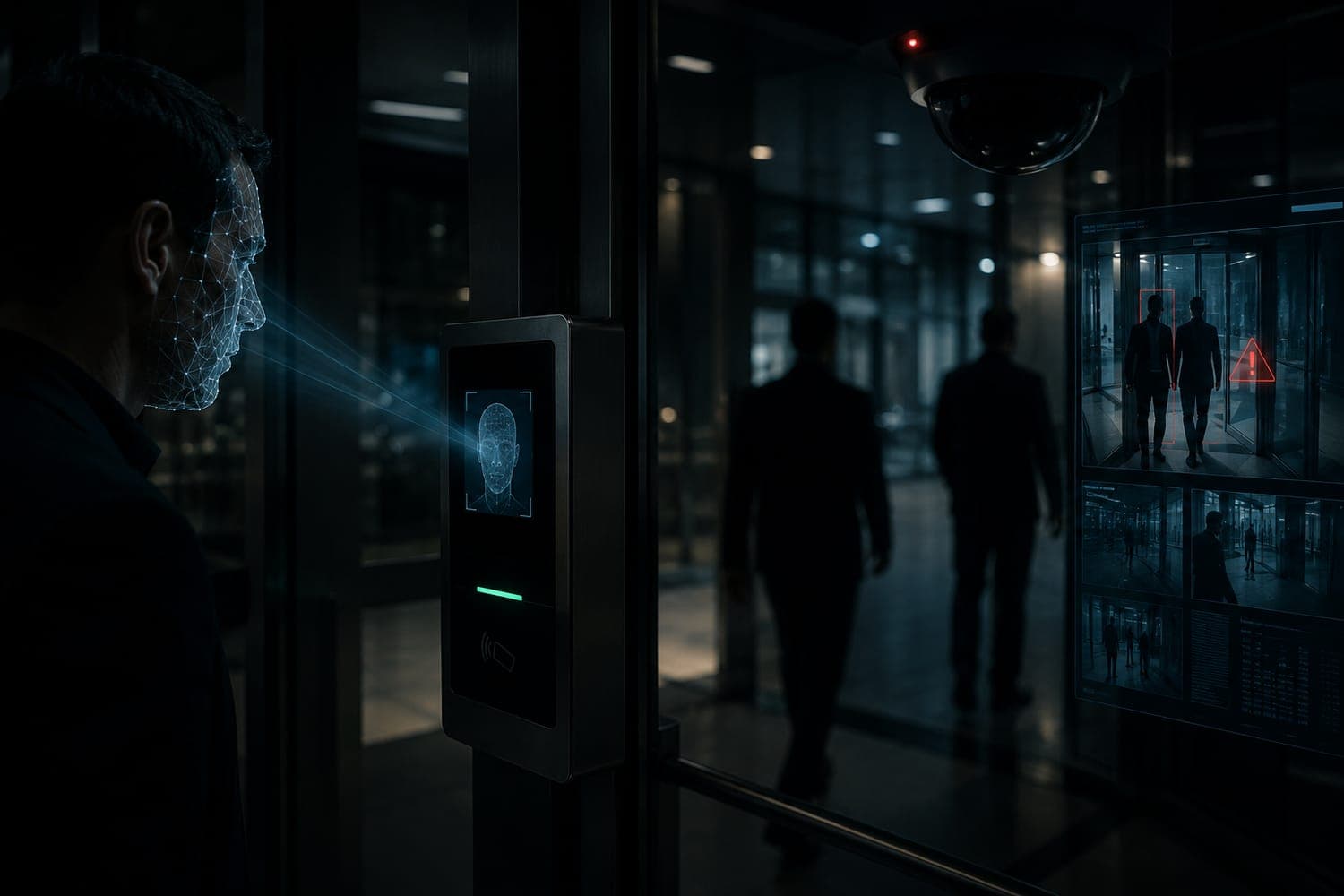
Traditional access control systems answer one question: is this credential valid? AI-powered access control adds a second, more important one: does this access event actually make sense right now? That shift — from credential validation to behavioral intelligence — is why 69% of security leaders already use AI for access control. Here's how it works, why tailgating is finally solvable, and what it means for security operators.
Most access control systems were designed to answer one question: is this credential valid? AI is changing the question entirely.
The problem with traditional access control systems
Here's a scenario that plays out every week in security operations across Latin America and beyond. A legitimate credential — a card, a PIN, a fob — gets used to enter a restricted area. Everything checks out at the reader. The door opens. And something bad happens anyway.
Traditional access control systems are binary by design. Credential valid → door opens. Credential invalid → door stays closed. There's no layer in between that asks should this person be entering this zone right now, at this hour, given everything else happening on site?
That gap — between "credential is valid" and "this access event makes sense" — is where most physical security incidents actually occur. Tailgating, credential sharing, insider misuse, authorized personnel entering areas outside their normal patterns. None of these trigger a standard access control system because the credential itself is legitimate.
This is the fundamental limitation that AI is now addressing, and it's why AI-powered access control has gone from a niche concept to a top investment priority for security decision-makers worldwide.
What AI actually adds to access control
From credential validation to behavioral intelligence
The shift from traditional to AI-powered access control isn't really about replacing card readers with fancier card readers. It's about adding a reasoning layer on top of the physical access infrastructure you already have.
A conventional access control system checks three things: who you are (identity), what you're allowed to access (permissions), and when (schedule). That's it. AI-powered access control adds a fourth dimension: whether this specific access event is consistent with normal patterns given everything the system knows.
Think of it this way. A facilities manager has valid access to the server room. But if that same credential is used to enter the server room at 2:47am on a Sunday — when that person has never once entered the building outside of standard working hours — that's a behavioral anomaly worth flagging. A traditional access control system would never catch it. An AI system would surface it immediately as an event requiring human review.
This is what intelligent access management actually means in practice: the system isn't just enforcing rules, it's learning what normal looks like and identifying deviations from that baseline.
Biometric access security: beyond the fingerprint scanner
Biometric access security has been around for decades — fingerprint readers have existed in corporate environments since the early 2000s. But the current generation of biometric access security is a completely different animal.
Modern systems combine multiple biometric signals simultaneously: facial geometry, iris patterns, gait recognition, voice verification. More importantly, they run these checks in real time against live camera feeds, not just at a dedicated reader station. This means biometric access security can operate passively — verifying identity as people move through a space rather than requiring them to stop and present a credential at every checkpoint.
The accuracy gap between first-generation biometric access security and current AI-driven systems is substantial. Error rates that used to be measured in single-digit percentages are now measured in fractions of a percent. For high-security environments — data centers, pharmaceutical facilities, government installations, financial institutions — that difference matters enormously.
The tailgating problem that access control has never solved
If you want to understand why AI-powered access control is getting so much attention right now, start with tailgating. It's the oldest unsolved problem in physical security.
Tailgating — one person using another's valid access event to pass through a controlled entry — is something that traditional access control systems are essentially blind to. The reader sees one valid credential. The camera might record what happened. But in real-time, no one flags it.
AI-powered access control with integrated computer vision changes this. The system can correlate access events with visual confirmation: one credential used, one body detected passing through — valid. One credential used, two bodies detected — flag for operator review. It sounds simple. The implementation isn't, because counting bodies accurately in a doorway with variable lighting, angles, and movement is genuinely hard computer vision. But it's a solved problem for mature platforms.
The same logic applies to physical security automation around door-prop events: a door held open beyond a defined time threshold, a controlled zone accessed and then left unsecured, an entry point opened from the inside without a corresponding valid access event. These are the details that slip through when humans are managing multiple feeds simultaneously, and exactly the kind of pattern that physical security automation catches consistently.
How access control and surveillance are converging
Here's something worth understanding about where the industry is heading: access control systems and CCTV surveillance are no longer separate systems that happen to share a building. They're converging into a single intelligent access management layer.
The most advanced deployments today treat every access event as a trigger for a broader verification workflow. Someone uses a credential at a perimeter door — the nearest camera automatically reviews the entry — computer vision confirms the person matches the authorized credential — the event is logged with visual evidence — any anomalies (wrong person, tailgating, unusual time) generate an alert.
This event-correlation approach — linking what happens at the reader with what the cameras see — is what separates genuine intelligent access management from simply having a newer card reader. The data generated is also qualitatively different: instead of a log entry saying "Badge 4471 used at Door 7 at 14:32," you get a structured incident record with visual confirmation, behavioral context, and anomaly scoring.
According to the 2026 World Security Report, 69% of security leaders are already using AI for access control and identity verification — making it the second most widespread AI application in physical security, just behind surveillance monitoring. And 38% cite advanced access control as one of their most critical physical security technology investments over the next two to three years.
The trajectory is clear: biometric access security and AI-driven behavior analysis are becoming table stakes, not differentiators, for serious security operations.
The operational reality: what this looks like for security companies
For a security company managing access control across dozens of client sites, the practical picture looks like this:
A traditional setup has access readers at every controlled point, a VMS or access control software logging events, and operators reviewing exceptions manually — usually after the fact. The coverage is technically complete but the real-time awareness is minimal.
An AI-powered access control setup changes the workflow materially. Events that match expected patterns flow through without interruption. Events that deviate — unusual timing, unverified identity, tailgating detected, credential used at a point outside normal zone — get surfaced to an operator as a prioritized alert, with visual context already attached.
The result is that operators can manage far more access points effectively. Instead of being physically present at or manually reviewing logs from 40 entry points, they can actively respond to the 5 or 6 events per shift that actually warrant attention. That's not an incremental improvement — it's a structural change in how physical security automation scales.
The cost argument is just as strong as the capability argument. Every operator hour spent reviewing routine, normal access logs is an hour not spent on genuine threat response. Physical security automation of routine access monitoring redirects human attention toward the events that require it.
How Closely approaches the access control problem
The access control challenge isn't separate from the broader security operations challenge — it's one layer of it. A monitoring center managing hundreds of client sites deals with access events, camera feeds, alarm triggers, and incident escalations all at once, from a single SOC.
Closely is built around exactly that operational reality. Rather than offering a standalone access control system, Closely functions as an AI intelligence layer that sits above existing infrastructure — integrating with the cameras, access hardware, and monitoring software that security operators already have deployed.
The Gatekeepers module within Closely handles access-related workflows: correlating credential events with camera-verified identity, flagging tailgating and anomalous entry patterns, and surfacing exceptions to SOC operators with the visual context they need to make fast, accurate decisions. Instead of an operator manually reviewing 200 access log entries at end of shift, they receive 8 to 12 real-time alerts throughout the shift — each one pre-validated and ready for a human decision.
Critically, every access event processed by Closely generates structured data: entry point, time, identity confidence score, behavioral flag (if any), operator response, outcome. That data, aggregated across a fleet of client sites over time, becomes a genuine intelligent access management intelligence layer — useful not just for today's incident response, but for pattern analysis, compliance reporting, and eventually for institutional use cases like insurance underwriting and risk scoring.
If your security company is managing access control across multiple sites and you're still working through manual log review, Closely is worth a conversation. The pilot model is designed to demonstrate measurable ROI against your current operation before any long-term commitment.
Frequently Asked Questions
What is the difference between a traditional access control system and an AI-powered access control system?
Traditional access control systems validate credentials — card, PIN, biometric — and grant or deny entry based on preset rules. AI-powered access control adds behavioral analysis: it learns what normal access patterns look like and flags deviations, even when the credential itself is valid. This catches insider threats, tailgating, and anomalous entry events that rule-based systems miss entirely.
How does AI detect tailgating at a controlled entry point?
AI-powered access control integrates computer vision with access event data. When a credential is used, the camera at that entry point analyzes how many people passed through during that access event. One credential + two people detected = a tailgating flag sent to the operator. The accuracy of modern systems for this use case is well above 90% in controlled deployments.
Can AI access control systems work with the hardware I already have installed?
In most cases, yes. AI access control platforms are designed to integrate with existing readers, controllers, and camera infrastructure via standard protocols. You don't typically need to replace the physical hardware — you add the AI reasoning layer on top of it. This is one of the main reasons physical security automation projects have shorter implementation timelines than people expect.
What is intelligent access management and why does it matter for security operations?
Intelligent access management refers to access control systems that don't just enforce static rules but actively adapt to behavioral patterns and context. It matters operationally because most physical security incidents involving access control aren't caused by credential failures — they're caused by legitimate credentials used in illegitimate ways. Intelligent systems catch the latter; traditional systems don't.
How does biometric access security compare to card-based access control?
Card-based systems verify possession (you have the card) but not identity (you are who the card says you are). Biometric access security verifies identity directly, eliminating the risk of lost, stolen, or shared credentials. Modern AI-driven biometric access security also adds liveness detection — preventing spoofing with photos or fabricated biometrics — which earlier generations couldn't do reliably.
Is AI-powered access control appropriate for mid-sized security operations, or only large enterprises?
The cost curve has dropped significantly. AI-powered access control is increasingly practical for mid-sized operations — the software licensing model means you're not paying for expensive proprietary hardware. For a security company managing multiple client sites from a centralized SOC, the ROI case is typically strong even at relatively modest camera and access point counts.
What happens when an AI access control system flags an anomalous entry event?
The flagged event is sent to a human operator as a prioritized alert with context: which entry point, what credential was used, what the camera captured, and what anomaly was detected. The operator reviews and decides: clear the event, contact the site, escalate to response. The AI handles detection and triage; the human makes the final call. This human-in-the-loop model is standard in mature intelligent access management deployments.
How does AI access control handle high-traffic entry points like lobbies or parking structures?
High-traffic zones are actually where AI adds the most value, because manual monitoring at those points is impractical. AI-powered access control at high-traffic entries typically focuses on behavioral anomalies — not reviewing every person who passes through, but flagging specific patterns: access events outside authorized hours, credential use followed by unusual dwell behavior, tailgating attempts during busy periods.
What data does an AI access control system generate and how can it be used beyond immediate security?
Every validated access event can be structured as data: identity, time, location, access type, any anomaly flags, and operator response. At scale, this data supports compliance reporting, forensic investigation, shift pattern analysis, and — increasingly — insurance underwriting and risk scoring. The structured incident data generated by physical security automation is valuable beyond the immediate security operation.
How do I evaluate whether my current access control setup needs an AI upgrade?
Ask yourself three questions. First, how many access events per day are reviewed in real time versus logged and ignored? Second, have you had incidents involving valid credentials used by the wrong person, or at the wrong time? Third, do your operators have the bandwidth to genuinely monitor access alerts alongside their other responsibilities? If the honest answers are "almost none," "yes," and "no," your operation is ready for AI-powered access control — and starting with a pilot like those offered by Closely is the lowest-friction way to test it.